On this page
- 01Key takeaways
- 02Do spelling mistakes really affect credibility?
- 03Where do website errors usually hide?
- 04How do you proofread a website properly?
- 05Does UK or US spelling matter?
- 06When are small errors less important?
- 07What does this look like in practice?
- 08Website proofreading checklist
- 09Next step
- 10Sources and further reading
- 11Frequently asked questions
Key takeaways
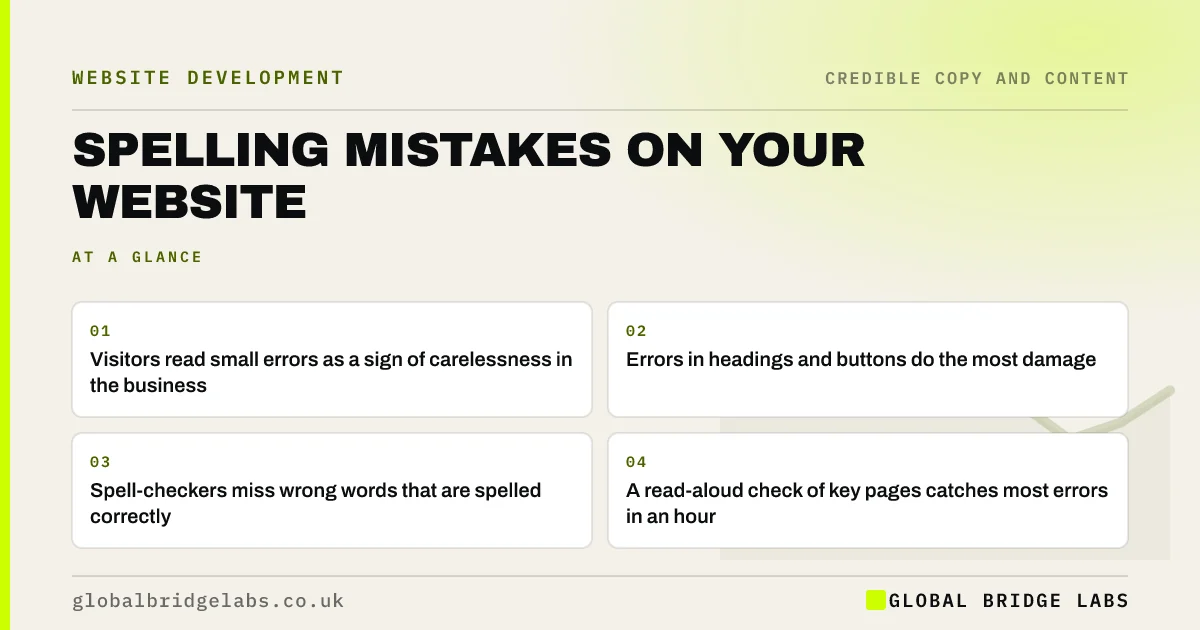
Spelling mistakes on a business website cost credibility because visitors read them as a sign of carelessness that may extend to the work. The Stanford guidelines for web credibility list avoiding errors of all types as a core principle. The most damaging errors sit in headings, buttons and the first screen, where every visitor sees them.
- Visitors read small errors as a sign of carelessness in the business.
- Errors in headings and buttons do the most damage.
- Spell-checkers miss wrong words that are spelled correctly.
- A read-aloud check of key pages catches most errors in an hour.
Want your key pages proofread for credibility? Message us on WhatsApp.
Chat on WhatsApp →Do spelling mistakes really affect credibility?
Yes. Spelling mistakes affect credibility because they are easy to notice and hard to excuse. Fogg's prominence-interpretation theory explains why: a visible error is noticed by many visitors and interpreted as a sign of low care. For a business selling accuracy or expertise, such as accountants, solicitors or engineers, the damage is greater.
Where do website errors usually hide?
Errors cluster in places owners rarely reread. A quarterly check of these areas catches most of them.
- Headings and buttons written in a hurry.
- Page titles and meta descriptions shown in Google.
- Form labels, error messages and thank-you pages.
- Image alternative text and captions.
- Old blog posts and location pages copied from a template.
How do you proofread a website properly?
Use three passes. First, a spell-checker or grammar tool set to UK English. Second, read every key page aloud, slowly, which catches wrong words and missing words that tools miss. Third, ask someone outside the business to read the homepage and service pages on a phone. Fix and re-check before publishing new pages.
Want a proofreading pass across your site? Message us on WhatsApp and we will discuss your requirements.
Chat on WhatsApp →Does UK or US spelling matter?
For a UK business selling to UK buyers, consistent UK spelling matters, because US spellings such as 'color' or 'optimize' can make the site look imported or template-made. Mixed spellings look careless. Set your editor and tools to UK English and choose one convention for words like 'enquire' and 'inquire'.
When are small errors less important?
Errors deep in old blog posts matter less than errors on the homepage, but they still appear in search results and AI answers. Typos in user comments or reviews are not your errors; do not edit customers' words. Focus effort on pages that visitors see before enquiring.
What does this look like in practice?
A pattern we see: a firm's main call-to-action button reads 'Get a qoute' and has done for months because nobody reads buttons closely. Every visitor ready to enquire sees it at the moment of decision. A five-second fix removes a doubt at the worst possible place.
Website proofreading checklist
- Set spelling tools to UK English.
- Read headings, buttons and forms aloud.
- Check page titles and meta descriptions.
- Ask an outsider to read key pages on a phone.
- Re-check every new page before publishing.
Next step
Read every button and heading on your homepage aloud today. It takes ten minutes and catches the most visible errors.
Message us on WhatsApp for a content review, or book a 30-minute consultation.
Chat on WhatsApp →Sources and further reading
- Stanford guidelines for web credibility · Stanford Web Credibility Project
- Prominence-interpretation theory: explaining how people assess credibility online · ACM (Fogg, 2003)
- Writing to GOV.UK standards: writing guidelines · GOV.UK
Frequently asked questions
Do typos make customers trust a business less?
Visible typos make many visitors doubt how careful a business is, which lowers credibility. The Stanford guidelines for web credibility list avoiding errors of all types as a core principle, because small errors are easy to notice and hard to excuse.
How do I check my website for spelling mistakes?
Use a spell-checker set to UK English, then read key pages aloud to catch correctly spelled wrong words, then ask someone outside the business to read on a phone. Check headings, buttons, forms and page titles, where errors often hide.
Should my UK website use British spelling?
Yes, if your buyers are in the UK. Consistent British spelling makes the site feel local and deliberate. Mixed or US spellings can make it look like a template or an overseas business.
Written by

Global Bridge Labs (GBL) is a UK–Sri Lanka partner for social media, websites and BPO. Everything here comes from client delivery, not theory.