On this page
- 01Key takeaways
- 02Why put credibility in a website brief?
- 03What should the credibility section include?
- 04Who supplies credibility content?
- 05How should credibility be tested before launch?
- 06What does this look like in practice?
- 07Credibility brief checklist
- 08Next step
- 09Sources and further reading
- 10Frequently asked questions
Key takeaways
A website brief that only describes the look produces sites that look fine and say little. Add a credibility section: which proof must appear and where, real photography, named people, company and regulatory details, content accuracy responsibilities, accessibility and security standards, and how credibility will be tested before launch.
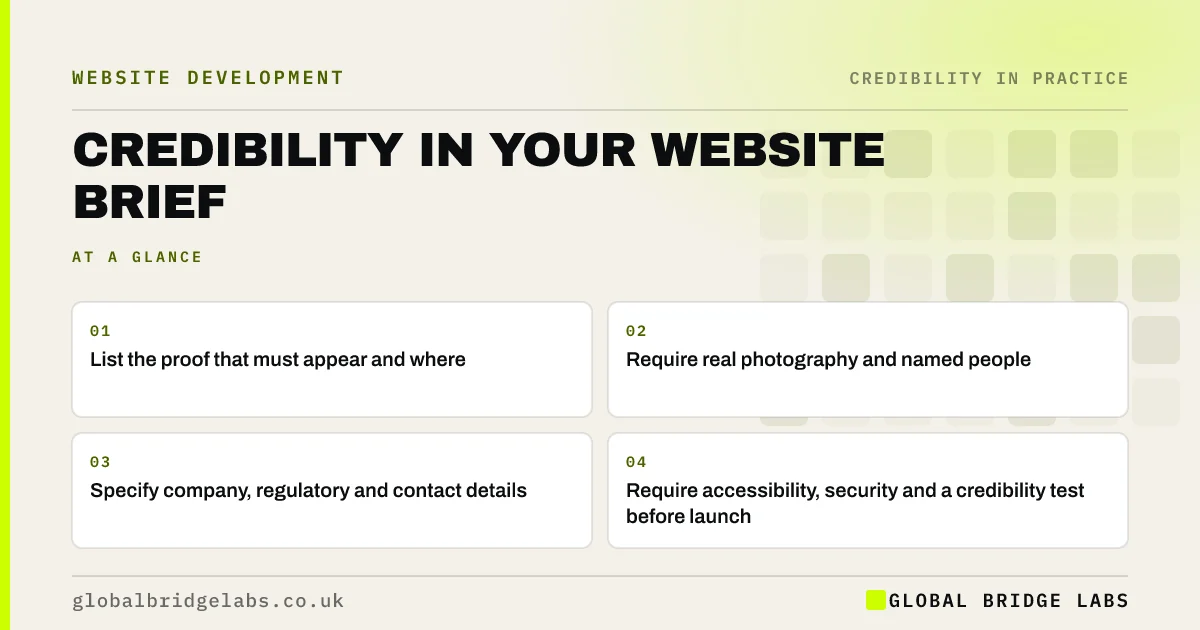
- List the proof that must appear and where.
- Require real photography and named people.
- Specify company, regulatory and contact details.
- Require accessibility, security and a credibility test before launch.
Want a credibility section written for your brief? Message us on WhatsApp.
Chat on WhatsApp →Why put credibility in a website brief?
Designers design what the brief asks for. If the brief focuses on style, colours and pages, the result is a good-looking template. Credibility depends on content and proof that only you can provide, so the brief must say what is needed, who will supply it and where it goes.
What should the credibility section include?
Cover the five signals explicitly.
- Real: team members to feature, photos needed, company and regulatory details.
- Competent: accessibility standard (WCAG 2.2 AA), performance and security requirements.
- Proven: reviews source, accreditations, case studies and where each appears.
- Current: who updates content, and dates shown.
- Open: pricing guidance, process page, policies and reply times.
Who supplies credibility content?
Assign it. Case studies, team bios, accreditation numbers and review permissions usually come from the business, and they are the most common cause of launch delays. Plan a photography day early. Agree who writes and who checks claims, especially in regulated sectors.
- Website photography cost in the UK: what a shoot buys
- Website claims and the CAP Code: what UK firms can say
Want help gathering credibility content before design starts? Message us on WhatsApp and we will discuss your requirements.
Chat on WhatsApp →How should credibility be tested before launch?
Write a test into the brief: three to five people who match your buyers review the staging site, with a first-impression test and a decision task. Include a check for placeholder content, broken forms and security warnings. Make launch conditional on passing.
What does this look like in practice?
A pattern we see: a brief specifies 12 pages and a modern style but no content responsibilities. Launch is delayed three months waiting for case studies and team photos, then the site goes live with stock images. A credibility section with owners and deadlines avoids both.
Credibility brief checklist
- Name the proof and its placement.
- Schedule photography.
- List company and regulatory details.
- Set accessibility and security standards.
- Assign content owners and deadlines.
- Require a credibility test before launch.
Next step
Add a 'Credibility' heading to your brief and list the five signals underneath. Fill in what you already have.
Message us on WhatsApp for help with your website brief, or book a 30-minute consultation.
Chat on WhatsApp →Sources and further reading
- Web Content Accessibility Guidelines (WCAG) 2.2 · W3C
- Stanford guidelines for web credibility · Stanford Web Credibility Project
- User research · GOV.UK Service Manual
Frequently asked questions
What should a website brief include about trust?
Which proof must appear and where, real photography and named people, company and regulatory details, accessibility and security standards, who supplies and checks each piece of content, and a credibility test before launch.
Who should provide case studies for a new website?
Usually the business, because it holds the client relationships and permissions. An agency can interview clients and write them up, but plan this early, as gathering case studies is a common cause of delay.
Should accessibility be in a website brief?
Yes. Specify a standard, usually WCAG 2.2 level AA, and ask how it will be tested. It protects credibility with all visitors and with larger clients who check suppliers.
Written by

Global Bridge Labs (GBL) is a UK–Sri Lanka partner for social media, websites and BPO. Everything here comes from client delivery, not theory.