On this page
- 01Key takeaways
- 02What are the four types of credibility?
- 03How does design affect surface credibility?
- 04How does a website show reputed credibility?
- 05Where do presumed and earned credibility come in?
- 06Which type matters most for a small business?
- 07What does this look like in practice?
- 08Four types of credibility checklist
- 09Next step
- 10Sources and further reading
- 11Frequently asked questions
Key takeaways
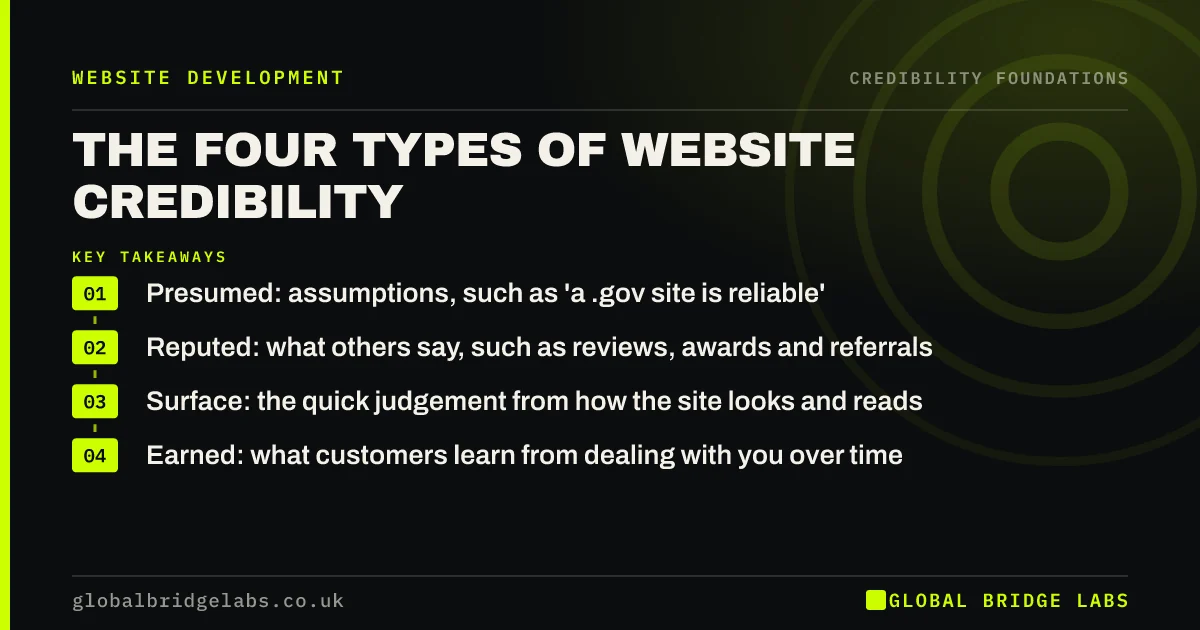
Researchers B.J. Fogg and Hsiang Tseng described four types of credibility: presumed, from general assumptions; reputed, from third-party reports; surface, from a quick inspection; and earned, from first-hand experience over time. Website design mostly shapes surface credibility, but a good site also displays reputed credibility and protects earned credibility.
- Presumed: assumptions, such as 'a .gov site is reliable'.
- Reputed: what others say, such as reviews, awards and referrals.
- Surface: the quick judgement from how the site looks and reads.
- Earned: what customers learn from dealing with you over time.
Want to know which type of credibility your site is missing? Message us on WhatsApp.
Chat on WhatsApp →What are the four types of credibility?
The four types of credibility are presumed, reputed, surface and earned, as defined by B.J. Fogg and Hsiang Tseng in 1999. They describe where a person's belief in a source comes from: general assumptions, third-party reports, a first look, or direct experience. A business needs all four, but each is built in a different place.
How does design affect surface credibility?
Surface credibility is the judgement visitors make from a quick inspection, and it is where design matters most. Layout, imagery, typography, errors and the presence of real people all feed it. Because many visitors decide within seconds whether to stay, surface credibility decides whether the other three types even get a chance to work.
How does a website show reputed credibility?
Reputed credibility comes from third parties: reviews, accreditations, awards, press coverage and referrals. A website cannot create it, but it can display it well or badly. Named, dated reviews, verifiable accreditation numbers and links to independent review platforms make reputed credibility visible and checkable.
Where do presumed and earned credibility come in?
Presumed credibility comes from assumptions visitors already hold, such as trusting a regulated profession or a UK domain. Show the regulator, membership or registration that triggers those assumptions. Earned credibility comes from real dealings with you, so the website protects it by matching what customers experience: same prices, same people, same promises.
- .co.uk vs .com: which domain do UK customers trust?
- Promise a reply time on your website, then keep it
Want your proof displayed so visitors can verify it? Message us on WhatsApp and we will discuss your requirements.
Chat on WhatsApp →Which type matters most for a small business?
For a small business, surface and reputed credibility matter most at first contact, because presumed credibility is limited and earned credibility only comes later. The practical priority is a site that passes the quick look, then shows independent proof straight away. Once customers buy, earned credibility drives referrals and repeat work.
What does this look like in practice?
A pattern we see: a trades business with 200 five-star reviews on Google shows none on its website. It has strong reputed credibility that visitors never see. Adding a review section with a link to the Google profile turns that reputation into surface credibility on the first screen.
Four types of credibility checklist
- Presumed: show regulators, memberships and registrations.
- Reputed: display named, dated reviews and verifiable accreditations.
- Surface: remove errors and show real people and work.
- Earned: keep website promises in line with real service.
Next step
List the reviews, accreditations and memberships you already have, then check how many appear on your homepage.
Message us on WhatsApp for a credibility review, or book a 30-minute consultation.
Chat on WhatsApp →Sources and further reading
- The elements of computer credibility · ACM (Fogg and Tseng, 1999)
- Stanford guidelines for web credibility · Stanford Web Credibility Project
- Social proof in the user experience · Nielsen Norman Group
Frequently asked questions
What is surface credibility?
Surface credibility is the believability a person assigns after a quick look at something, based on its appearance and obvious features. On a website it comes from design quality, real imagery, the absence of errors and visible signs of a real business.
What is earned credibility?
Earned credibility is belief built from direct, first-hand experience over time. Customers who receive what you promised, on time and at the quoted price, give you earned credibility, which then becomes reputed credibility when they review or refer you.
Who defined the four types of credibility?
B.J. Fogg and Hsiang Tseng described presumed, reputed, surface and earned credibility in their 1999 paper 'The elements of computer credibility', presented at the ACM CHI conference. The framework is still widely used in credibility research.
Written by

Global Bridge Labs (GBL) is a UK–Sri Lanka partner for social media, websites and BPO. Everything here comes from client delivery, not theory.