On this page
Key takeaways
Placeholder text, such as 'Lorem ipsum', dummy testimonials, demo blog posts or stock team members from a template, makes a live website look unfinished and can mislead visitors. It is surprisingly common after launches and theme changes. Search the site for template text, check every page in the menu and sitemap, and add a content check to your launch process.
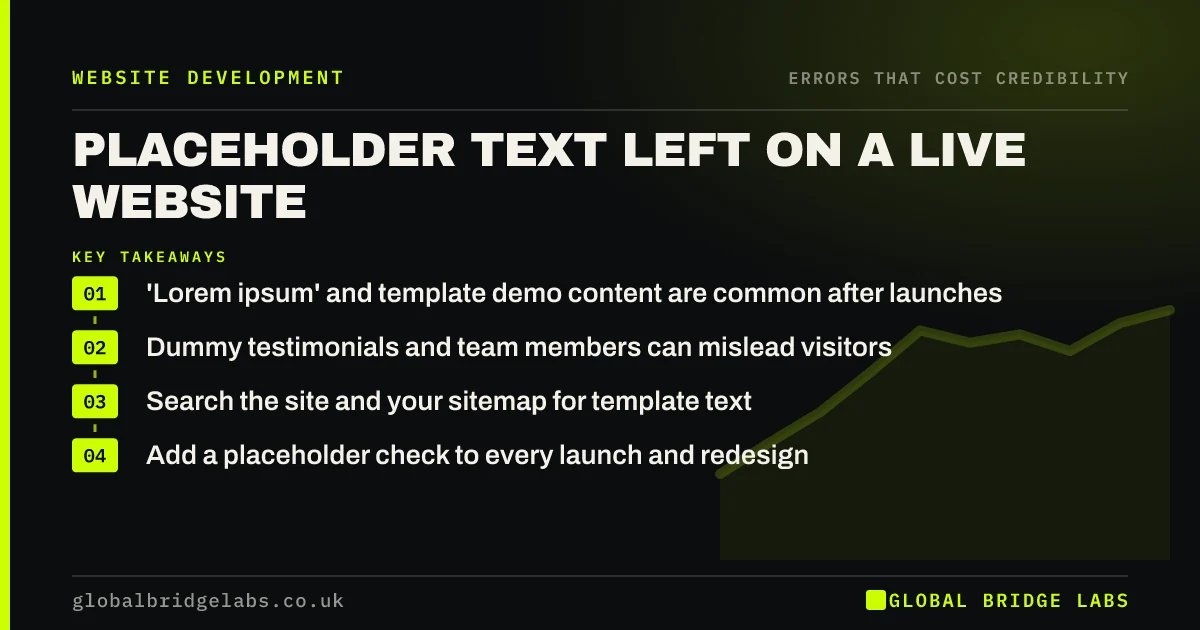
- 'Lorem ipsum' and template demo content are common after launches.
- Dummy testimonials and team members can mislead visitors.
- Search the site and your sitemap for template text.
- Add a placeholder check to every launch and redesign.
Want a sweep of your site for leftover template content? Message us on WhatsApp.
Chat on WhatsApp →Why does placeholder content hurt credibility?
Placeholder content tells visitors nobody finished the job, which suggests a business that does not finish jobs. Template demo testimonials and team members are worse: they present fictional people as real, which can mislead buyers. Google can also index demo pages, so they appear in search results under your name.
Where does placeholder content hide?
Look beyond the main pages.
- Demo blog posts and categories from the theme.
- Sample testimonials and team sections.
- Footer text and social links pointing to the theme maker.
- Image alt text and page titles left as defaults.
- Unlinked pages still in the sitemap, such as 'Sample Page'.
How do you find it?
Search the site for 'lorem', 'ipsum', 'sample', 'demo', 'your company' and 'example.com'. Check your XML sitemap for pages you do not recognise. Search Google with 'site:yourdomain.co.uk' to see what is indexed. Review every page linked in the menu and footer on a phone.
Want your site checked for leftover demo content? Message us on WhatsApp and we will discuss your requirements.
Chat on WhatsApp →How do you stop it happening again?
Add a placeholder check to your launch checklist and to any theme change. Delete demo content when installing a theme, rather than editing around it. Before launch, have someone outside the project click every page. Make one person responsible for signing off content.
What does this look like in practice?
A pattern we see: a new site goes live with three demo testimonials from 'Jane Doe, CEO' that the owner meant to replace. A prospect notices the same quotes on another site using the theme. Removing them and adding two real reviews fixes both the credibility and the risk of misleading buyers.
Placeholder content checklist
- Search for 'lorem', 'sample' and 'demo'.
- Check the sitemap for unknown pages.
- Run a site: search in Google.
- Replace or delete demo testimonials and team members.
- Add a placeholder check to launches.
Next step
Search Google for 'site:yourdomain lorem' and 'site:yourdomain sample'. Fix anything that appears.
Message us on WhatsApp for a credibility review, or book a 30-minute consultation.
Chat on WhatsApp →Sources and further reading
- Stanford guidelines for web credibility · Stanford Web Credibility Project
- Digital Markets, Competition and Consumers Act 2024, Schedule 20 (banned practices, including fake reviews) · legislation.gov.uk
- Google Search Essentials · Google Search Central
Frequently asked questions
What is placeholder text on a website?
Placeholder text is temporary content used during design, such as 'Lorem ipsum' or sample testimonials supplied with a theme. It should be replaced before launch. When it remains on a live site, it makes the business look unfinished.
Can Google index my placeholder pages?
Yes. If demo or sample pages are published and linked or listed in the sitemap, Google can index them, and they may appear in search results for your business. Delete them or remove them from the sitemap and noindex them.
Are template testimonials a legal problem?
Presenting fictional testimonials as genuine could mislead consumers, which UK consumer protection law prohibits. Remove any testimonial that did not come from a real customer, and replace it with genuine reviews.
Written by

Global Bridge Labs (GBL) is a UK–Sri Lanka partner for social media, websites and BPO. Everything here comes from client delivery, not theory.