On this page
- 01Key takeaways
- 02Which review platform do UK buyers check?
- 03How do Google and Trustpilot reviews differ?
- 04Which should you prioritise first?
- 05How should each appear on your website?
- 06When does the platform not matter?
- 07What does this look like in practice?
- 08Review platform checklist
- 09Next step
- 10Sources and further reading
- 11Frequently asked questions
Key takeaways
For most UK small businesses, Google reviews come first, because they appear in Google Maps and local search where buyers find you. Trustpilot suits online shops and national service brands, whose buyers look for an independent review site. Start with one platform, build volume and recency there, then add the second if your buyers expect it.
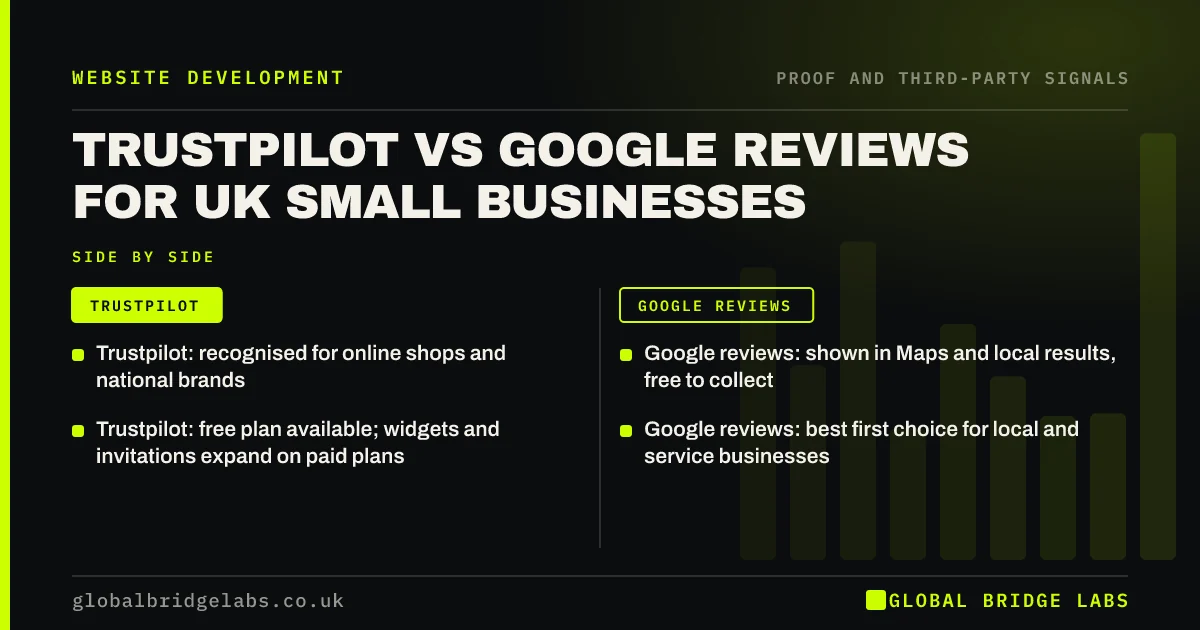
- Trustpilot: recognised for online shops and national brands.
- Google reviews: shown in Maps and local results, free to collect.
- Trustpilot: free plan available; widgets and invitations expand on paid plans.
- Google reviews: best first choice for local and service businesses.
Want help choosing and setting up your review platform? Message us on WhatsApp.
Chat on WhatsApp →Which review platform do UK buyers check?
For local and service businesses, buyers mostly see Google reviews, because they appear in Google Maps and local search results alongside your Business Profile. For online shopping and national brands, many buyers also look for a Trustpilot score. Ask recent customers where they checked you; their answer is the best guide for your business.
How do Google and Trustpilot reviews differ?
The two platforms differ in where reviews appear and how you manage them.
- Google: reviews appear in Maps and local results next to your listing.
- Trustpilot: reviews sit on an independent profile page and in widgets.
- Google: free; you share a link to ask for reviews.
- Trustpilot: free basic plan; paid plans add automated invitations and widgets.
- Both: ban fake and incentivised reviews and let you reply publicly.
Which should you prioritise first?
Prioritise Google if you serve a local area or customers find you through Maps. Prioritise Trustpilot if you sell online nationally and compete with brands that display Trustpilot scores. Splitting effort between both too early leaves you with few reviews on each, which looks weaker than many on one.
- New business website: credibility before you have reviews
- How to make an online shop look trustworthy
Want a review plan tied to how your buyers find you? Message us on WhatsApp and we will discuss your requirements.
Chat on WhatsApp →How should each appear on your website?
Show the platform your buyers trust most, with your rating, review count and a link to the profile so visitors can verify it. Quote two or three recent reviews on key pages. If you use both, show both badges in the same place, such as below the homepage headline, rather than scattering them.
When does the platform not matter?
The platform matters less than volume, recency and how you respond. Twenty recent reviews with thoughtful replies on one platform build more credibility than five old reviews on three. For B2B firms with few, large clients, named case studies and references may matter more than either platform.
What does this look like in practice?
A pattern we see: a local firm pays for Trustpilot because a competitor uses it, but customers find them through Google Maps, where they have only six reviews. Shifting review requests to Google first raises their local visibility and the rating buyers actually see.
Review platform checklist
- Ask recent customers where they checked you.
- Choose one platform to build first.
- Ask every satisfied customer, not only the happiest.
- Reply to every review, positive or negative.
- Show rating, count and a link on your website.
Next step
Count your reviews from the last 12 months on each platform. Build the one where buyers already look.
Message us on WhatsApp for a review and credibility plan, or book a 30-minute consultation.
Chat on WhatsApp →Sources and further reading
- Maps user-generated content policy: prohibited and restricted content · Google
- Publishing consumer reviews and complying with consumer protection law · Competition and Markets Authority
- How online reviews influence sales · Spiegel Research Center, Northwestern University
Frequently asked questions
Is Trustpilot or Google better for a small business?
For local and service businesses, Google is usually better because reviews appear in Maps and local search. For online shops and national brands, Trustpilot can matter more because buyers look for it. Start with the one your buyers use.
Is Trustpilot free for businesses?
Trustpilot offers a free plan that lets businesses claim a profile and reply to reviews. Paid plans add features such as automated review invitations, more widgets and analytics. Check current plans on Trustpilot's site.
Should I have reviews on more than one platform?
Eventually, perhaps, but build volume on one first. A strong, recent rating on the platform your buyers use is more credible than a handful of reviews spread across several sites.
Written by

Global Bridge Labs (GBL) is a UK–Sri Lanka partner for social media, websites and BPO. Everything here comes from client delivery, not theory.