On this page
- 01Key takeaways
- 02What are distinctive brand assets?
- 03Why do they matter for credibility?
- 04How do you build them as a small business?
- 05How do you know if an asset is working?
- 06When is changing your assets a mistake?
- 07What does this look like in practice?
- 08Distinctive assets checklist
- 09Next step
- 10Sources and further reading
- 11Frequently asked questions
Key takeaways
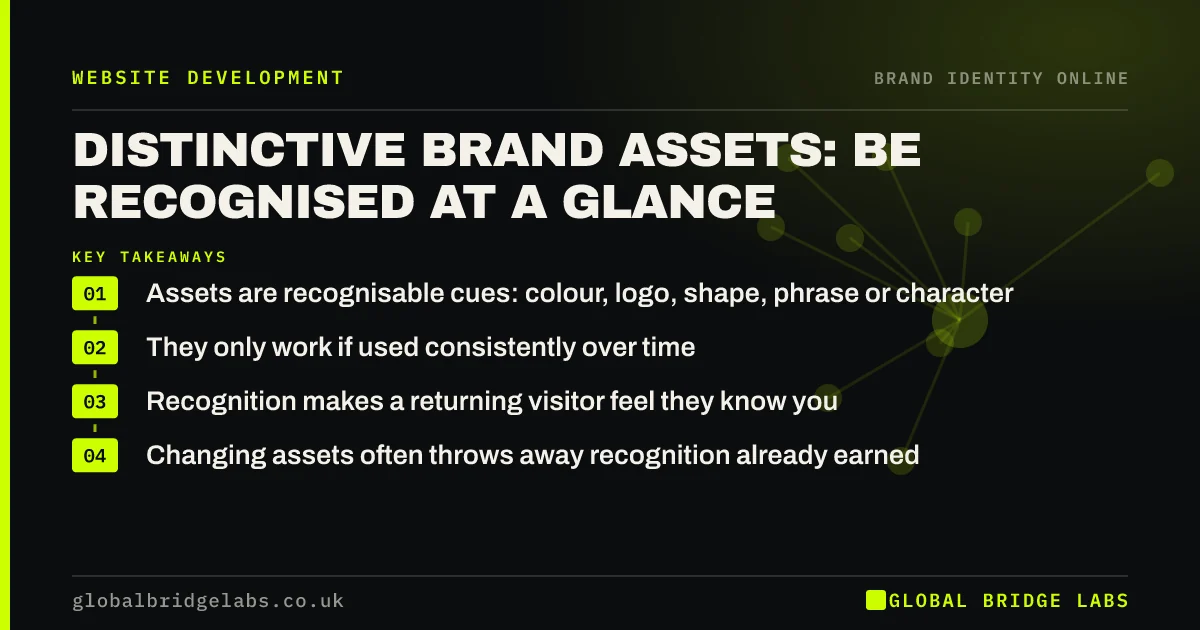
Distinctive brand assets are the colours, shapes, logos, characters, phrases and sounds people associate with your brand without needing to read the name. The idea comes from research at the Ehrenberg-Bass Institute. For a small business, they build recognition, and recognition makes a business feel familiar and more credible when buyers meet it again.
- Assets are recognisable cues: colour, logo, shape, phrase or character.
- They only work if used consistently over time.
- Recognition makes a returning visitor feel they know you.
- Changing assets often throws away recognition already earned.
Want to know which of your brand assets people recognise? Message us on WhatsApp.
Chat on WhatsApp →What are distinctive brand assets?
Distinctive brand assets are non-name brand elements, such as a colour, logo shape, typeface, character, tagline or jingle, that people link to a specific brand. The concept was developed by Jenni Romaniuk and colleagues at the Ehrenberg-Bass Institute for Marketing Science. An asset is distinctive only when people actually recognise it as yours.
Why do they matter for credibility?
Familiarity breeds credibility. When a buyer who saw your van, your social post and your Google listing reaches your website and sees the same colour and mark, the business feels established and real. When each touchpoint looks different, they may not connect them, or may wonder whether they have the right company.
How do you build them as a small business?
Choose a small number of assets and use them everywhere, every time, for years. Distinctiveness comes from consistency more than cleverness.
- Pick one main colour and use it in the same way everywhere.
- Keep one logo and one simplified mark for small spaces.
- Use a consistent photo style, such as real work on site.
- Repeat a plain descriptive phrase rather than changing slogans.
- Apply them to vans, signage, social profiles and the website.
- Brand guidelines for your website: what to include
- Do you need a favicon? The small icon buyers notice
Want your brand assets applied consistently across your site? Message us on WhatsApp and we will discuss your requirements.
Chat on WhatsApp →How do you know if an asset is working?
Test it simply: show customers or local people your colour or logo without the name and ask which business it is. If few connect it to you, it is not yet distinctive. Track whether direct and branded search visits grow over time, which suggests recognition is building.
When is changing your assets a mistake?
Changing assets is a mistake when the only reason is boredom. Owners tire of their brand long before customers notice it. Each change resets recognition. Refresh execution, such as sharper files and better photos, while keeping the core colour and mark.
What does this look like in practice?
A pattern we see: a business's vans are bright orange, but the website is navy because the designer preferred it. Customers who see the vans do not recognise the site. Bringing the orange onto the website as the accent and button colour connects the two immediately.
Distinctive assets checklist
- List the colours, marks and phrases you already use.
- Choose the ones customers already know.
- Apply them identically on every touchpoint.
- Test recognition with real customers.
- Resist changing them without evidence.
Next step
Lay out photos of your van, sign, social profile and website. If they do not look like one business, start there.
Message us on WhatsApp for a brand consistency review, or book a 30-minute consultation.
Chat on WhatsApp →Sources and further reading
- Research on brand growth and distinctive brand assets · Ehrenberg-Bass Institute for Marketing Science
- Website logo placement for maximum brand recall · Nielsen Norman Group
- Define a favicon to show in search results · Google Search Central
Frequently asked questions
What are examples of distinctive brand assets?
Common examples are a signature colour, a logo shape, a typeface, a character or mascot, a tagline and a sound. For small businesses, the most practical are a consistent colour, logo and photo style used across vans, signage, social media and the website.
Who came up with distinctive brand assets?
The concept was developed and popularised by Jenni Romaniuk at the Ehrenberg-Bass Institute for Marketing Science, building on the institute's wider research into how brands grow, associated with Byron Sharp.
How long does it take to build brand recognition?
It takes consistent use over a long period, usually years rather than months. Recognition builds every time someone sees the same asset used the same way, which is why frequent changes undermine it.
Written by

Global Bridge Labs (GBL) is a UK–Sri Lanka partner for social media, websites and BPO. Everything here comes from client delivery, not theory.