On this page
Key takeaways
The Microsoft desirability toolkit is a set of 118 product reaction cards, such as 'trustworthy', 'professional', 'confusing' and 'dated', that participants choose from to describe a design. It turns vague reactions into words you can count. Use it to check whether your website feels the way your brand intends, before and after a redesign.
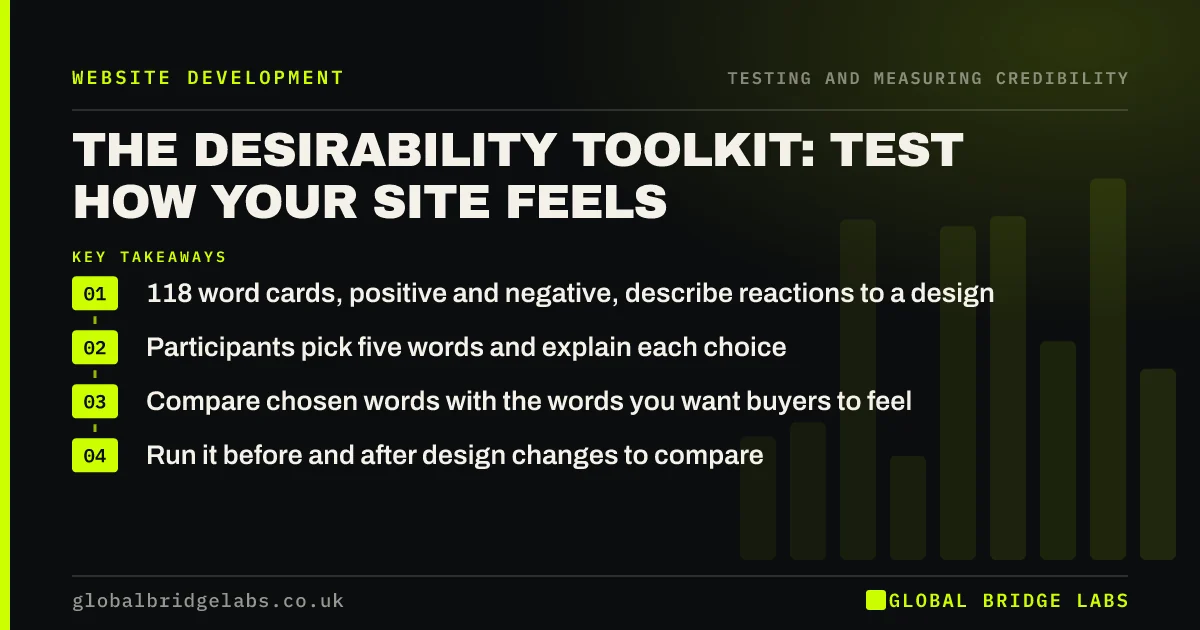
- 118 word cards, positive and negative, describe reactions to a design.
- Participants pick five words and explain each choice.
- Compare chosen words with the words you want buyers to feel.
- Run it before and after design changes to compare.
Want to know how your site feels to buyers? Message us on WhatsApp.
Chat on WhatsApp →What is the desirability toolkit?
The desirability toolkit is a research method developed by Joey Benedek and Trish Miner at Microsoft in 2002. It uses 118 product reaction cards, roughly 60% positive and 40% negative, to help participants describe their reaction to a design. Nielsen Norman Group recommends it for testing visual appeal and brand perception.
How do you run it?
A short session per participant is enough.
- Show the homepage, or let them browse for two minutes.
- Give them the word list or cards.
- Ask them to pick the five words that best describe it.
- Ask why they chose each word.
- Repeat with five to ten people who match your buyers.
How do you read the results?
Before testing, choose three to five words you want buyers to associate with your site, such as 'trustworthy', 'professional' and 'approachable'. Count how often participants choose them, and how often they choose negative words such as 'dated', 'busy' or 'impersonal'. The explanations show which design elements caused each reaction.
Want a desirability test before and after your redesign? Message us on WhatsApp and we will discuss your requirements.
Chat on WhatsApp →What are its limits?
The toolkit measures perception, not behaviour. A site that feels 'trustworthy' may still hide the price list. Use it alongside task tests and analytics. Also watch for the aesthetic-usability effect: people who like how a site looks may describe it more positively than its usability deserves.
What does this look like in practice?
A pattern we see: a firm wants to seem 'approachable', but participants most often choose 'corporate' and 'impersonal'. Their explanations point to stock photos and formal copy. Real team photos and a plainer voice shift the words chosen in a re-test.
Desirability test checklist
- Choose your target words first.
- Test with five to ten buyers.
- Ask for five words and the reasons.
- Count target and negative words.
- Re-test after changes.
Next step
Write down the three words you want buyers to feel about your site. Then ask three buyers which words they would choose.
Message us on WhatsApp for a brand perception test, or book a 30-minute consultation.
Chat on WhatsApp →Sources and further reading
- Using the Microsoft Desirability Toolkit to test visual appeal · Nielsen Norman Group
- Rating scales in UX research: Likert or semantic differential? · Nielsen Norman Group
- The aesthetic-usability effect · Nielsen Norman Group
Frequently asked questions
What are product reaction cards?
They are 118 words, such as 'trustworthy', 'confusing' and 'fresh', developed at Microsoft in 2002. Participants pick the words that best describe a design and explain why, giving structured insight into how it feels to them.
How many participants do I need for a desirability test?
Five to ten people who match your buyers usually show clear patterns. Larger numbers let you compare versions more confidently. Use the same method each time so results are comparable.
Is a desirability test the same as a preference test?
No. A preference test asks which of two designs people prefer. A desirability test asks how one design makes them feel, using a fixed word list. They work well together when comparing design options.
Written by

Global Bridge Labs (GBL) is a UK–Sri Lanka partner for social media, websites and BPO. Everything here comes from client delivery, not theory.