On this page
- 01Key takeaways
- 02Why does a founder story build credibility?
- 03What should a founder story include?
- 04Where should the founder story go?
- 05What makes a founder story backfire?
- 06When should you skip the founder story?
- 07What does this look like in practice?
- 08Founder story checklist
- 09Next step
- 10Sources and further reading
- 11Frequently asked questions
Key takeaways
A founder story builds trust when it explains why the business exists in a way that matters to the customer: the problem you saw, the expertise you brought and the standard you hold. Keep it short, true and specific, with a real photo. Put a short version on the homepage or about page and link to more detail.
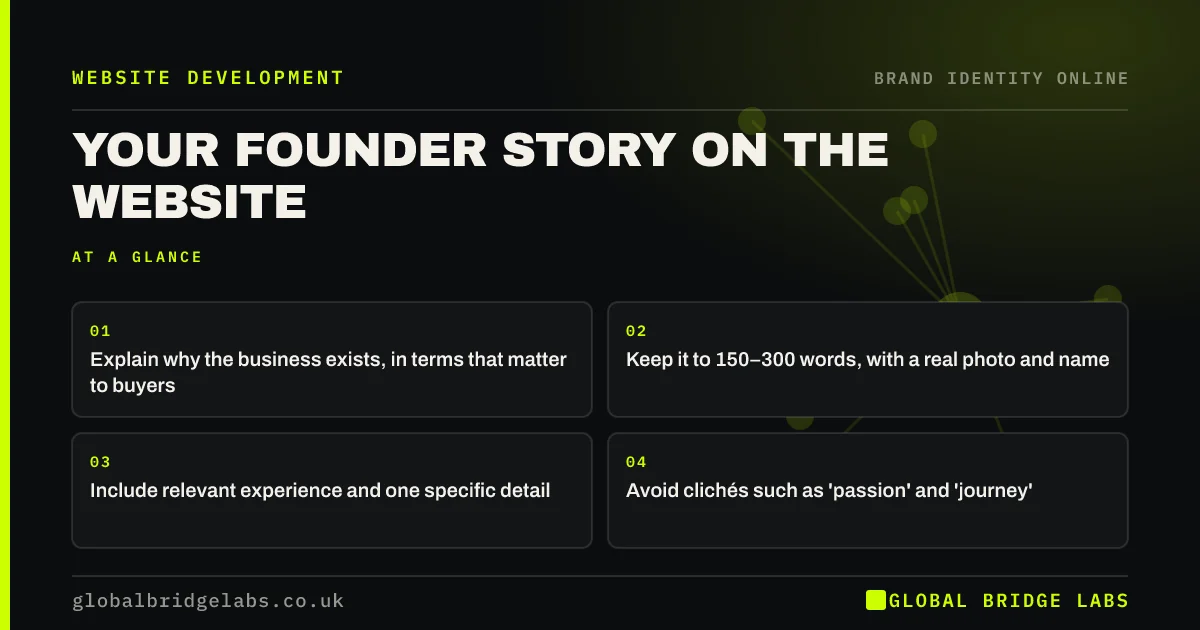
- Explain why the business exists, in terms that matter to buyers.
- Keep it to 150–300 words, with a real photo and name.
- Include relevant experience and one specific detail.
- Avoid clichés such as 'passion' and 'journey'.
Want help writing a founder story that builds trust? Message us on WhatsApp.
Chat on WhatsApp →Why does a founder story build credibility?
A founder story builds credibility by putting a real, accountable person behind the business. It answers questions visitors cannot ask: who started this, what do they know and why should I believe them? Nielsen Norman Group's research on about pages found users look for information about who runs a company to judge whether it can be trusted.
What should a founder story include?
The best founder stories are short and concrete. Each element should help a buyer decide.
- The customer problem you saw, in one or two sentences.
- The experience or skill that equipped you to solve it.
- One specific detail, such as a year, a place or a first client type.
- The standard you hold the business to, stated as a fact.
- A real photo, your name and your role today.
Where should the founder story go?
Put a two- or three-sentence version on the homepage near your proof, and the full version on the about page. For personal services, it can sit higher on the homepage. Do not make visitors read your story before they know what you sell; lead with the offer, then the people.
- Personal brand vs company brand: which should lead?
- Website value proposition: say it in five seconds
Want your about page rewritten around a credible founder story? Message us on WhatsApp and we will discuss your requirements.
Chat on WhatsApp →What makes a founder story backfire?
Founder stories backfire when they are all about the founder and nothing about the customer, when they rely on clichés like 'a passion for excellence', or when they exaggerate. Visitors can check LinkedIn and Companies House; a story that does not match the record damages credibility more than having none.
When should you skip the founder story?
Skip or shorten it when the founder is no longer involved, when the business is large enough that buyers deal with a team, or when the story adds nothing a buyer cares about. In those cases, a strong team page and company history do the same job.
What does this look like in practice?
A pattern we see: an about page opens with 'Our journey began with a dream'. Rewriting it as 'After 12 years fitting kitchens for national retailers, Sam started the business in 2015 to give homeowners one accountable fitter from survey to sign-off' gives buyers a reason to trust in one sentence.
Founder story checklist
- State the customer problem first.
- Include relevant experience and one specific detail.
- Add a real photo, name and role.
- Remove clichés and exaggeration.
- Check it matches LinkedIn and company records.
Next step
Write your story in three sentences: the problem, your experience, your standard. If it works at three, expand it.
Message us on WhatsApp for an about page review, or book a 30-minute consultation.
Chat on WhatsApp →Sources and further reading
- 'About Us' information on corporate websites · Nielsen Norman Group
- Stanford guidelines for web credibility · Stanford Web Credibility Project
- The impact of tone of voice on users' brand perception · Nielsen Norman Group
Frequently asked questions
Should my website include a founder story?
If the founder is involved and buyers care who runs the business, yes. A short, specific founder story gives visitors a real person to trust. If the founder is no longer involved, a team page and company history may serve better.
How long should a founder story be?
Two or three sentences on the homepage and 150–300 words on the about page is enough for most small businesses. Longer stories risk focusing on the founder instead of what the customer gets.
What makes a good founder story?
A good founder story is true, specific and about the customer: the problem the founder saw, the experience they brought to solve it and the standard the business keeps. A real photo and one concrete detail make it believable.
Written by

Global Bridge Labs (GBL) is a UK–Sri Lanka partner for social media, websites and BPO. Everything here comes from client delivery, not theory.