On this page
- 01Key takeaways
- 02What is the difference between credibility and trust?
- 03How does a website build credibility?
- 04How does a website turn credibility into trust?
- 05Which should you fix first?
- 06When do the two get confused?
- 07What does this look like in practice?
- 08Credibility and trust checklist
- 09Next step
- 10Sources and further reading
- 11Frequently asked questions
Key takeaways
Credibility is whether visitors believe you are honest and competent. Trust is whether they are willing to act on that belief, by calling, booking or paying. Credibility is a judgement; trust is a decision that also depends on risk. A credible site can still lose a buyer who sees too much risk in acting.
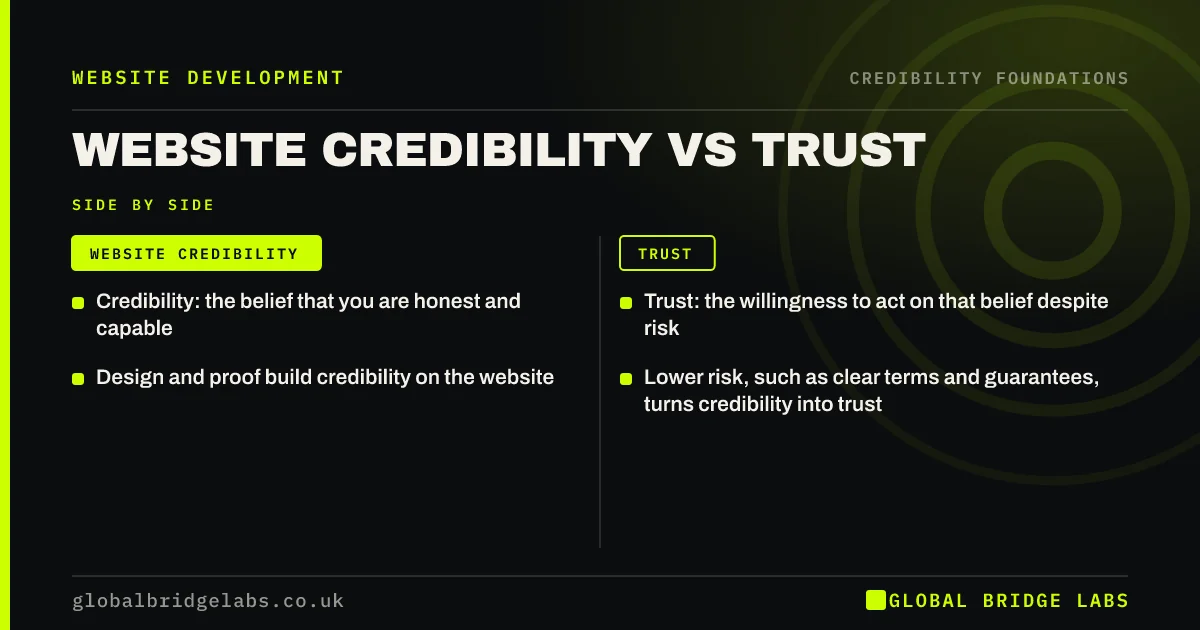
- Credibility: the belief that you are honest and capable.
- Trust: the willingness to act on that belief despite risk.
- Design and proof build credibility on the website.
- Lower risk, such as clear terms and guarantees, turns credibility into trust.
Want to know whether your site has a credibility or a trust gap? Message us on WhatsApp.
Chat on WhatsApp →What is the difference between credibility and trust?
Credibility is a perception: the visitor's judgement that you are believable. Trust is a willingness: their readiness to take a risk on you. Researchers describe credibility as perceived trustworthiness plus expertise. Trust adds the stakes. Buying a £20 product needs little trust; signing a £20,000 contract needs a lot, even from a credible supplier.
How does a website build credibility?
A website builds credibility by showing evidence: real people, specific detail, third-party proof, current content and a cared-for design. These answer 'are they real and good at this?'. Without them, visitors have nothing to believe.
How does a website turn credibility into trust?
A website turns credibility into trust by lowering the risk of acting. Clear prices or ranges, a described process, cancellation terms, a named contact, a promised reply time and a low-commitment first step all reduce the perceived risk. Credibility says 'they can do it'; risk reduction says 'it is safe to try'.
- Show prices or typical ranges.
- Explain what happens after someone enquires.
- Offer a small first step, such as a 30-minute call.
- State your terms, guarantees and policies plainly.
Want your enquiry route made lower-risk? Message us on WhatsApp and we will discuss your requirements.
Chat on WhatsApp →Which should you fix first?
Fix credibility first, because risk reduction does nothing for a business visitors do not believe. If visitors say the site looks unreliable or they could not tell who you are, it is credibility. If they believe you but hesitate to commit, it is trust: work on prices, process and first steps.
When do the two get confused?
They get confused when owners add more proof to a site that already has plenty, while buyers are really stuck on risk, such as unclear prices or a long contract. They also get confused in surveys, where 'I did not trust it' can mean either. Ask a follow-up: 'Was it the business, or the commitment?'
What does this look like in practice?
A pattern we see: a professional firm has excellent reviews and credentials, but enquiries are low. Visitors believe the firm but do not know what the first meeting costs or involves. Adding 'Free 30-minute call, no obligation' and a three-step process changes the decision without changing the credibility.
Credibility and trust checklist
- Show real people and named proof (credibility).
- Remove errors and dated content (credibility).
- Show prices or ranges (trust).
- Describe the next steps after enquiry (trust).
- Offer a low-commitment first step (trust).
Next step
Ask three recent customers what nearly stopped them contacting you. Sort the answers into 'belief' and 'risk'.
Message us on WhatsApp for a credibility and trust review, or book a 30-minute consultation.
Chat on WhatsApp →Sources and further reading
- The elements of computer credibility · ACM (Fogg and Tseng, 1999)
- Trustworthiness in web design: 4 credibility factors · Nielsen Norman Group
- In brands we trust? 2019 Edelman Trust Barometer special report · Edelman
Frequently asked questions
Can a website be credible but not trusted?
Yes. Visitors may believe the business is real and capable but still not act, because the risk feels too high: unclear prices, a long contract or no idea what happens next. Reducing that risk turns credibility into trust.
Is trust or credibility more important for a website?
Credibility comes first, because nobody trusts a business they do not believe. But a business only gets enquiries when visitors trust it enough to act, so both are needed. Most small business sites are weaker on credibility at first contact.
What are trust signals on a website?
Trust signals are elements that make visitors more willing to act: reviews, accreditations, secure checkout, clear terms, guarantees, real contact details and named people. Many of them also build credibility, which is why the terms are often used together.
Written by

Global Bridge Labs (GBL) is a UK–Sri Lanka partner for social media, websites and BPO. Everything here comes from client delivery, not theory.