On this page
Key takeaways
You cannot measure credibility directly, but you can track its effects: enquiry rate from new visitors, form starts versus submissions, visits to proof pages before enquiring, branded search impressions, review volume and rating, and what prospects say on first calls. Track five numbers monthly and compare them before and after credibility changes.
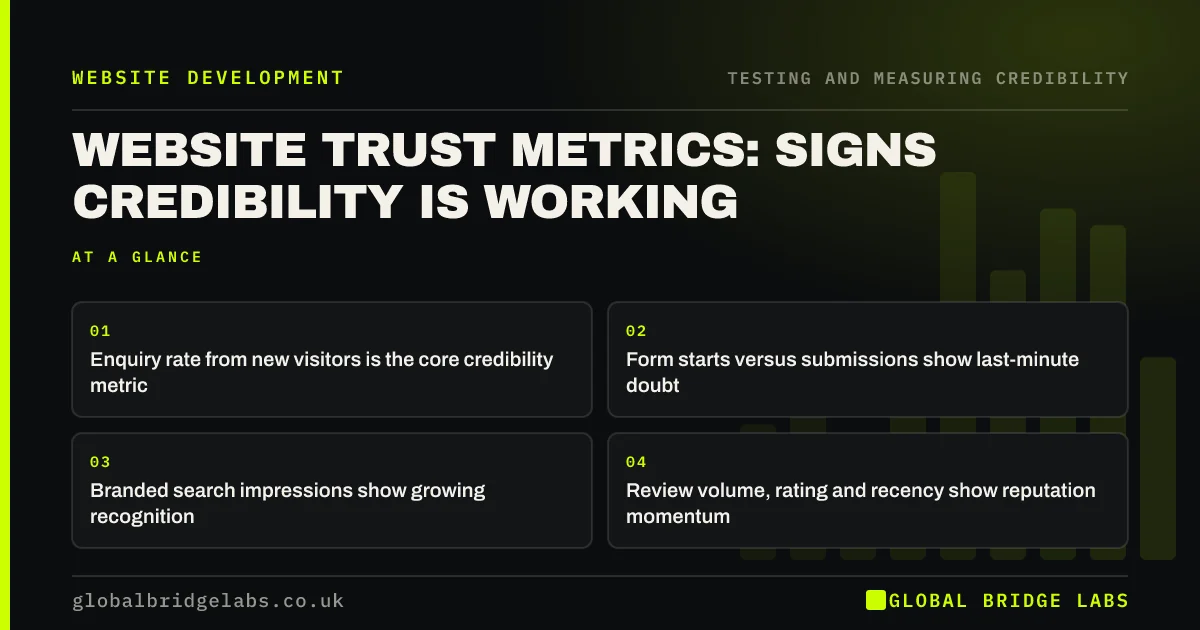
- Enquiry rate from new visitors is the core credibility metric.
- Form starts versus submissions show last-minute doubt.
- Branded search impressions show growing recognition.
- Review volume, rating and recency show reputation momentum.
Want a simple credibility dashboard set up? Message us on WhatsApp.
Chat on WhatsApp →Which metrics show credibility?
Choose a small set you can track every month.
- Enquiry rate from new users in Google Analytics 4 (GA4).
- Form start to submit rate on contact and quote forms.
- Share of enquirers who viewed reviews, case studies or about pages.
- Branded search impressions in Google Search Console.
- Google review count, average rating and reviews in the last 90 days.
- First-call notes: how often prospects raise trust concerns.
Why focus on new visitors?
Returning visitors and referrals already have some trust. New visitors arriving from search or ads rely almost entirely on what the website shows them, so their enquiry rate is the most sensitive measure of on-site credibility. Segment new users in GA4 and track key events, such as form submissions and calls, for that group.
How do you measure a credibility change?
Record four to eight weeks of baseline data, make the change, then compare an equal period after, allowing for seasonality and changes in traffic sources. Watch whether new-user enquiry rate and form completion rise. Session recordings can show whether visitors now reach proof and contact points.
Want a before-and-after measurement plan for your changes? Message us on WhatsApp and we will discuss your requirements.
Chat on WhatsApp →Which metrics mislead?
Time on page and bounce rate are weak credibility signals on their own; a visitor who finds the phone number quickly and calls may 'bounce'. Social follower counts say little about trust. Total traffic can rise while credibility falls. Stick to metrics tied to decisions: enquiries, completions and what prospects say.
What does this look like in practice?
A pattern we see: after adding reviews and team photos to service pages, total enquiries barely change because traffic dipped seasonally. But the enquiry rate from new users rose and fewer prospects asked 'Are you a real company?' on calls. The right metric showed the change worked.
Trust metrics checklist
- Set up GA4 key events for enquiries.
- Segment new users.
- Track form start to submit rate.
- Track branded impressions and review momentum.
- Log trust questions on first calls.
- Compare equal periods before and after changes.
Next step
Find your enquiry rate from new users for the last 90 days. That is your credibility baseline.
Message us on WhatsApp for a measurement review, or book a 30-minute consultation.
Chat on WhatsApp →Sources and further reading
- About key events · Google Analytics Help
- Performance report (Search results) · Search Console Help
- About Microsoft Clarity (heatmaps and session recordings) · Microsoft
Frequently asked questions
How do you measure website credibility?
Track its effects: enquiry rate from new visitors, form completion, visits to proof pages before enquiring, branded search impressions, review momentum and how often prospects raise trust concerns. Compare equal periods before and after changes.
Is bounce rate a good measure of trust?
Not on its own. A visitor who finds your phone number and calls may count as a bounce. Use enquiry rate and form completion for new visitors instead, which are tied to the decision credibility affects.
What is a good enquiry rate for a website?
It varies widely by sector, traffic source and offer. Compare against your own baseline and look for improvement after changes. Our guide to UK conversion rate benchmarks gives indicative ranges by sector.
Written by

Global Bridge Labs (GBL) is a UK–Sri Lanka partner for social media, websites and BPO. Everything here comes from client delivery, not theory.