On this page
- 01Key takeaways
- 02What is E-E-A-T?
- 03What does each letter mean for a small business?
- 04Why is trust the most important part?
- 05Is E-E-A-T a ranking factor?
- 06When should you not worry about E-E-A-T?
- 07What does this look like in practice?
- 08E-E-A-T checklist
- 09Next step
- 10Sources and further reading
- 11Frequently asked questions
Key takeaways
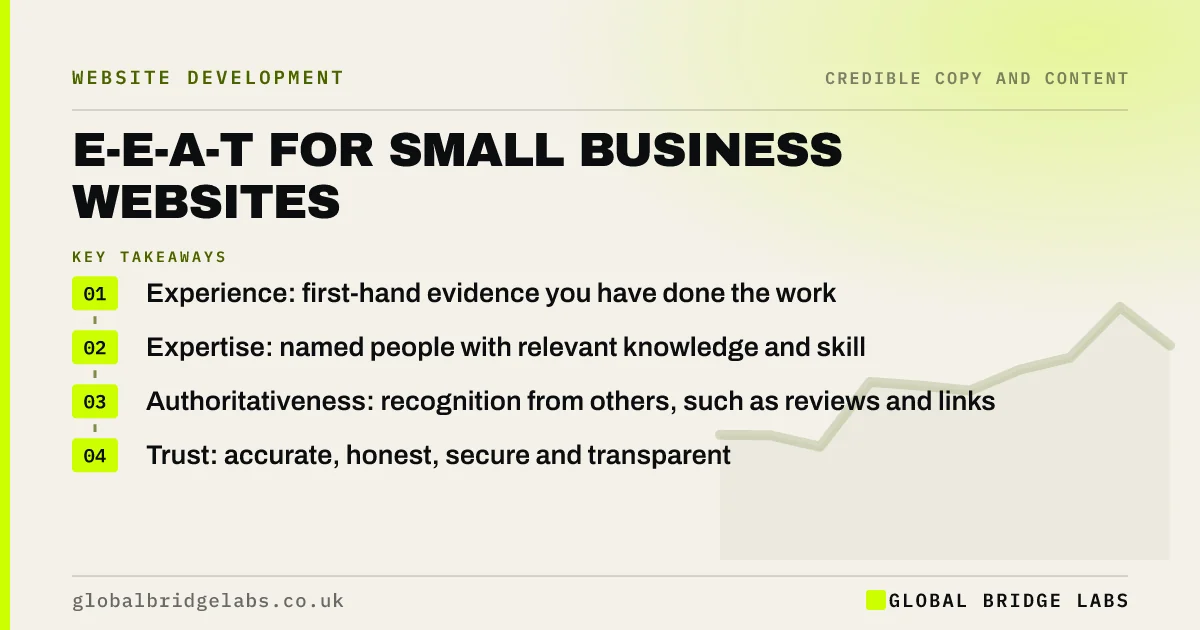
E-E-A-T stands for experience, expertise, authoritativeness and trust. It is the framework Google's quality raters use to judge content, and Google says trust is the most important part. For a small business, it means showing first-hand experience, named experts, recognition from others and honest, accurate, transparent information about the business.
- Experience: first-hand evidence you have done the work.
- Expertise: named people with relevant knowledge and skill.
- Authoritativeness: recognition from others, such as reviews and links.
- Trust: accurate, honest, secure and transparent; Google calls it the most important.
Want your site reviewed against E-E-A-T? Message us on WhatsApp.
Chat on WhatsApp →What is E-E-A-T?
E-E-A-T is a concept from Google's Search Quality Rater Guidelines, which human raters use to evaluate search results. Google added 'Experience' in December 2022, turning E-A-T into E-E-A-T. It is not a single ranking factor, but it describes the qualities Google's systems aim to reward, and it closely matches how buyers judge credibility.
What does each letter mean for a small business?
Translated into website terms:
- Experience: real project photos, case studies and specific delivery detail.
- Expertise: named authors and team members with qualifications.
- Authoritativeness: reviews, accreditations, press mentions and links from respected sites.
- Trust: company details, contact routes, secure pages, accurate claims and clear policies.
Why is trust the most important part?
Google's rater guidelines say trust is the most important member of the E-E-A-T family, because untrustworthy pages have low E-E-A-T however expert they seem. For a business, trust starts with being verifiable: who you are, where you are, how to contact you and whether your claims hold up. These are also what customers check.
Want a trust and E-E-A-T fix list for your site? Message us on WhatsApp and we will discuss your requirements.
Chat on WhatsApp →Is E-E-A-T a ranking factor?
Not directly. Google says E-E-A-T is not a specific ranking factor, but its systems use many signals that align with it. In practice, the work that improves E-E-A-T, such as clear authorship, first-hand content, real proof and accurate claims, also improves how buyers judge you, so it is worth doing either way.
When should you not worry about E-E-A-T?
Do not chase it with tricks such as fake author profiles, invented credentials or paid links. Those undermine trust, the most important part. If your business is real and your content is honest and specific, you are building E-E-A-T by default; the job is to make it visible.
What does this look like in practice?
A pattern we see: a firm with 20 years' experience publishes generic articles that could come from anywhere. Adding real project examples, the author's name and qualifications, and company details turns the same topics into content that shows experience and expertise.
E-E-A-T checklist
- Add first-hand examples to service pages and articles.
- Name authors with roles and experience.
- Display reviews, accreditations and press.
- Show company details and contact routes.
- Source claims and keep content current.
Next step
Pick one key page and add one example of first-hand experience. It is the easiest E-E-A-T gain.
Message us on WhatsApp for an E-E-A-T review, or book a 30-minute consultation.
Chat on WhatsApp →Sources and further reading
- Our latest update to the quality rater guidelines: E-A-T gets an extra E for Experience · Google Search Central Blog
- Search quality rater guidelines · Google
- Creating helpful, reliable, people-first content · Google Search Central
Frequently asked questions
What does E-E-A-T stand for?
Experience, expertise, authoritativeness and trust. It comes from Google's Search Quality Rater Guidelines, which describe how human raters judge the quality of search results. Google added 'experience' in December 2022.
How do I improve E-E-A-T on my website?
Show first-hand experience through real examples, name qualified authors, display reviews and accreditations, give clear company and contact details, source your claims and keep content up to date. Trust is the most important element.
Does E-E-A-T matter for small businesses?
Yes, especially for topics involving money, health, safety or major purchases. Small businesses often have strong first-hand experience that is simply not shown on their website. Making it visible helps both searchers and search engines.
Written by

Global Bridge Labs (GBL) is a UK–Sri Lanka partner for social media, websites and BPO. Everything here comes from client delivery, not theory.