On this page
- 01Key takeaways
- 02Why does citing sources build credibility?
- 03What should you cite?
- 04How do you cite sources on a business site?
- 05How does sourcing help with AI search?
- 06When is citing overkill?
- 07What does this look like in practice?
- 08Source citing checklist
- 09Next step
- 10Sources and further reading
- 11Frequently asked questions
Key takeaways
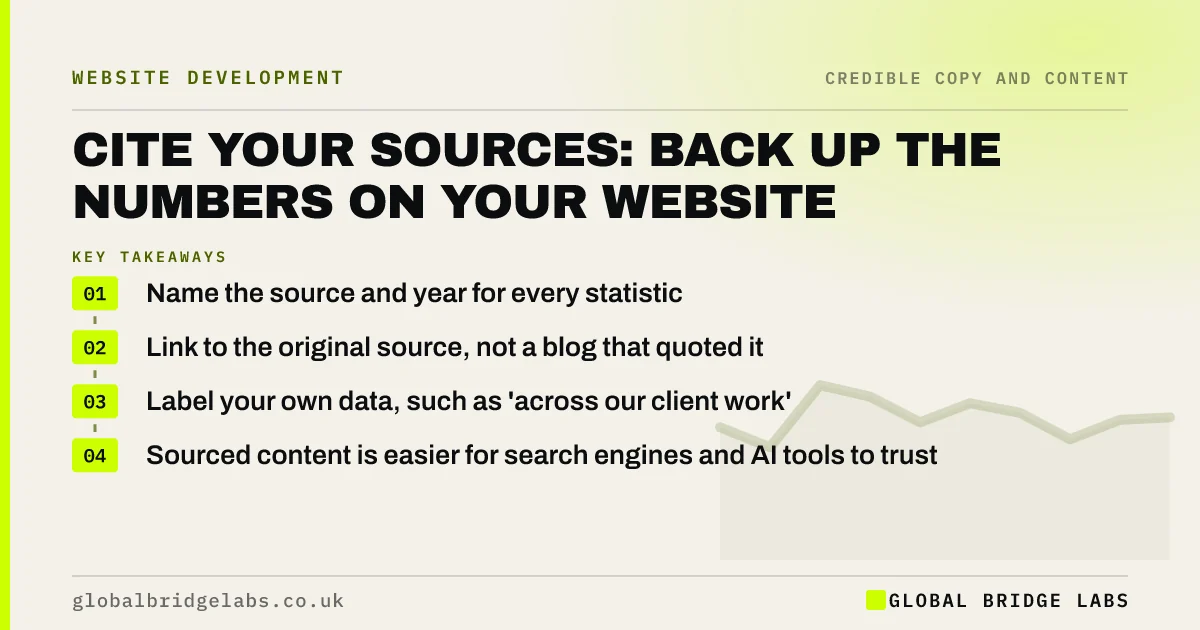
Citing sources on a business website makes claims checkable, and checkable claims are more credible. The first Stanford guideline for web credibility is to make it easy to verify the accuracy of the site. Name the source and year for every statistic, link to the original, and label your own data clearly as yours.
- Name the source and year for every statistic.
- Link to the original source, not a blog that quoted it.
- Label your own data, such as 'across our client work'.
- Sourced content is easier for search engines and AI tools to trust.
Want your key claims sourced and checked? Message us on WhatsApp.
Chat on WhatsApp →Why does citing sources build credibility?
Citing sources builds credibility because it lets visitors check you, and the willingness to be checked signals honesty. The Stanford guidelines put verifiable accuracy first. Google's guidance on helpful content asks whether content is supported by clear sourcing and evidence of expertise. Unsourced statistics invite doubt, especially round numbers that sound invented.
What should you cite?
Cite anything a sceptical buyer might question.
- Market statistics and industry figures.
- Laws, regulations and official guidance.
- Research findings you use to explain your approach.
- Price ranges, with where they come from.
- Your own results, with how they were measured.
How do you cite sources on a business site?
Keep it light. In the sentence, name the source and year, such as 'Office for National Statistics, 2025', and link to the original page. For articles, add a short 'Sources' list at the end. Prefer primary sources: government, regulators, standards bodies and original research, rather than other blogs.
- E-E-A-T for small business websites, in plain terms
- Author bios on a business blog: show who wrote it
Want a sourcing pass across your articles and service pages? Message us on WhatsApp and we will discuss your requirements.
Chat on WhatsApp →How does sourcing help with AI search?
AI tools that summarise the web, such as Google's AI Overviews, tend to draw on content that is specific, factual and well supported. Clear statements with named sources are easier to quote accurately. Your own clearly labelled data, such as aggregated client results, is especially valuable because nobody else has it.
When is citing overkill?
You do not need to cite common knowledge or your own descriptions of your services. Over-citing short sales pages can make them feel academic. Save formal sourcing for statistics, legal points and articles, and keep service pages to plain claims you can prove on request.
What does this look like in practice?
A pattern we see: a blog post claims '88% of customers check reviews' with no source. A reader cannot verify it and the original study, if it exists, is a decade old. Replacing it with a current, linked figure, or removing it, makes the whole article more believable.
Source citing checklist
- List every statistic on your key pages.
- Find the original source and year for each.
- Replace or remove any you cannot trace.
- Link to primary sources.
- Label your own data clearly.
Next step
Pick your three most-visited articles and check every number in them has a named, linked source.
Message us on WhatsApp for a content credibility review, or book a 30-minute consultation.
Chat on WhatsApp →Sources and further reading
- Stanford guidelines for web credibility · Stanford Web Credibility Project
- Creating helpful, reliable, people-first content · Google Search Central
- AI features and your website · Google Search Central
Frequently asked questions
Should a business website cite sources?
Yes, for statistics, legal points and research. Citing sources lets visitors check your claims, which builds credibility, and supports search engines and AI tools in treating your content as reliable. Service descriptions do not need formal citations.
How do you cite a source in a blog post?
Name the source and year in the sentence, link to the original page, and add a short list of sources at the end. Prefer primary sources such as government, regulators and original research over articles that quote them.
Can I use statistics from other websites?
You can quote facts and figures with attribution, but trace them to the original source first, because statistics are often misquoted. Do not copy large passages of text or charts without permission, which may infringe copyright.
Written by

Global Bridge Labs (GBL) is a UK–Sri Lanka partner for social media, websites and BPO. Everything here comes from client delivery, not theory.