On this page
- 01Key takeaways
- 02Who should you survey about trust?
- 03Which questions work best?
- 04How should you word trust questions?
- 05How do you turn answers into fixes?
- 06When do surveys mislead?
- 07What does this look like in practice?
- 08Trust survey checklist
- 09Next step
- 10Sources and further reading
- 11Frequently asked questions
Key takeaways
The most useful trust survey questions are open and specific: 'What, if anything, nearly stopped you contacting us?' and 'What made you confident enough to get in touch?' Ask new customers soon after they enquire, and ask visitors who leave a key page. Keep surveys to one to three questions and look for repeated themes.
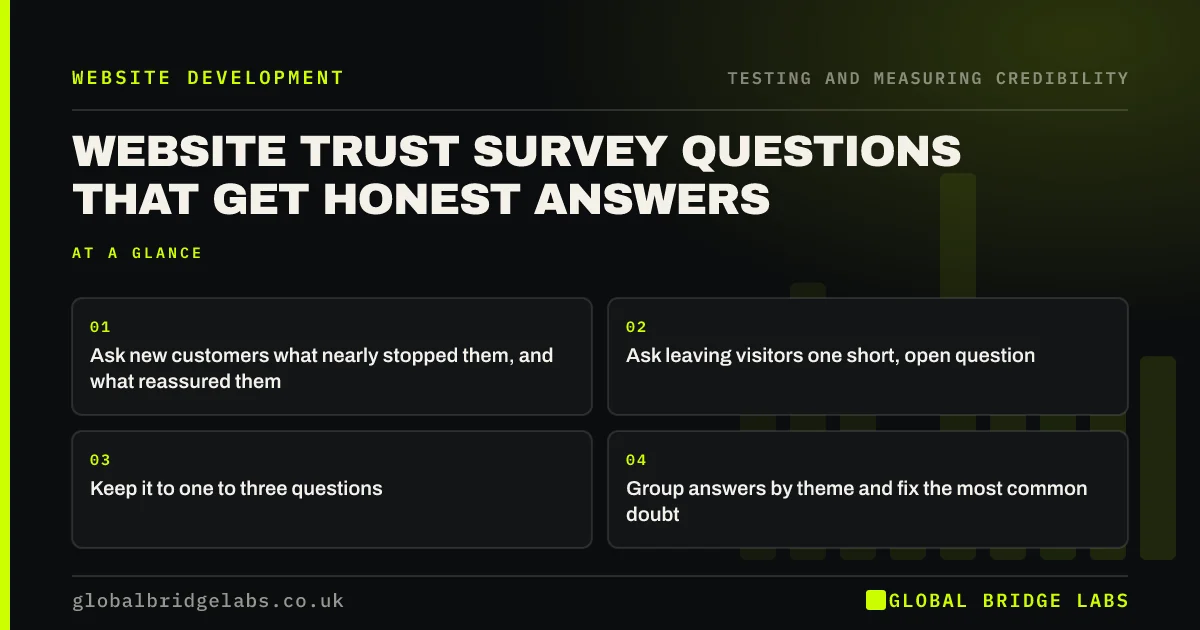
- Ask new customers what nearly stopped them, and what reassured them.
- Ask leaving visitors one short, open question.
- Keep it to one to three questions.
- Group answers by theme and fix the most common doubt.
Want a short trust survey set up for your site? Message us on WhatsApp.
Chat on WhatsApp →Who should you survey about trust?
Survey two groups. New customers, shortly after they enquire or buy, can tell you what reassured them and what almost stopped them. Visitors who leave key pages without acting can tell you what was missing. Existing long-term clients already trust you and are less useful for this.
Which questions work best?
Open questions reveal reasons; scales show size.
- 'What, if anything, nearly stopped you contacting us?'
- 'What made you confident enough to get in touch?'
- 'What information were you looking for that you could not find?'
- 'How much do you trust this business?' (1 to 7), then 'Why?'
- 'Which other businesses did you consider?'
How should you word trust questions?
Keep questions neutral, so you do not lead people to a positive answer. 'How easy was it?' assumes it was easy. Ask about behaviour and specifics rather than general opinions. Nielsen Norman Group's guidance on rating scales recommends labelling scale points clearly and pairing ratings with an open 'why' question.
Want your survey questions written and analysed? Message us on WhatsApp and we will discuss your requirements.
Chat on WhatsApp →How do you turn answers into fixes?
Tag each answer with one of the five credibility signals: real, competent, proven, current or open. Count the tags each month. The most common doubt is your next fix. Quote positive answers, with permission, as testimonials on the pages where those doubts arise.
When do surveys mislead?
Surveys mislead when sample sizes are tiny, questions are leading or only happy customers reply. They also capture what people say, not what they do. Combine survey themes with analytics and occasional user tests to confirm what you hear.
What does this look like in practice?
A pattern we see: a one-question survey on a firm's enquiry form asks, 'What nearly stopped you contacting us?' Within a month, the most common answer is 'no idea of cost'. Adding a price guide to service pages addresses the top doubt directly.
Trust survey checklist
- Ask new customers within a week of enquiring.
- Ask leaving visitors one open question.
- Avoid leading wording.
- Pair any rating with 'why'.
- Tag answers by credibility signal monthly.
Next step
Add one question to your enquiry form or thank-you email: 'What nearly stopped you contacting us?'
Message us on WhatsApp for a trust survey set-up, or book a 30-minute consultation.
Chat on WhatsApp →Sources and further reading
- Rating scales in UX research: Likert or semantic differential? · Nielsen Norman Group
- User research · GOV.UK Service Manual
- How do users evaluate the credibility of web sites? A study with over 2,500 participants · ACM (Fogg et al., 2003)
Frequently asked questions
What questions measure customer trust?
Open questions such as 'What nearly stopped you contacting us?' and 'What made you confident to get in touch?' reveal reasons. A 1 to 7 trust rating followed by 'Why?' gives a number you can track and the explanation behind it.
When should I ask customers about trust?
Soon after they enquire or buy, while the decision is fresh, usually within a week. For visitors who do not convert, a short on-site question on key pages captures doubts at the moment they arise.
How many survey responses do I need?
For spotting themes, even 20 to 30 open answers are useful. For tracking a rating over time, more is better. Focus on repeated reasons rather than exact percentages when numbers are small.
Written by

Global Bridge Labs (GBL) is a UK–Sri Lanka partner for social media, websites and BPO. Everything here comes from client delivery, not theory.