On this page
- 01Key takeaways
- 02Weeks 1–2: how do you set a baseline?
- 03Weeks 3–5: what do you fix first?
- 04Weeks 6–10: how do you build proof and content?
- 05Weeks 11–13: how do you decide what next?
- 06When should you skip straight to a redesign?
- 07What does this look like in practice?
- 0890-day plan checklist
- 09Next step
- 10Sources and further reading
- 11Frequently asked questions
Key takeaways
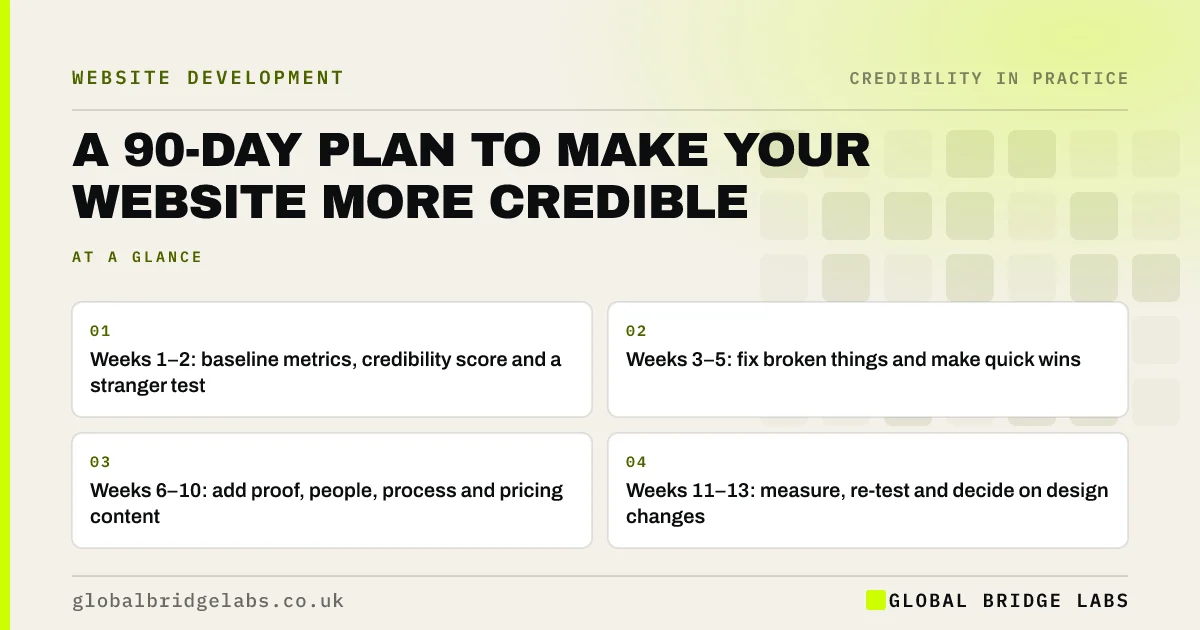
A 90-day credibility plan works in four phases: measure and score in weeks 1–2, fix broken things and quick wins in weeks 3–5, add proof and content in weeks 6–10, then measure, re-test and decide on design changes in weeks 11–13. Most of the gain comes before any redesign, and the evidence tells you whether one is needed.
- Weeks 1–2: baseline metrics, credibility score and a stranger test.
- Weeks 3–5: fix broken things and make quick wins.
- Weeks 6–10: add proof, people, process and pricing content.
- Weeks 11–13: measure, re-test and decide on design changes.
Want a 90-day credibility plan built for your site? Message us on WhatsApp.
Chat on WhatsApp →Weeks 1–2: how do you set a baseline?
Record enquiry rate from new users, form start to submit rate and branded search impressions for the last 90 days. Score the site on the five credibility signals: real, competent, proven, current and open. Run a quick test with three people who match your buyers. Write down the top three doubts.
Weeks 3–5: what do you fix first?
Remove anything that stops enquiries, then add easy proof.
- Fix security warnings, broken forms and wrong contact details.
- Add company details and a domain email.
- Replace stock photos of people.
- Add reviews and accreditations beside the main action.
- Remove dated content and dead links.
Weeks 6–10: how do you build proof and content?
Write two or three case studies, a process page and pricing guidance. Add named team profiles and a founder story. Start a review request routine with every customer. Book a photography session for real team and work images. Rewrite vague service copy into specifics.
- A 'How we work' page: show the process buyers buy
- Website photography cost in the UK: what a shoot buys
Want help producing case studies and service content? Message us on WhatsApp and we will discuss your requirements.
Chat on WhatsApp →Weeks 11–13: how do you decide what next?
Re-score the site, repeat the stranger test and compare metrics with the baseline. If doubts now centre on the look, such as 'dated' or 'cluttered', plan a visual refresh. If doubts are gone but enquiries are flat, look at offer, price or traffic. Name an owner to keep credibility current.
When should you skip straight to a redesign?
Skip ahead only if the site is broken on phones, very slow, insecure or on a platform nobody can update. Even then, gather proof and content in parallel, because a new design without them will look as generic as the old one.
What does this look like in practice?
A pattern we see: an owner plans a redesign but follows the 90-day plan first. By week 10, strangers' doubts have shifted from 'is this real?' to 'it looks a bit dated'. The redesign brief is then focused and cheaper, because the content and proof already exist.
90-day plan checklist
- Record baseline metrics and score.
- Run a stranger test.
- Fix broken things and quick wins.
- Produce case studies, process and pricing content.
- Re-measure and decide on design.
- Name an ongoing owner.
Next step
Book 30 minutes this week to record your baseline and score your site. That is day one of the plan.
Message us on WhatsApp for a 90-day credibility plan, or book a 30-minute consultation.
Chat on WhatsApp →Sources and further reading
- Stanford guidelines for web credibility · Stanford Web Credibility Project
- About key events · Google Analytics Help
- Why you only need to test with 5 users · Nielsen Norman Group
Frequently asked questions
How long does it take to improve website credibility?
Quick wins can be made in a week. A fuller programme of proof, content and testing typically takes around 90 days. You can usually see effects on enquiry rate within four to eight weeks of the main changes.
Should I redesign my website to improve credibility?
Only after fixing content and proof, unless the site is broken on phones, very slow or insecure. Most credibility gaps are content gaps. A redesign without real proof will look as generic as before.
Who should own website credibility?
Name one person responsible for keeping content, proof and details current, with a quarterly review. In a small business this is often the owner or office manager, supported by whoever maintains the website.
Written by

Global Bridge Labs (GBL) is a UK–Sri Lanka partner for social media, websites and BPO. Everything here comes from client delivery, not theory.