On this page
Key takeaways
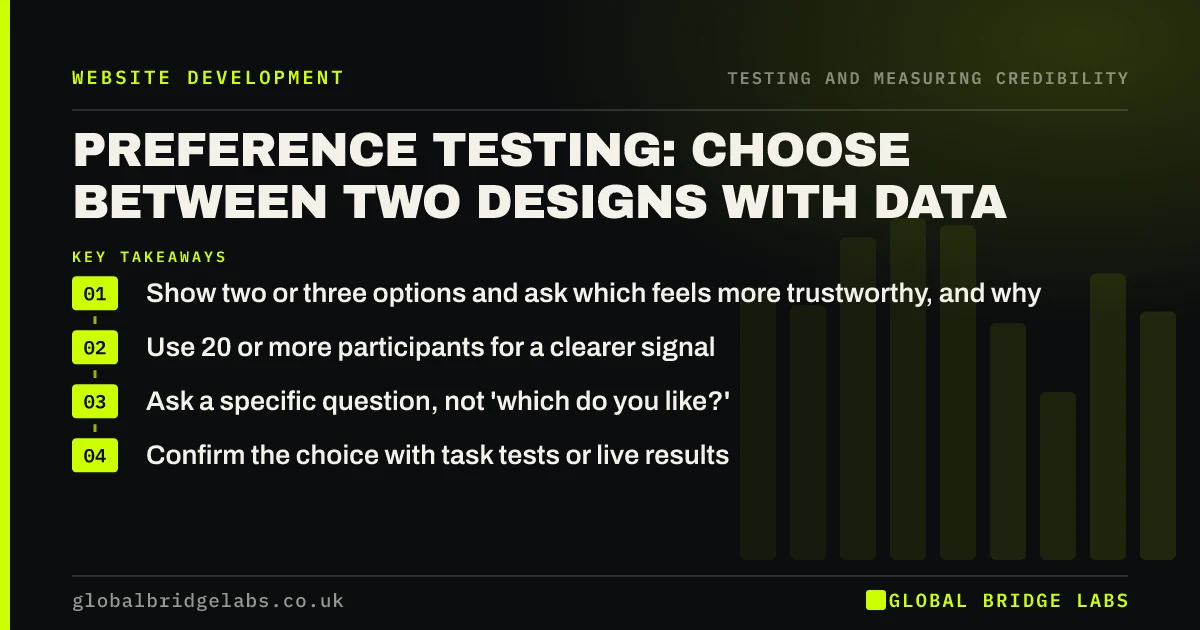
A preference test shows buyers two or more design options and asks which they prefer and why. It is quick and cheap, and useful for choosing between visual directions, such as photos or layouts, on credibility grounds. But preference is not performance: confirm the winner with a task test or live data where traffic allows.
- Show two or three options and ask which feels more trustworthy, and why.
- Use 20 or more participants for a clearer signal.
- Ask a specific question, not 'which do you like?'
- Confirm the choice with task tests or live results.
Want two design options tested with your buyers? Message us on WhatsApp.
Chat on WhatsApp →What is a preference test?
A preference test is a research method in which participants view two or more design variations and choose the one they prefer, then explain their choice. It suits early design decisions, such as choosing a homepage hero, imagery style or colour direction, when you cannot yet run a live A/B test.
How do you run one properly?
Make the comparison fair and the question specific.
- Change one main thing between versions, such as the photo style.
- Show versions in random order.
- Ask 'Which business would you be more likely to trust?' not 'Which do you like?'
- Ask why, in their own words.
- Recruit people who match your buyers.
Why is preference not performance?
People often prefer designs that look attractive, even when they are harder to use, a pattern described by the aesthetic-usability effect. A preferred design can still hide the contact button. Use preference tests to rule options out, then check the chosen design with a task test or, with enough traffic, a live A/B test.
Want design options tested for preference and performance? Message us on WhatsApp and we will discuss your requirements.
Chat on WhatsApp →How many participants do you need?
For a clear signal between two options, aim for 20 or more participants. With fewer, a small difference may be chance. If results are close, the choice probably matters less than other credibility factors, so pick the one that fits your brand and move on.
What does this look like in practice?
A pattern we see: an owner and designer disagree between an illustrated hero and a team photo. A preference test with 25 local buyers asking which business they would trust more favours the team photo, mainly because 'they look like real people'. The decision is made on evidence, not taste.
Preference test checklist
- Change one main element between versions.
- Randomise the order shown.
- Ask a trust-focused question.
- Collect reasons, not only votes.
- Confirm with a task test or live data.
Next step
Next time you face a design choice, ask 20 buyers which version they would trust more, and why.
Message us on WhatsApp for a design test, or book a 30-minute consultation.
Chat on WhatsApp →Sources and further reading
- The aesthetic-usability effect · Nielsen Norman Group
- Rating scales in UX research: Likert or semantic differential? · Nielsen Norman Group
- Minimise A/B testing impact in Google Search · Google Search Central
Frequently asked questions
What is the difference between a preference test and an A/B test?
A preference test asks people which design they prefer and why, usually before launch. An A/B test shows different versions to live visitors and measures what they actually do. Preference tests are faster; A/B tests measure behaviour but need more traffic.
What question should I ask in a preference test?
Ask a specific question tied to your goal, such as 'Which business would you be more likely to trust?' or 'Which makes it clearer what this company does?', then ask why. Avoid 'Which do you like?'
How many people should take a preference test?
Twenty or more participants who match your buyers gives a clearer signal between two options. With fewer, treat the result as directional and focus on the reasons people give for their choice.
Written by

Global Bridge Labs (GBL) is a UK–Sri Lanka partner for social media, websites and BPO. Everything here comes from client delivery, not theory.