On this page
Key takeaways
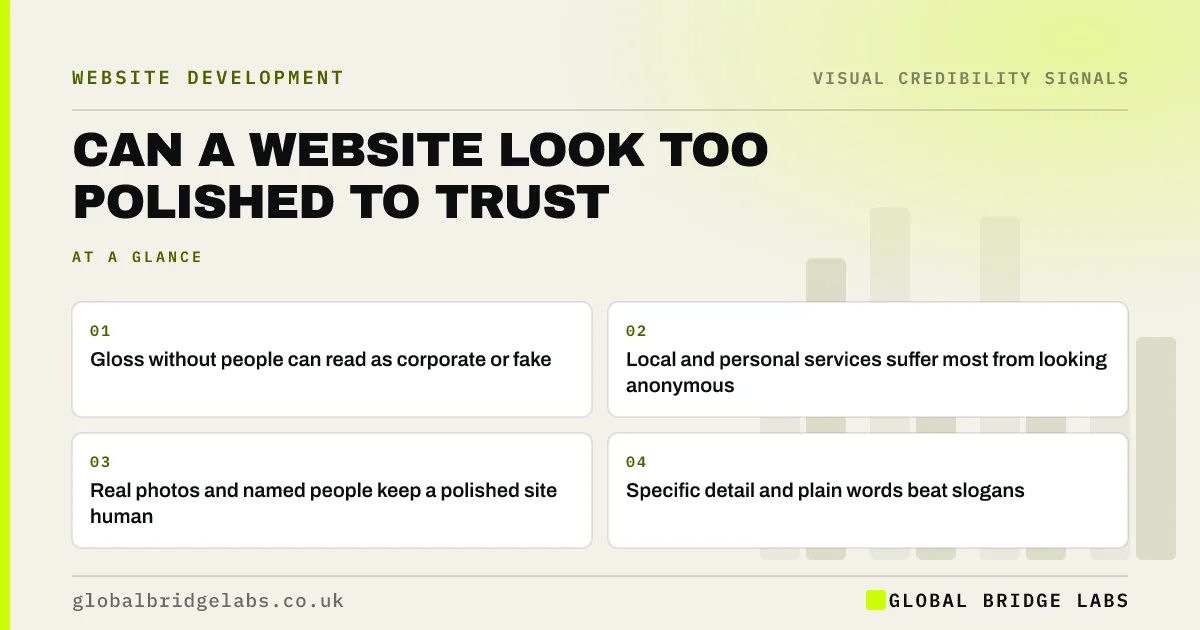
A website can look too polished when the gloss replaces evidence of real people. Over-produced sites with stock imagery, generic slogans and no names can feel corporate, distant or even fake, especially for local and personal services. Polish is not the problem; anonymity is. Pair a clean design with real faces, specific detail and a human voice.
- Gloss without people can read as corporate or fake.
- Local and personal services suffer most from looking anonymous.
- Real photos and named people keep a polished site human.
- Specific detail and plain words beat slogans.
Want to know whether your site feels real or generic? Message us on WhatsApp.
Chat on WhatsApp →Can a website be too professional?
A website cannot be too well made, but it can be too impersonal. When a small business site looks like a large corporation's, with stock photos, abstract slogans and no names, buyers may wonder who they will actually deal with. Some will assume a middleman or a scam. Credibility needs competence and honesty, and anonymity weakens the second.
Which buyers distrust slick sites?
Buyers of personal and local services are most sensitive: homeowners choosing a tradesperson, patients choosing a clinic, families choosing a care provider. They want to see who will turn up. B2B buyers are more tolerant of a corporate look but still want named people and real clients. Almost nobody is reassured by stock photos of handshakes.
How do you look polished and real?
Keep the clean design and add evidence of real people and work. Show the team with names and roles, the premises or vans, real projects and named reviews. Write in a plain, human voice. A founder's note or a short video can add personality without undermining the polish.
- Team photos with names and roles.
- Photos of your real work, premises or vehicles.
- A plain-English description of who you help.
- Named, dated reviews.
- A direct phone number and a named contact.
- Team photos on your website: what works and what does not
- Your founder story on the website: when it builds trust
Want your site to feel more personal without losing polish? Message us on WhatsApp and we will discuss your requirements.
Chat on WhatsApp →When is a more corporate look right?
A more corporate look is right when you sell to large organisations that expect a formal supplier, such as in tenders or regulated sectors. Even then, named leadership, verifiable credentials and real case studies matter. Corporate should mean formal and organised, not faceless.
What does this look like in practice?
A pattern we see: a family-run firm commissions a sleek new site with drone footage and abstract taglines. Older customers say it no longer feels like them. Adding the family's photo and story, real job photos and a direct mobile number restores the warmth while keeping the quality.
Polished and real checklist
- Replace stock photos of people with real ones.
- Name the people buyers will deal with.
- Swap abstract slogans for specific statements.
- Show real work and premises.
- Write the about page in a human voice.
Next step
Count the real people visible on your homepage. If the answer is zero, add at least one this month.
Message us on WhatsApp for a credibility review, or book a 30-minute consultation.
Chat on WhatsApp →Sources and further reading
- Trustworthiness in web design: 4 credibility factors · Nielsen Norman Group
- Photos as web content · Nielsen Norman Group
- The impact of tone of voice on users' brand perception · Nielsen Norman Group
Frequently asked questions
Why does my website look fake?
Sites often look fake when they rely on stock photos of people, generic slogans and no names, addresses or company details. Visitors cannot find evidence of real people, so they doubt the business. Real photos, named staff and company details fix most of it.
Should a small business website look corporate?
Only if your buyers expect a formal supplier, such as large organisations or public sector clients. Most small business buyers want competence and approachability: a clean design with real people, plain language and a direct contact route.
Does a personal touch make a website more credible?
Usually, yes, for service businesses. Named people, a founder's story and real photos give visitors evidence of who they will deal with. Keep it relevant and professional; personal does not mean casual about quality.
Written by

Global Bridge Labs (GBL) is a UK–Sri Lanka partner for social media, websites and BPO. Everything here comes from client delivery, not theory.