On this page
- 01Key takeaways
- 02What do shippers check on a logistics website?
- 03Which credentials should a logistics site show?
- 04How do you show reliability?
- 05What costs a logistics site credibility?
- 06What does this look like in practice?
- 07Logistics website checklist
- 08Next step
- 09Sources and further reading
- 10Frequently asked questions
Key takeaways
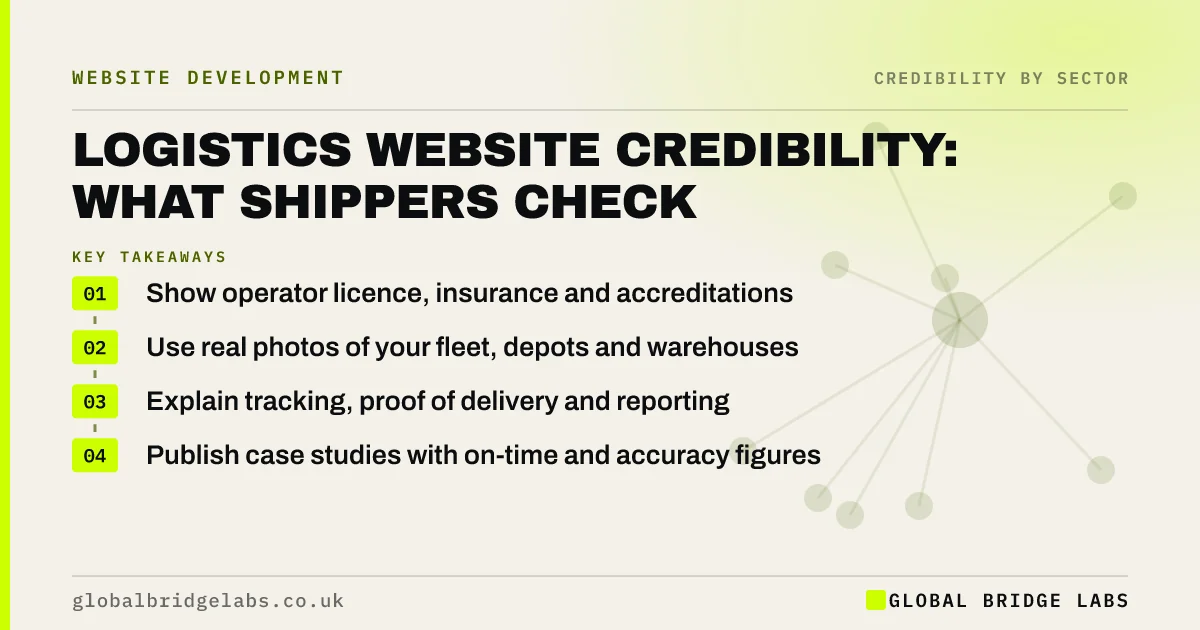
Shippers choosing a carrier or third-party logistics (3PL) provider want proof of reliability: the right licences, insurance, accreditations, real fleet and warehouse photos, tracking, and case studies with numbers such as on-time rates. A logistics website that shows these specifically looks like a partner; a generic one looks like a broker.
- Show operator licence, insurance and accreditations.
- Use real photos of your fleet, depots and warehouses.
- Explain tracking, proof of delivery and reporting.
- Publish case studies with on-time and accuracy figures.
Want your logistics site reviewed for credibility? Message us on WhatsApp.
Chat on WhatsApp →What do shippers check on a logistics website?
Shippers check whether you can move their goods safely, on time and with visibility. They look for licences and insurance, sector experience, capacity, coverage, technology and proof from similar clients. Procurement teams will verify details later, so the website's job is to make the shortlist by answering those questions clearly.
Which credentials should a logistics site show?
Show what is required and what shippers recognise.
- Goods vehicle operator licence, where you run qualifying vehicles.
- Goods-in-transit and liability insurance cover levels.
- Quality and safety accreditations your clients ask for.
- Data security standards for integrations, such as Cyber Essentials.
- Sector-specific approvals, such as temperature-controlled handling.
How do you show reliability?
Reliability is shown with numbers and specifics: on-time delivery rates, order accuracy, volumes handled, coverage maps and named sectors served. Explain how tracking and proof of delivery work, and what happens when something goes wrong. A short case study with a before-and-after figure is worth more than any slogan.
Want case studies and service pages that show reliability? Message us on WhatsApp and we will discuss your requirements.
Chat on WhatsApp →What costs a logistics site credibility?
Stock photos of other companies' lorries, vague 'end-to-end solutions' copy, no coverage map, no named contacts and quote forms that go unanswered. Shippers comparing several providers drop those that cannot answer basic questions quickly.
What does this look like in practice?
A pattern we see: a regional haulier's site uses stock images and lists 'transport solutions'. Replacing them with photos of its own fleet, a coverage map, its insurance levels and a case study showing a client's on-time rate improvement makes the business look like the established operator it is.
Logistics website checklist
- Licences, insurance and accreditations stated.
- Real fleet and site photos.
- Coverage map and sectors served.
- Tracking and proof-of-delivery explained.
- Case studies with numbers.
- Quote requests answered quickly.
Next step
List the five questions procurement teams ask you most. Make sure your website answers each one.
Message us on WhatsApp for a logistics website review, or book a 30-minute consultation.
Chat on WhatsApp →Sources and further reading
- Being a goods vehicle operator · GOV.UK
- Cyber Essentials overview · National Cyber Security Centre
- Find and update company information · Companies House
Frequently asked questions
What should a logistics company website include?
Services and coverage, licences, insurance and accreditations, real photos of fleet and sites, sectors served, how tracking and reporting work, case studies with performance figures and a quick quote route. Specifics build more credibility than slogans.
How do I make my haulage company look more professional online?
Use real photos of your own vehicles and drivers, state your licences and insurance, show a coverage map, publish a case study with numbers and make sure quote requests are answered quickly. Remove generic stock imagery.
Do shippers check carrier credentials?
Yes, especially larger shippers and procurement teams, who typically ask for licences, insurance certificates and accreditations during onboarding. Showing them on your website helps you reach the shortlist.
Written by

Global Bridge Labs (GBL) is a UK–Sri Lanka partner for social media, websites and BPO. Everything here comes from client delivery, not theory.