On this page
- 01Key takeaways
- 02Myth: a redesign will fix credibility
- 03Myth: more badges and logos mean more trust
- 04Myth: only perfect reviews build trust
- 05Myth: HTTPS means visitors will trust you
- 06Myth: credibility is set at launch
- 07What does this look like in practice?
- 08Myth-busting checklist
- 09Next step
- 10Sources and further reading
- 11Frequently asked questions
Key takeaways
Common credibility myths send money in the wrong direction: that a redesign fixes trust, that more badges mean more trust, that perfect reviews are best, that HTTPS proves legitimacy, that looking bigger is better and that credibility is set once at launch. Each contains some truth but misleads on where to spend first.
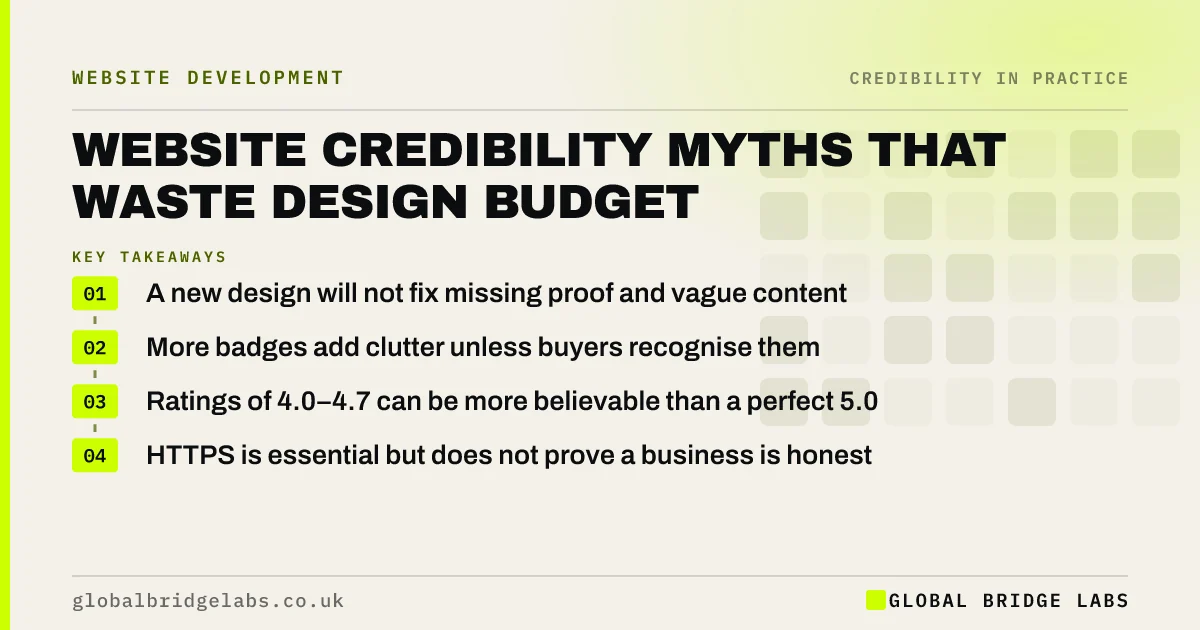
- A new design will not fix missing proof and vague content.
- More badges add clutter unless buyers recognise them.
- Ratings of 4.0–4.7 can be more believable than a perfect 5.0.
- HTTPS is essential but does not prove a business is honest.
Want to know where your credibility budget should go first? Message us on WhatsApp.
Chat on WhatsApp →Myth: a redesign will fix credibility
A redesign improves the look, which matters for first impressions. But most credibility gaps are about missing evidence: real people, proof, company details and current content. A new design with the same stock photos and vague copy still leaves buyers unsure. Fix content and proof first, then redesign if the look still holds you back.
Myth: more badges and logos mean more trust
Recognised, verifiable accreditations help. A strip of unknown badges, expired memberships or bought awards adds clutter and can look like padding. Five relevant, linked credentials beat fifteen obscure ones.
Myth: only perfect reviews build trust
Spiegel Research Center found purchase likelihood peaked for ratings between 4.0 and 4.7, falling as ratings neared 5.0, because perfect scores can seem too good to be true. A mix of reviews with thoughtful replies to criticism is more believable than a wall of five stars.
- Should you show negative reviews on your website?
- Showing Google reviews on your website, the right way
Want a credibility review that prioritises spend by impact? Message us on WhatsApp and we will discuss your requirements.
Chat on WhatsApp →Myth: HTTPS means visitors will trust you
HTTPS is essential, because without it browsers warn visitors away. But it only encrypts the connection; scam sites use it too. Google even replaced Chrome's padlock in 2023 partly because people misread it as a sign of trustworthiness. Legitimacy comes from verifiable business details and proof.
Myth: credibility is set at launch
Credibility decays. Team members leave, reviews age, blogs stall, accreditations lapse and copyright years go stale. A site that was credible at launch can look neglected within two years. Name an owner and review quarterly.
What does this look like in practice?
A pattern we see: an owner budgets for a redesign and a wall of badges, believing the site looks untrustworthy. A stranger test shows the real doubts are no named people and no prices. Fixing those costs a fraction of the budget and changes the impression more.
Myth-busting checklist
- Test with strangers before spending on design.
- Keep only recognised, verifiable badges.
- Show honest reviews with replies.
- Treat HTTPS as the minimum, not the proof.
- Review credibility quarterly.
Next step
Before your next website spend, ask three strangers what makes them doubt your business. Spend on their answers.
Message us on WhatsApp for a credibility review, or book a 30-minute consultation.
Chat on WhatsApp →Sources and further reading
- How online reviews influence sales · Spiegel Research Center, Northwestern University
- An update on the lock icon · Chromium Blog
- Stanford guidelines for web credibility · Stanford Web Credibility Project
Frequently asked questions
Does a better-looking website make a business more credible?
It helps first impressions, but credibility also depends on evidence: real people, proof, company details and current content. A better-looking site without those still leaves buyers unsure, so fix substance first.
Do trust badges always help?
Only when buyers recognise them and can verify them, and when they are placed near decisions such as forms and checkout. Unknown or unverifiable badges add little and can look like padding.
Is a perfect five-star rating best?
Not necessarily. Research by the Spiegel Research Center found purchase likelihood peaked for ratings between 4.0 and 4.7. A few critical reviews with good replies can make your rating more believable.
Written by

Global Bridge Labs (GBL) is a UK–Sri Lanka partner for social media, websites and BPO. Everything here comes from client delivery, not theory.