On this page
- 01Key takeaways
- 02Why are video testimonials more credible?
- 03When are they worth the effort?
- 04How do you film one simply?
- 05What questions should you ask?
- 06When do video testimonials backfire?
- 07What does this look like in practice?
- 08Video testimonial checklist
- 09Next step
- 10Sources and further reading
- 11Frequently asked questions
Key takeaways
Video testimonials are harder to fake than text, so a real customer on camera can carry more credibility, especially for high-value services. They are worth the effort when you have customers willing to appear and a considered purchase to support. Keep them short, unscripted and specific, and always include a text summary for people who will not press play.
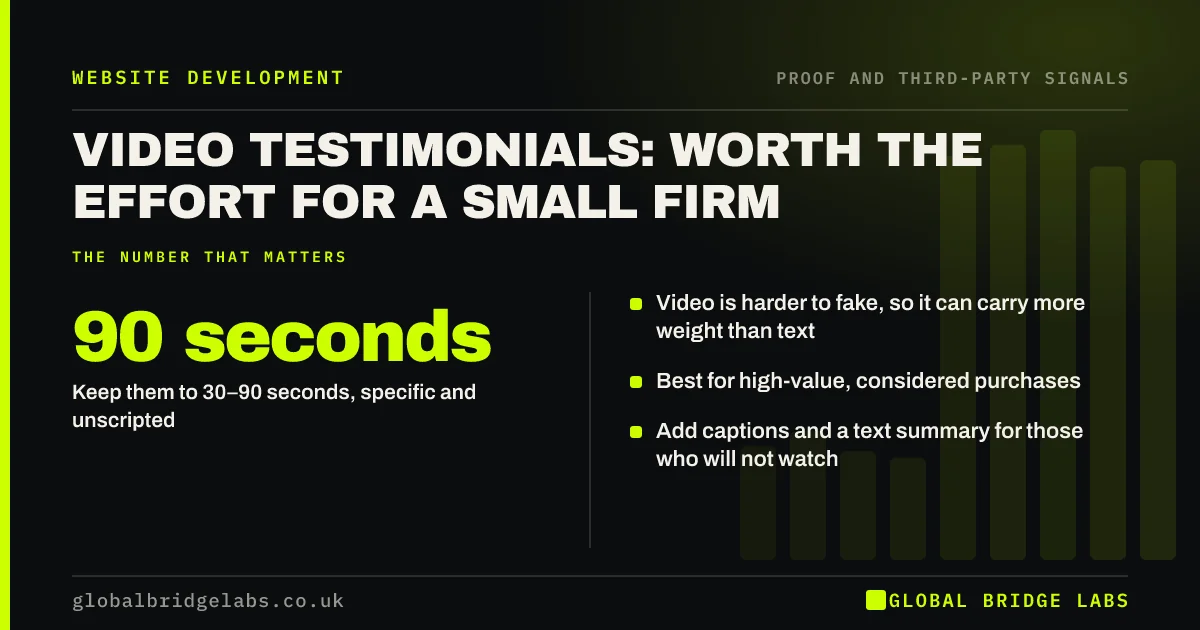
- Video is harder to fake, so it can carry more weight than text.
- Best for high-value, considered purchases.
- Keep them to 30–90 seconds, specific and unscripted.
- Add captions and a text summary for those who will not watch.
Want a simple plan for filming customer stories? Message us on WhatsApp.
Chat on WhatsApp →Why are video testimonials more credible?
Video testimonials are more credible because they show a real person, voice and setting, which is much harder to invent than a line of text. Viewers judge sincerity from tone and body language. Nielsen Norman Group notes social proof is strongest when people see others like them, and video makes the similarity visible.
When are they worth the effort?
They are worth it when the purchase is significant, when buyers worry about risk, and when you have customers who are happy to appear. Building work, professional services, healthcare and B2B services suit video. For low-cost, quick purchases, text reviews on Google are usually enough.
How do you film one simply?
A phone, good light and quiet are enough.
- Film in landscape at the customer's site, near a window.
- Use a clip-on microphone if possible.
- Ask open questions, not a script.
- Edit to 30–90 seconds with captions.
- Get written consent covering where you will use it.
Want your customer videos edited and placed on key pages? Message us on WhatsApp and we will discuss your requirements.
Chat on WhatsApp →What questions should you ask?
Ask questions that bring out the before and after: what problem they had, what worried them about choosing a supplier, what it was like working with you and what changed. Specifics such as timescales, savings or outcomes make the testimonial believable. Never put words in the customer's mouth.
When do video testimonials backfire?
They backfire when they look staged, use actors, are too long or slow the page with heavy embeds. A scripted, glossy testimonial can feel less credible than a simple, honest one. Load video only when clicked, so it does not slow the page for everyone.
What does this look like in practice?
A pattern we see: a renovation firm's text reviews are good, but buyers still worry about disruption. A 60-second video of a client in their finished kitchen, describing how the team handled dust and timings, answers that worry better than any written promise.
Video testimonial checklist
- Get written consent for each use.
- Ask open questions about before, during and after.
- Keep each video under 90 seconds.
- Add captions and a text summary.
- Load the video only when clicked.
Next step
Ask your happiest recent client if they would talk for two minutes on camera at their site.
Message us on WhatsApp for a proof and credibility review, or book a 30-minute consultation.
Chat on WhatsApp →Sources and further reading
- Social proof in the user experience · Nielsen Norman Group
- Lawful basis for processing personal data · Information Commissioner's Office
- Lazy loading video · web.dev (Google)
Frequently asked questions
Are video testimonials better than written ones?
They can be more credible because they are harder to fake and show a real person. They take more effort and some visitors will not watch, so use them alongside written reviews, with a text summary, for considered purchases.
How long should a video testimonial be?
Thirty to ninety seconds suits most websites. Focus on the customer's problem, their experience and the result. Longer case study videos can live on a separate page for buyers who want the detail.
Do I need consent to use a customer video?
Yes. Get written consent that covers where and how long you will use the video, such as your website and social media. Under UK data protection law, a recognisable person's image is personal data.
Written by

Global Bridge Labs (GBL) is a UK–Sri Lanka partner for social media, websites and BPO. Everything here comes from client delivery, not theory.