On this page
- 01Short answer
- 02What is a website trust signal?
- 03Why does trust matter more than ever?
- 04Which trust signals matter most?
- 05Where should trust signals go on the page?
- 06What are the rules on reviews in the UK?
- 07When can trust signals backfire?
- 08What does this look like in practice?
- 09Trust signal checklist
- 10Next step
- 11Sources and further reading
- 12Frequently asked questions
Short answer
Website trust signals are the details that convince a cautious visitor that your business is real, competent and safe to deal with. The ones that move UK buyers most are specific reviews, real photographs, verifiable credentials, full contact details, honest pricing and a secure, working site, each placed next to the decision it supports.
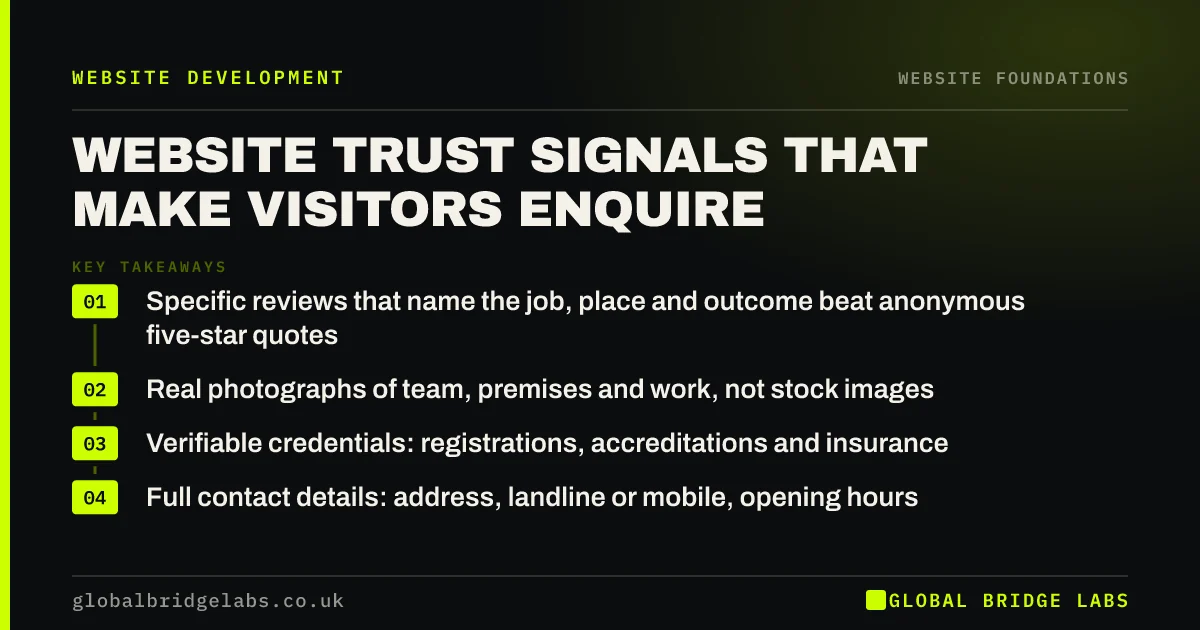
- Specific reviews that name the job, place and outcome beat anonymous five-star quotes.
- Real photographs of team, premises and work, not stock images.
- Verifiable credentials: registrations, accreditations and insurance, with numbers.
- Full contact details: address, landline or mobile, opening hours, company number.
- Place proof next to every call to action, not on a separate page.
Want to know which trust signals your site is missing? Send us the URL on WhatsApp.
Chat on WhatsApp →What is a website trust signal?
A website trust signal is any visible element of a web page that gives visitors evidence a business is legitimate, capable and accountable, such as reviews, credentials, contact details, security indicators and real photographs.
The word evidence matters. Claims such as trusted, reliable and established are not trust signals, because anyone can type them. A signal is something a buyer could check.
Why does trust matter more than ever?
Buyers are more cautious online because fraud is common and well publicised. The UK government's Cyber Security Breaches Survey 2025/2026 found that 43% of businesses reported a cyber breach or attack in the previous 12 months, with phishing the most common type. Customers see the same scams in their own inboxes.
The result is that visitors look harder for reassurance before they share details or pay a deposit. A site that looks abandoned, hides its address or cannot be matched to a real company loses those buyers quietly.
Which trust signals matter most?
In rough order of impact for UK service businesses:
- Reviews with specifics, ideally from Google or an independent platform, with a review count.
- Photographs of real work, real premises and real people.
- Credentials buyers recognise: Gas Safe, NICEIC, FCA, SRA, CQC, trade bodies.
- Full contact details and, for limited companies, the registered company information.
- Clear pricing, or at least ranges and what drives the cost.
- Guarantees and policies: what happens if something goes wrong.
- A secure site (HTTPS), no broken pages, and recent dates on content.
Where should trust signals go on the page?
Put trust signals where the visitor is deciding. A review strip directly under the homepage headline, a relevant review next to each service's call to action, accreditation logos near the quote form, and security reassurance next to payment fields.
A separate testimonials page is the least effective place for proof, because few visitors go looking for it. The proof needs to meet them at the moment of doubt.
What are the rules on reviews in the UK?
Reviews carry legal responsibility. Under the Digital Markets, Competition and Consumers Act 2024, fake reviews and concealed incentivised reviews are banned, and the Competition and Markets Authority can fine businesses directly for breaches of consumer law.
Publish genuine reviews only, do not selectively hide negative ones in a way that misleads, and disclose any incentive offered for a review. Follow the CMA's short guide for businesses publishing consumer reviews before you embed or quote them.
Want a trust signal plan for your key pages that stays inside the review rules? Message us on WhatsApp.
Chat on WhatsApp →When can trust signals backfire?
Trust signals backfire when they look manufactured. A wall of 30 logos, a perfect 5.0 rating from a handful of reviews, or badges nobody has heard of can make buyers more suspicious, not less.
Old signals also backfire. A news page last updated three years ago, a copyright year well out of date or a review dated years back all suggest the business may no longer be trading. Remove what you cannot keep current.
What does this look like in practice?
A pattern in trades and home services: 150 strong Google reviews that appear nowhere on the website, a Gas Safe registration mentioned only in the footer, and a contact page with a mobile number and no address.
Adding a review summary under the headline, a relevant review on each service page, the registration number next to the quote form and a full business address in the footer uses assets the business already has. It costs almost nothing and addresses the exact doubts that stop a homeowner from calling a stranger.
Trust signal checklist
Tick each one for your homepage and top service pages.
- Show a review summary with count near the top.
- Place a specific review next to each call to action.
- Use real photographs throughout.
- Display credentials with registration numbers.
- Publish full contact and company details.
- Give pricing ranges or cost factors.
- State what happens if something goes wrong.
- Remove out-of-date news, dates and badges.
Next step
Most businesses already have the proof they need. It is just in the wrong place. We will find it with you in 30 minutes and show you where each piece should go.
Message us on WhatsApp for a trust signal review, or book a 30-minute consultation.
Chat on WhatsApp →Sources and further reading
- Publishing consumer reviews and complying with consumer protection law · Competition and Markets Authority
- Cyber security breaches survey 2025/2026 · DSIT and Home Office
- Running a limited company: signs, stationery and promotional material · GOV.UK
Frequently asked questions
What are examples of website trust signals?
Examples include customer reviews with names and specifics, real photographs of your team and work, recognised accreditations with registration numbers, a full business address and phone number, company registration details, clear pricing, guarantees and a secure HTTPS connection. Each gives visitors evidence they could check themselves.
Do trust badges increase conversions?
Recognised badges placed near the point of decision can help, particularly accreditations buyers already know, such as Gas Safe or FCA authorisation. Unfamiliar badges or long walls of logos add little and can look manufactured. Specific reviews and real photographs usually do more work.
Can I copy Google reviews onto my website?
You can display genuine reviews, ideally through an official widget or with a link to the source, provided you do not edit them misleadingly or hide negative ones in a way that distorts the overall picture. UK consumer law, enforced by the CMA, bans fake and concealed incentivised reviews.
Does HTTPS matter for a small business website?
Yes. Browsers mark sites without HTTPS as not secure, which puts visitors off immediately, especially on pages with forms. HTTPS is usually free through your hosting provider and is a basic expectation. It protects form data in transit and removes an obvious reason for visitors to leave.
Written by

Global Bridge Labs (GBL) is a UK–Sri Lanka partner for social media, websites and BPO. Everything here comes from client delivery, not theory.