On this page
Key takeaways
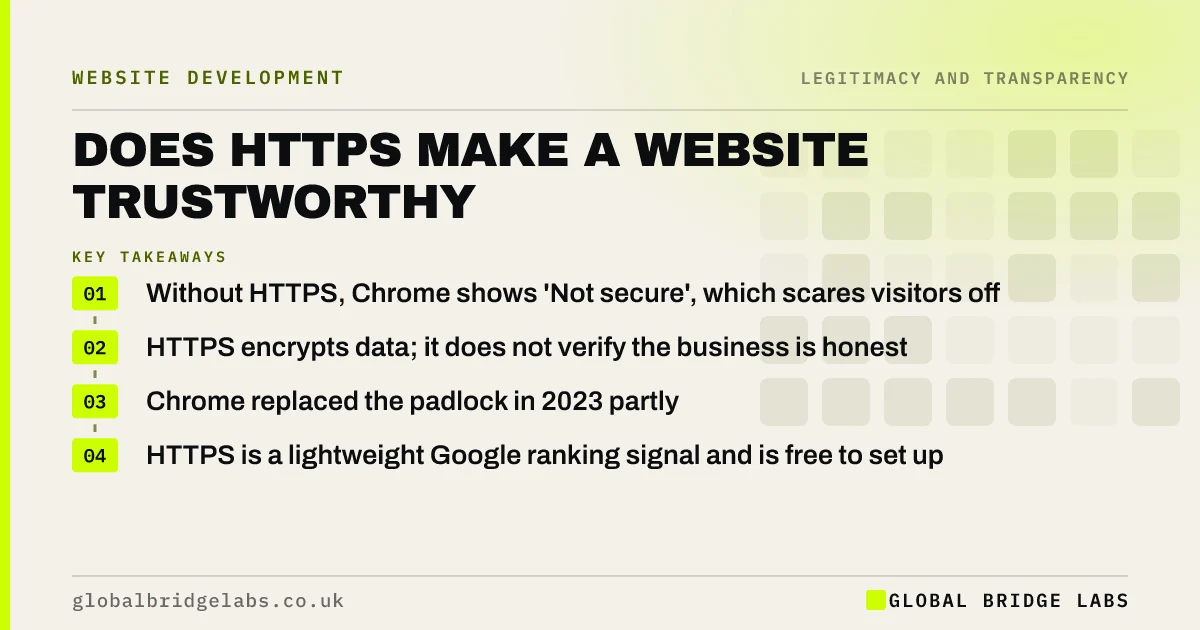
HTTPS is essential but it does not make a website trustworthy on its own. It encrypts the connection, and without it Chrome labels a site 'Not secure', which damages credibility instantly. But scam sites use HTTPS too. Treat HTTPS as the minimum, then build credibility with real business details, proof and a well-maintained site.
- Without HTTPS, Chrome shows 'Not secure', which scares visitors off.
- HTTPS encrypts data; it does not verify the business is honest.
- Chrome replaced the padlock in 2023 partly because it was misread as 'trustworthy'.
- HTTPS is a lightweight Google ranking signal and is free to set up.
Want your HTTPS and security basics checked? Message us on WhatsApp.
Chat on WhatsApp →What does HTTPS actually do?
HTTPS encrypts the connection between a visitor's browser and your website, so data such as form entries cannot easily be read or altered in transit. It also confirms the visitor is connected to the domain they typed. It does not confirm who owns the domain or whether the business is legitimate.
Why is HTTPS essential for credibility?
Since Chrome 68 in July 2018, Chrome has marked all HTTP pages 'Not secure' in the address bar, and other browsers show similar warnings. Visitors who see that label, especially on a page with a form, often leave. Google has also used HTTPS as a lightweight ranking signal since 2014. There is no good reason for a business site to lack it.
Why does HTTPS not prove trustworthiness?
Anyone can get a free certificate, including scammers, so most phishing sites now use HTTPS. Google's Chromium team replaced the padlock icon in Chrome in 2023, noting that many people wrongly believed it meant a site was trustworthy. HTTPS means the connection is private, not that the business on the other end is honest.
Want the rest of your credibility signals reviewed? Message us on WhatsApp and we will discuss your requirements.
Chat on WhatsApp →How do you set up HTTPS properly?
Most hosts make this simple.
- Install a certificate; many hosts provide free ones that renew automatically.
- Redirect every HTTP address to HTTPS.
- Fix mixed content, such as images still loading over HTTP.
- Monitor renewal so the certificate never expires.
What does this look like in practice?
A pattern we see: a site has a certificate, but the contact page loads an old form script over HTTP, so some browsers flag the page. Updating the script removes the warning from the exact page where visitors decide whether to get in touch.
HTTPS checklist
- Confirm every page loads over HTTPS.
- Redirect HTTP to HTTPS.
- Fix mixed content warnings.
- Set certificates to renew automatically.
- Add the business details HTTPS cannot prove.
Next step
Type your domain with http:// in front. If it does not redirect to https://, fix that first.
Message us on WhatsApp for a security and credibility review, or book a 30-minute consultation.
Chat on WhatsApp →Sources and further reading
- A secure web is here to stay · Chromium Blog
- An update on the lock icon · Chromium Blog
- HTTPS as a ranking signal · Google Search Central Blog
Frequently asked questions
Does HTTPS mean a website is safe?
It means the connection is encrypted, so data in transit is protected. It does not mean the business is legitimate; scam sites also use HTTPS. Check business details, reviews and company records to judge whether a site is trustworthy.
Do I need an SSL certificate for a small business website?
Yes. Without one, browsers label your site 'Not secure', which deters visitors, especially on forms. Many hosts provide free certificates that renew automatically, so cost is rarely a barrier.
Does HTTPS help SEO?
Google has used HTTPS as a lightweight ranking signal since 2014. Its bigger effect is indirect: visitors stay on a site without security warnings, and Chrome's 'Not secure' label drives people away.
Written by

Global Bridge Labs (GBL) is a UK–Sri Lanka partner for social media, websites and BPO. Everything here comes from client delivery, not theory.