On this page
Key takeaways
'As seen in' logos build trust because recognisable media names act as borrowed credibility. They only work if the coverage was genuine editorial, not a paid advertorial or a passing listing. Link each logo to the article so buyers can check, and choose outlets your buyers read, such as trade press for B2B, over generic national names.
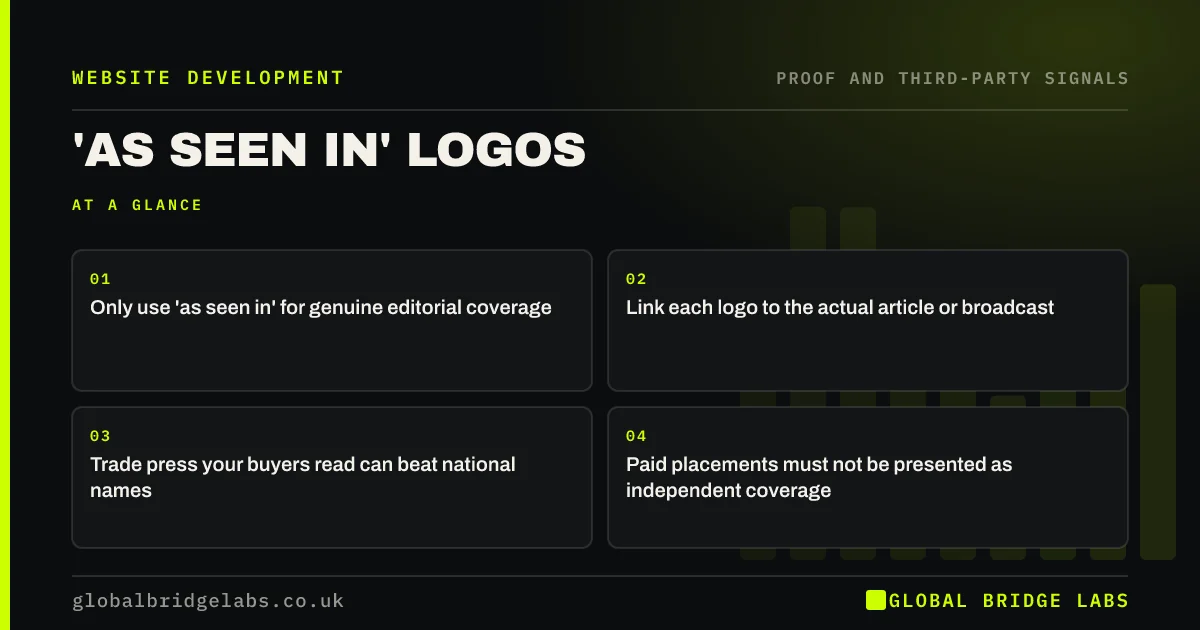
- Only use 'as seen in' for genuine editorial coverage.
- Link each logo to the actual article or broadcast.
- Trade press your buyers read can beat national names.
- Paid placements must not be presented as independent coverage.
Want your press coverage turned into checkable proof? Message us on WhatsApp.
Chat on WhatsApp →Do 'as seen in' logos build credibility?
Yes, when they are genuine and relevant. Media coverage implies a journalist found the business worth writing about, which is third-party validation. The effect comes from the outlet's own credibility. But visitors increasingly know that such strips are sometimes inflated, so linked, specific coverage is far more convincing than a row of logos alone.
What are the honesty rules?
Presenting paid content, a press release on a distribution site or a quote in a list as editorial coverage could mislead buyers, and misleading claims in marketing on your own website fall under the CAP Code. Describe the coverage accurately. If it was sponsored, either leave it off or say so.
How should you display press coverage?
Make it specific and checkable.
- Use the outlet's logo in a single, muted colour.
- Link each logo to the article or broadcast.
- Add a short quote or headline from the coverage.
- Date the coverage.
- Keep a 'Press' page listing all coverage with links.
- Where to place social proof so it lifts enquiries
- Cite your sources: back up the numbers on your website
Want a press section that buyers can verify? Message us on WhatsApp and we will discuss your requirements.
Chat on WhatsApp →When do press logos not help?
They help little when the coverage is old, irrelevant to buyers or from outlets buyers do not know. A quote in a national newspaper about an unrelated topic says less than a case study in your sector's trade magazine. If you have no meaningful coverage, use reviews and case studies instead of reaching for logos.
What does this look like in practice?
A pattern we see: a homepage shows five national newspaper logos, linked to nothing. One came from a paid supplement. Replacing the strip with two linked articles from the sector's trade press, each with a one-line quote, is smaller and more convincing.
Press mention checklist
- Keep only genuine editorial coverage.
- Link every logo to the coverage.
- Add a quote and a date.
- Prefer outlets your buyers read.
- Remove paid or misleading placements.
Next step
Click every press logo on your site. Any that do not lead to real coverage should go.
Message us on WhatsApp for a proof and credibility review, or book a 30-minute consultation.
Chat on WhatsApp →Sources and further reading
- UK Code of Non-broadcast Advertising and Direct & Promotional Marketing (CAP Code) · ASA / CAP
- Unfair commercial practices guidance (CMA207) · Competition and Markets Authority
- Social proof in the user experience · Nielsen Norman Group
Frequently asked questions
Can I use 'as seen in' if I paid for the article?
It is risky. Presenting paid content as independent coverage may mislead buyers, and marketing claims on your own website are covered by the CAP Code. If the piece was sponsored, describe it accurately or leave it off.
Do I need permission to use a newspaper's logo?
Logos are trade marks, and some publishers restrict their use. Using an outlet's name and linking to genuine coverage is generally safer than displaying its logo prominently. Check the publisher's guidance if unsure.
Where should press mentions go on a website?
One or two of the strongest, most relevant mentions can sit near the top of the homepage or about page. Keep a full, linked list on a press or news page so interested visitors can check the coverage.
Written by

Global Bridge Labs (GBL) is a UK–Sri Lanka partner for social media, websites and BPO. Everything here comes from client delivery, not theory.