On this page
- 01Key takeaways
- 02How is website credibility defined?
- 03What are the two parts of credibility?
- 04How do visitors decide whether a site is credible?
- 05Why does credibility matter for a small business?
- 06When is credibility not the issue?
- 07What does this look like in practice?
- 08Website credibility basics checklist
- 09Next step
- 10Sources and further reading
- 11Frequently asked questions
Key takeaways
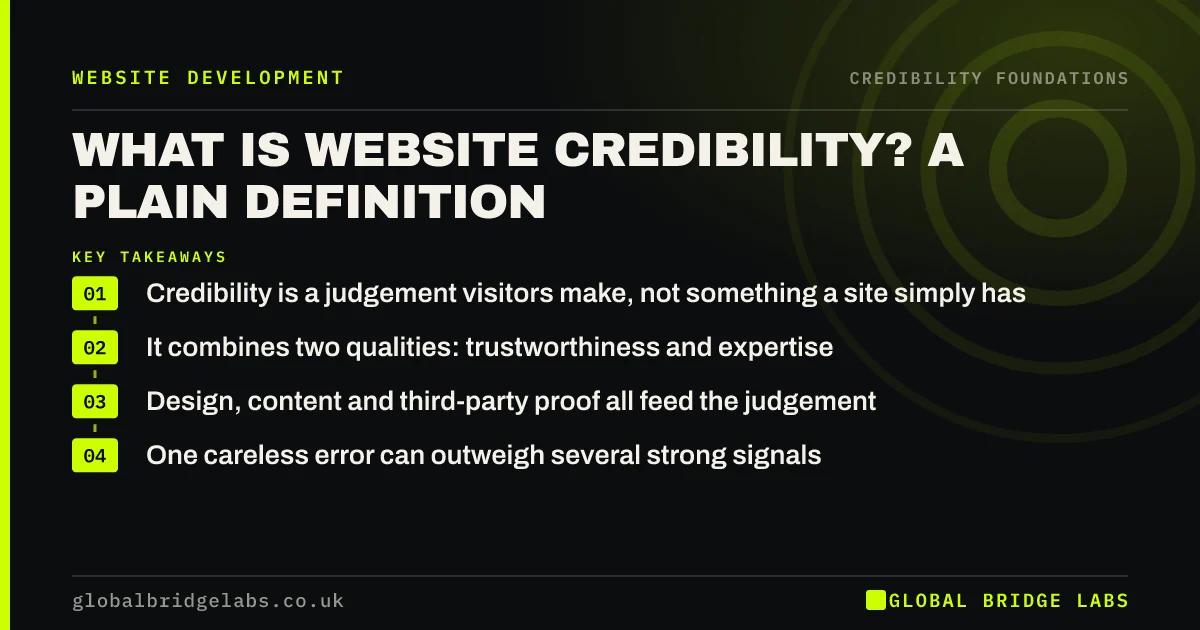
Website credibility is how believable a website is to the people who visit it. Researchers break it into two qualities: trustworthiness, meaning the business seems honest and well-intentioned, and expertise, meaning it seems to know what it is doing. Visitors judge both quickly, from design, content and proof.
- Credibility is a judgement visitors make, not something a site simply has.
- It combines two qualities: trustworthiness and expertise.
- Design, content and third-party proof all feed the judgement.
- One careless error can outweigh several strong signals.
Want to know how credible your site looks to a stranger? Message us on WhatsApp.
Chat on WhatsApp →How is website credibility defined?
Website credibility is the believability of a website and the organisation behind it, as perceived by its visitors. B.J. Fogg's research at Stanford defines credibility as a perceived quality made of two dimensions, trustworthiness and expertise. A site with honest intent but amateur execution, or expert content with a shifty tone, falls short on one of them.
What are the two parts of credibility?
Trustworthiness is whether visitors believe you are honest and acting in their interest. Expertise is whether they believe you are knowledgeable and capable. Both are needed. A friendly site with no proof of capability feels pleasant but risky; a technical site with no people or prices feels capable but guarded.
- Trustworthiness signals: real people, open prices, clear policies, honest claims.
- Expertise signals: specific detail, case studies, qualifications, accurate content.
- Both are undermined by errors, which suggest carelessness.
How do visitors decide whether a site is credible?
Visitors decide in two passes. First, a fast impression from the look of the site, formed in well under a second. Then, if the stakes are high, a slower check of the details: who runs the business, what others say, whether the content is current and whether contact is easy. Fogg's prominence-interpretation theory explains that only what visitors notice can affect their judgement.
Why does credibility matter for a small business?
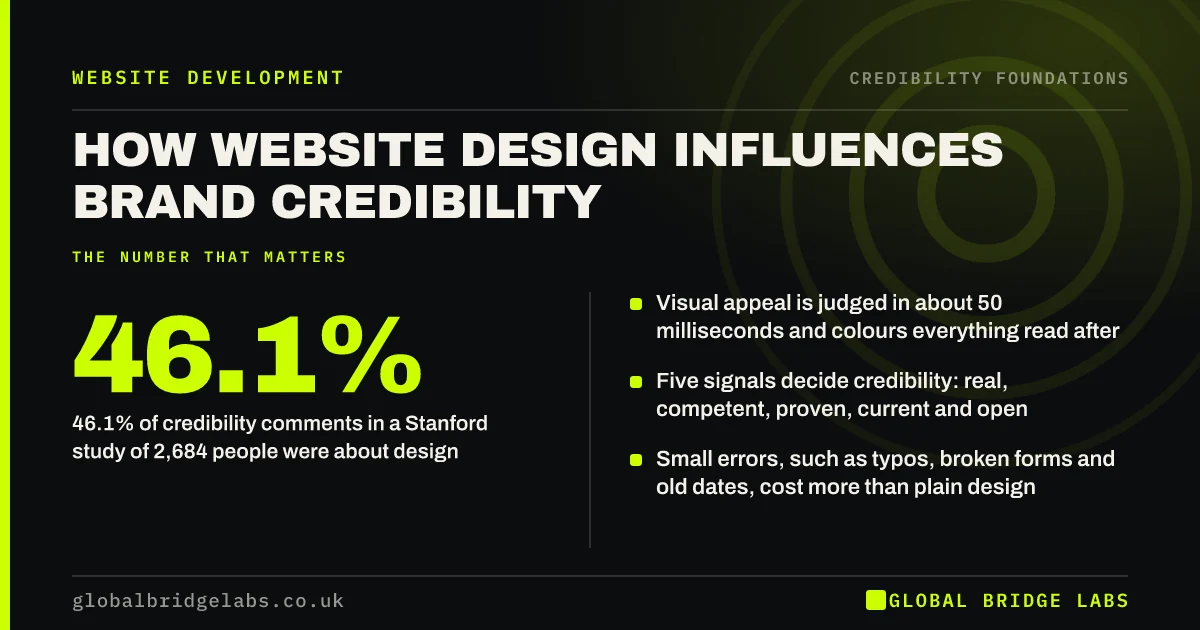
Credibility matters more for small businesses because buyers know less about them. A large brand borrows credibility from its name; a ten-person firm has to earn it on the page. In a Stanford study of 2,684 people, 46.1% of comments about credibility referred to design, so a small business with a careless site loses buyers before they read about its work.
When is credibility not the issue?
Credibility is not the issue when visitors never reach the site, or when they believe you but your offer or price does not fit. If analytics show few visitors, work on visibility. If visitors read your service pages, check your reviews and still leave, test the offer and the price before reworking how the site looks.
What does this look like in practice?
A pattern we see: a specialist firm with decades of experience has a site that reads as a start-up, with a template layout, no team names and no client examples. The expertise is real but invisible. Adding named people with qualifications, two case studies and the year the firm started gives visitors the evidence they need.
Website credibility basics checklist
- Name the people behind the business, with photos.
- Show at least one specific, verifiable result.
- Display company details and a full contact route.
- Remove anything out of date.
- Check every page for errors.
Next step
Ask someone who does not know your business whether they would trust it, and why. Their answer is your starting point.
Message us on WhatsApp for a website credibility review, or book a 30-minute consultation.
Chat on WhatsApp →Sources and further reading
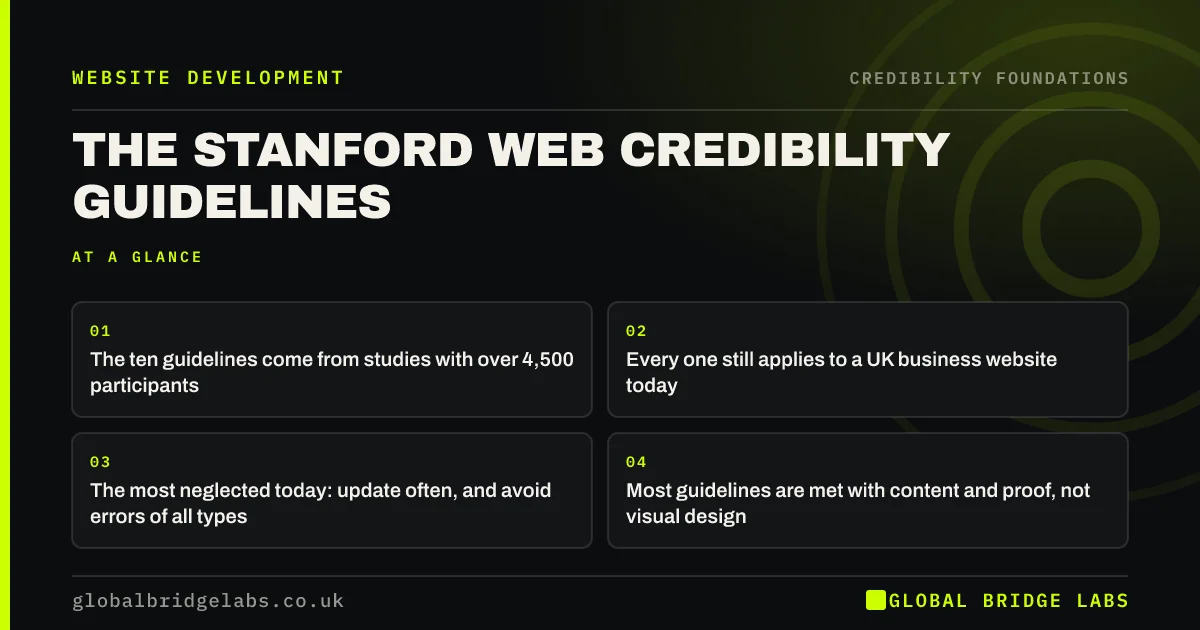
- Stanford guidelines for web credibility · Stanford Web Credibility Project
- How do users evaluate the credibility of web sites? A study with over 2,500 participants · ACM (Fogg et al., 2003)
- The elements of computer credibility · ACM (Fogg and Tseng, 1999)
Frequently asked questions
What is an example of website credibility?
A credible business site shows who runs it, with real photos and names, displays reviews with names and dates, lists company details and contact routes, and has current, accurate content. Each of those lets a visitor check the business is real and capable rather than take it on faith.
Is credibility the same as trust?
Not quite. Credibility is the visitor's belief that you are honest and competent, formed from what they see. Trust is their willingness to act on that belief, such as calling you or paying. Credibility is the input; trust is the decision it supports.
Who researched website credibility?
The best-known research comes from B.J. Fogg and the Stanford Persuasive Technology Lab, which published the Stanford guidelines for web credibility and large studies of how people judge sites. Nielsen Norman Group has also published long-running research on trustworthiness in web design.
Written by

Global Bridge Labs (GBL) is a UK–Sri Lanka partner for social media, websites and BPO. Everything here comes from client delivery, not theory.