On this page
- 01Key takeaways
- 02Does Google penalise AI-written content?
- 03Why does generic AI copy hurt credibility?
- 04How do you use AI without losing trust?
- 05Should you disclose AI use?
- 06When is AI copy fine as it is?
- 07What does this look like in practice?
- 08AI content checklist
- 09Next step
- 10Sources and further reading
- 11Frequently asked questions
Key takeaways
AI-written copy costs trust when it is generic, unchecked or inaccurate, not because AI was used. Google says it rewards helpful content however it is produced, but warns against mass-produced content made to manipulate rankings. Use AI for drafts and structure, then add your own facts, examples and voice, and check every claim.
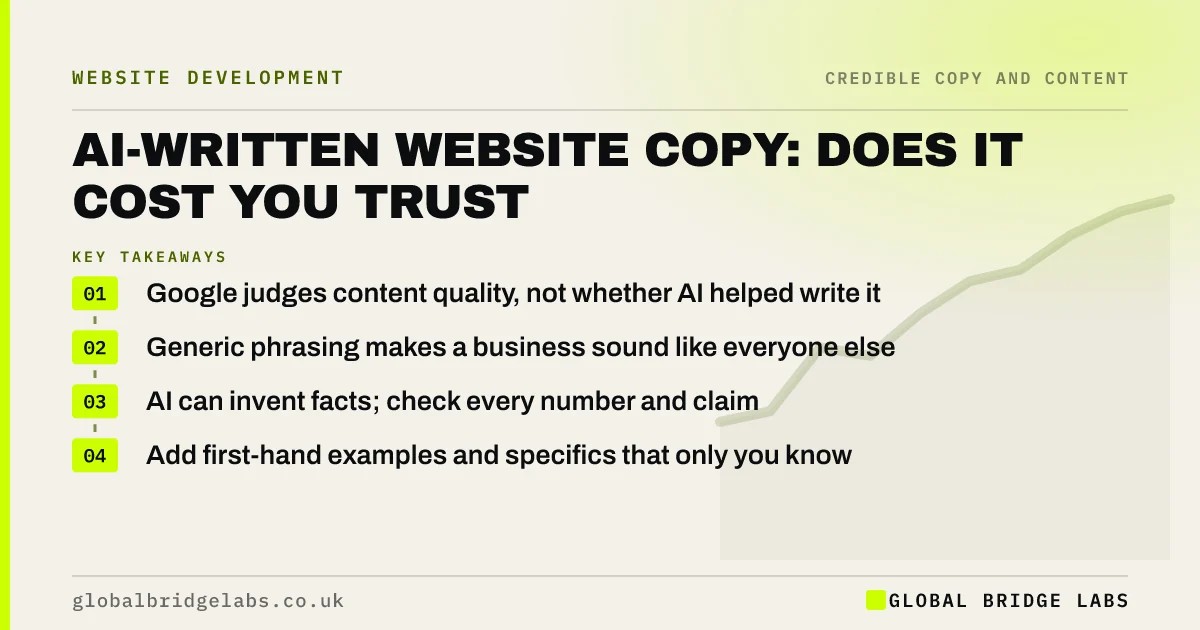
- Google judges content quality, not whether AI helped write it.
- Generic phrasing makes a business sound like everyone else.
- AI can invent facts; check every number and claim.
- Add first-hand examples and specifics that only you know.
Want your AI-drafted pages checked and made specific? Message us on WhatsApp.
Chat on WhatsApp →Does Google penalise AI-written content?
No, not for being AI-written. Google's guidance on generative AI content says it focuses on the quality of content rather than how it is produced. Using automation to generate many pages mainly to manipulate rankings is a breach of its spam policies on scaled content abuse. Helpful, accurate, original content is acceptable whatever tools were used.
Why does generic AI copy hurt credibility?
Generic AI copy hurts credibility because it says what any business could say. Phrases like 'we pride ourselves on delivering exceptional results' carry no evidence. Readers increasingly recognise the patterns. Worse, AI tools can produce confident errors, such as wrong regulations or invented statistics, which damage trust when spotted.
How do you use AI without losing trust?
Treat AI as a junior drafter, not an author.
- Give it your facts: services, areas, prices, process and real examples.
- Use it for structure and first drafts, not final copy.
- Rewrite in your voice and cut generic phrases.
- Check every fact, number and legal point against a source.
- Have a named expert review and sign off the page.
- Cite your sources: back up the numbers on your website
- Author bios on a business blog: show who wrote it
Want a review process for AI-assisted content? Message us on WhatsApp and we will discuss your requirements.
Chat on WhatsApp →Should you disclose AI use?
For ordinary marketing copy reviewed by your team, disclosure is not generally required. Be transparent where readers would reasonably expect it, such as AI-generated images that look like real people or automated advice. Never present AI-generated reviews, testimonials or people as real; that is misleading and, for reviews, unlawful.
When is AI copy fine as it is?
It is rarely fine unedited for pages that sell. It can be acceptable for low-stakes text such as alt text drafts or meta description options, once checked. For service pages, about pages and advice, the value comes from what only you know, which AI cannot supply.
What does this look like in practice?
A pattern we see: a site's service pages were generated in an afternoon and read smoothly, but every page could belong to any competitor. Adding the firm's process, areas covered, typical timescales and two real examples per page turns them into content buyers believe.
AI content checklist
- Feed AI your real facts and examples.
- Cut phrases that any business could use.
- Check every fact and number.
- Add first-hand detail before publishing.
- Have a named person review and own the page.
Next step
Read your homepage and underline every sentence a competitor could also say. Replace each with a fact about you.
Message us on WhatsApp for a copy review, or book a 30-minute consultation.
Chat on WhatsApp →Sources and further reading
- Google Search's guidance on generative AI content on your website · Google Search Central
- Creating helpful, reliable, people-first content · Google Search Central
- Digital Markets, Competition and Consumers Act 2024, Schedule 20 (banned practices, including fake reviews) · legislation.gov.uk
Frequently asked questions
Is AI-generated content bad for my website?
Not inherently. Google rewards helpful content regardless of how it is made. AI content becomes a problem when it is generic, inaccurate or mass-produced to manipulate rankings. Edit AI drafts heavily, add your own facts and check everything.
Can customers tell if copy is written by AI?
Often they can sense it, through generic phrasing, repetitive structure and claims without evidence. Even if they cannot identify AI, they notice copy that could belong to any business, which lowers credibility.
Do I have to say my content was written with AI?
There is no general requirement for marketing copy reviewed by people. Be transparent where readers would expect it, such as AI images of people or automated advice, and never present AI-generated reviews or people as real.
Written by

Global Bridge Labs (GBL) is a UK–Sri Lanka partner for social media, websites and BPO. Everything here comes from client delivery, not theory.