On this page
- 01Key takeaways
- 02What does UK law say about fake reviews?
- 03What counts as a fake or misleading review?
- 04What must businesses do?
- 05Can you still ask customers for reviews?
- 06Why do fake reviews also damage credibility?
- 07What does this look like in practice?
- 08Review compliance checklist
- 09Next step
- 10Sources and further reading
- 11Frequently asked questions
Key takeaways
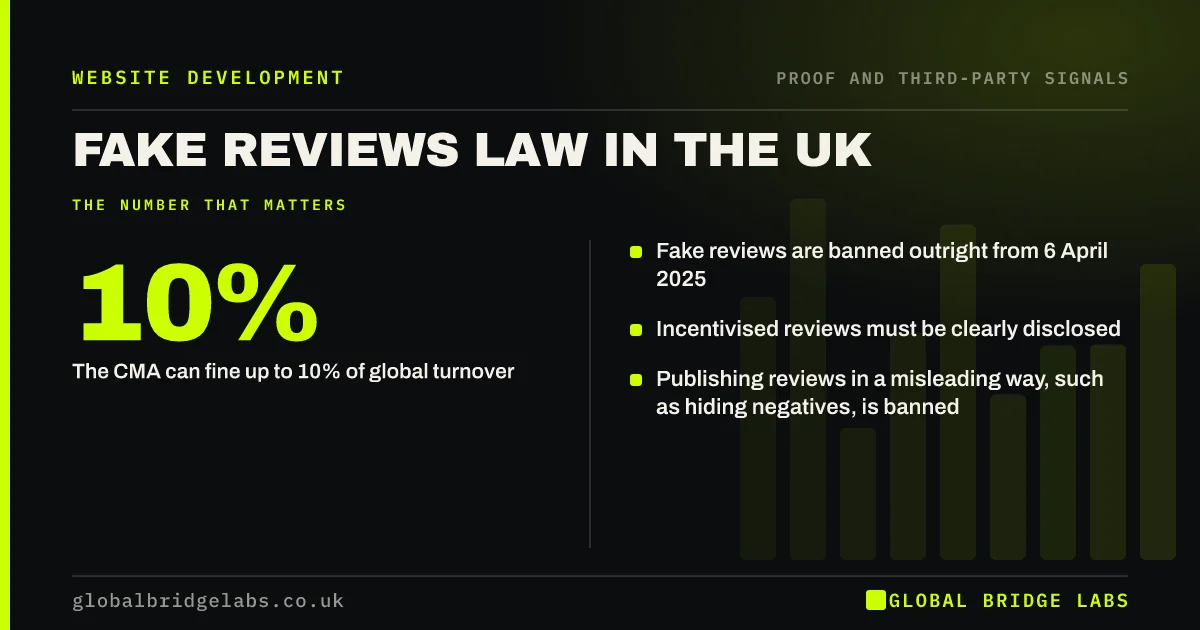
Since 6 April 2025, the Digital Markets, Competition and Consumers Act 2024 bans fake reviews and concealed incentivised reviews in the UK outright. Businesses that publish reviews must take reasonable and proportionate steps to prevent and remove fake ones. The Competition and Markets Authority (CMA) can fine businesses up to 10% of global turnover.
- Fake reviews are banned outright from 6 April 2025.
- Incentivised reviews must be clearly disclosed.
- Publishing reviews in a misleading way, such as hiding negatives, is banned.
- The CMA can fine up to 10% of global turnover.
Want your review practices checked against the new rules? Message us on WhatsApp.
Chat on WhatsApp →What does UK law say about fake reviews?
Schedule 20 of the Digital Markets, Competition and Consumers Act 2024 lists commercial practices that are banned in all circumstances. They include submitting or commissioning fake reviews, commissioning or publishing concealed incentivised reviews, and publishing consumer reviews in a misleading way. These bans took effect on 6 April 2025, with CMA guidance on what businesses must do.
What counts as a fake or misleading review?
The following are risky or banned:
- Reviews written by the owner, staff, friends or family posing as customers.
- Paying for reviews, or offering discounts for positive ones, without disclosure.
- Buying reviews from review sellers.
- Suppressing or hiding negative reviews while implying a full picture.
- Editing reviews in a way that changes their meaning.
What must businesses do?
Businesses that publish reviews, such as on their own website, must take reasonable and proportionate steps to prevent and remove fake reviews and to stop reviews being presented misleadingly. In practice: ask all customers, not just happy ones; disclose any incentive; keep records of where reviews came from; and show negative reviews alongside positive ones where you display a full set.
Want a compliant review request and display process? Message us on WhatsApp and we will discuss your requirements.
Chat on WhatsApp →Can you still ask customers for reviews?
Yes. Asking genuine customers for honest reviews is fine and encouraged. Ask everyone, at a consistent point, such as after completion. Google's policies also prohibit selectively asking only satisfied customers, sometimes called review gating. If you offer an incentive, it must be offered regardless of sentiment and clearly disclosed.
Why do fake reviews also damage credibility?
Beyond the law, fake reviews damage credibility when spotted, and buyers are increasingly good at spotting them. Clusters of short five-star reviews, similar wording and reviewers with no history are warning signs that consumer groups such as Which? teach people to look for. One exposure can undo years of genuine reputation.
What does this look like in practice?
A pattern we see: a business emails a review link only to customers who rated a survey 9 or 10. Under the new rules and Google's policy, that is a problem. Sending the same request to every customer after completion, and replying professionally to any criticism, is compliant and more credible.
Review compliance checklist
- Never write or buy reviews.
- Ask every customer the same way.
- Disclose any incentive clearly.
- Do not hide or edit negative reviews.
- Keep records of review sources.
- Train staff on the rules.
Next step
Write down exactly how your business asks for reviews today. If anyone is excluded, change the process this week.
Message us on WhatsApp for a review practice review, or book a 30-minute consultation.
Chat on WhatsApp →Sources and further reading
- Digital Markets, Competition and Consumers Act 2024, Schedule 20 (banned practices, including fake reviews) · legislation.gov.uk
- Publishing consumer reviews and complying with consumer protection law · Competition and Markets Authority
- How to spot a fake review · Which?
Frequently asked questions
Are fake reviews illegal in the UK?
Yes. Since 6 April 2025, the Digital Markets, Competition and Consumers Act 2024 bans submitting, commissioning or publishing fake reviews, concealed incentivised reviews and misleadingly presented reviews. The CMA can fine businesses up to 10% of global turnover.
Can I offer a discount for a review?
Only if the incentive is offered regardless of whether the review is positive or negative, and the review clearly discloses it. Offering rewards only for positive reviews, or hiding the incentive, is banned under UK law and against platform policies.
Can I remove negative reviews from my website?
You can moderate genuinely abusive or fake content, but suppressing honest negative reviews to make your rating look better is a misleading practice. If you display reviews, present them fairly and reply professionally to criticism.
Written by

Global Bridge Labs (GBL) is a UK–Sri Lanka partner for social media, websites and BPO. Everything here comes from client delivery, not theory.