On this page
- 01Key takeaways
- 02Are businesses liable for what their chatbot says?
- 03How do wrong answers damage credibility?
- 04How do you reduce the risk?
- 05When is a person better than a bot?
- 06What does this look like in practice?
- 07Chatbot risk checklist
- 08Next step
- 09Sources and further reading
- 10Frequently asked questions
Key takeaways
If a chatbot on your website gives customers wrong information, they will hold your business responsible, and a tribunal may too. In Moffatt v Air Canada (2024), a Canadian tribunal held the airline liable for its chatbot's incorrect advice on fares. Limit what a chatbot can answer, ground it in your own content and offer a human route.
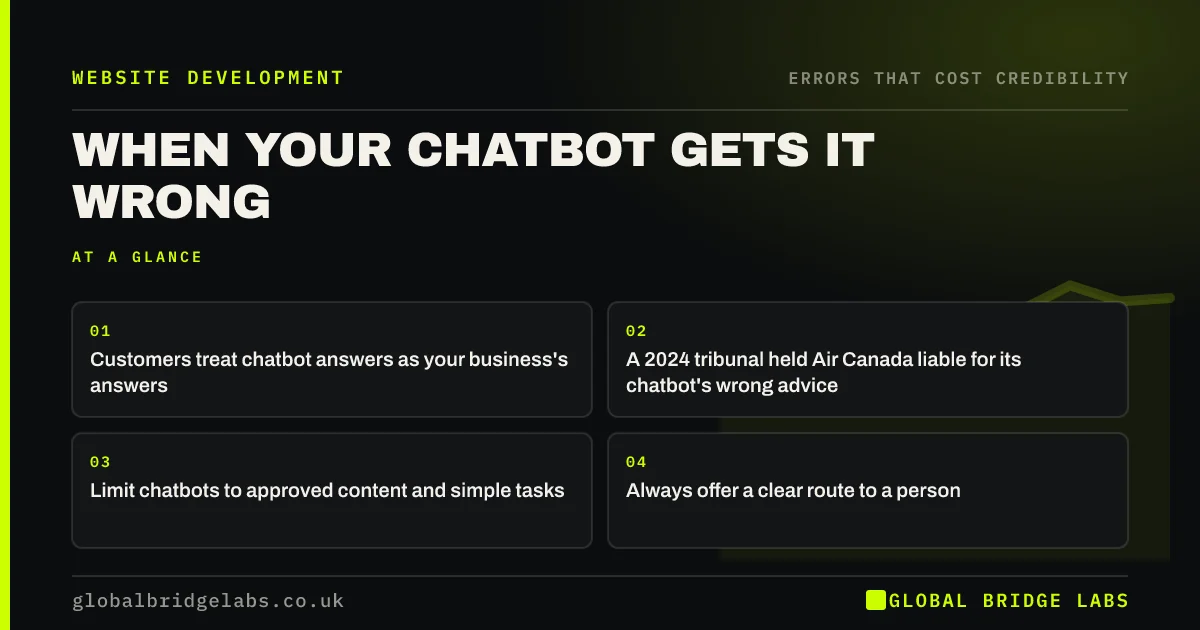
- Customers treat chatbot answers as your business's answers.
- A 2024 tribunal held Air Canada liable for its chatbot's wrong advice.
- Limit chatbots to approved content and simple tasks.
- Always offer a clear route to a person.
Want your website chatbot reviewed for risk? Message us on WhatsApp.
Chat on WhatsApp →Are businesses liable for what their chatbot says?
In the Moffatt v Air Canada decision, British Columbia's Civil Resolution Tribunal rejected the airline's argument that its chatbot was responsible for its own actions, and ordered it to compensate a customer misled about bereavement fares. It is a Canadian case, not UK law, but UK consumer law also prohibits misleading information, wherever it comes from on your site.
How do wrong answers damage credibility?
A chatbot that invents a price, a policy or an opening time creates a broken promise in your name. Customers who act on it and are let down feel misled, and they tell others. Because the bot speaks with confidence, its errors look like the business's errors, not a technical glitch.
How do you reduce the risk?
Use chatbots for what they do well, and fence off the rest.
- Ground answers in your own approved pages and documents.
- Block answers on prices, legal terms or guarantees unless quoted directly.
- Show sources or links with each answer.
- Hand over to a person for anything complex or disputed.
- Review conversation logs weekly for wrong answers.
Want a safer setup for your chatbot or live chat? Message us on WhatsApp and we will discuss your requirements.
Chat on WhatsApp →When is a person better than a bot?
For high-value, regulated or emotional enquiries, a person is better: legal, financial, health and complaints. Many small businesses get more credibility from a fast human reply via WhatsApp or phone in business hours than from a bot available all night that sometimes gets it wrong.
What does this look like in practice?
A pattern we see: a chatbot trained loosely on a website tells a visitor a service is available in an area the business does not cover. The visitor books, then is cancelled and leaves an angry review. Limiting the bot to approved answers and routing area questions to staff prevents a repeat.
Chatbot risk checklist
- Ground the bot in approved content only.
- Block unsupported answers on prices and terms.
- Show links with answers.
- Offer a human handover.
- Review logs weekly.
Next step
Ask your chatbot five questions a customer might ask about prices and policies. Note every wrong or invented answer.
Message us on WhatsApp for a chatbot and enquiry handling review, or book a 30-minute consultation.
Chat on WhatsApp →Sources and further reading
- Moffatt v. Air Canada, 2024 BCCRT 149 · Civil Resolution Tribunal of British Columbia
- Unfair commercial practices guidance (CMA207) · Competition and Markets Authority
- Google Search's guidance on generative AI content on your website · Google Search Central
Frequently asked questions
Can a business be held responsible for its chatbot?
In Moffatt v Air Canada (2024), a Canadian tribunal held the airline responsible for its chatbot's incorrect information. UK cases may differ, but UK consumer law prohibits misleading information, and customers will hold you responsible either way.
Should a small business use an AI chatbot?
It can help with simple, well-defined questions if it is grounded in your own content and hands over to a person when needed. For many small businesses, a fast human reply via WhatsApp or phone builds more trust.
How do I stop my chatbot giving wrong answers?
Restrict it to approved content, block answers it cannot support with a source, test it regularly with real customer questions and review conversation logs. Provide an easy route to a person for anything complex.
Written by

Global Bridge Labs (GBL) is a UK–Sri Lanka partner for social media, websites and BPO. Everything here comes from client delivery, not theory.