On this page
- 01Short answer
- 02What is an About page for?
- 03Why do most About pages fail?
- 04What should an About page include?
- 05How do you write the story part without clichés?
- 06Why do real people matter for search and AI too?
- 07When should team photos stay off the site?
- 08What does this look like in practice?
- 09About page checklist
- 10Next step
- 11Sources and further reading
- 12Frequently asked questions
Short answer
An effective About page for a small business answers one question: why should I trust these people with my money? It does that with real photographs of the team, a short specific story, verifiable credentials, how you work, and a clear route to enquire. It is about the customer's confidence, not the company's history.
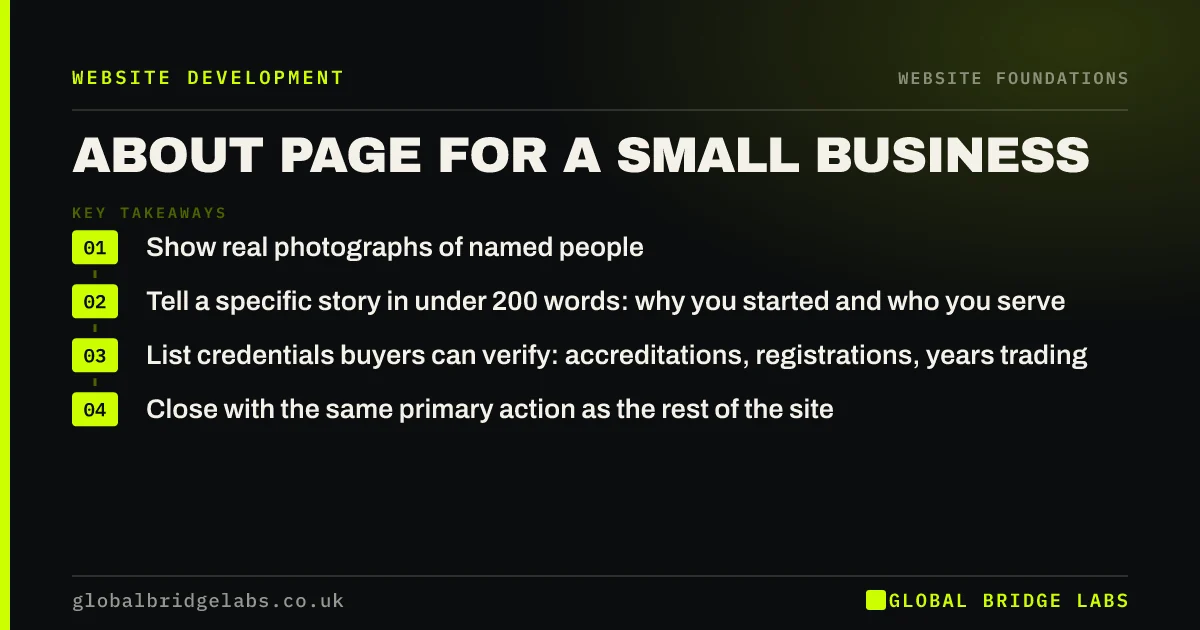
- Show real photographs of named people. Stock photos undermine trust immediately.
- Tell a specific story in under 200 words: why you started and who you serve.
- List credentials buyers can verify: accreditations, registrations, years trading.
- Close with the same primary action as the rest of the site.
Want your About page reviewed for trust signals? Send us the link on WhatsApp.
Chat on WhatsApp →What is an About page for?
An About page is a web page that explains who runs a business, why it exists and how it works, so that a potential customer can judge whether the people behind it are credible and a good fit.
It is often one of the most visited pages on a small business site, because buyers check it just before they enquire. That makes it a conversion page, not a formality, and it deserves the same attention as a service page.
Why do most About pages fail?
Most About pages fail because they talk about the company in abstract terms. Mission statements, values lists and phrases such as customer-focused and passionate appear on almost every competitor's site, so they tell a buyer nothing.
The second failure is anonymity. A page with no names, no faces and no location reads like a business that does not want to be found, which is the opposite of what a buyer needs to see before handing over a deposit.
- Generic values that any company could claim.
- Stock photographs of people who do not work there.
- A long founding history with no link to what the customer gets.
- No call to action, so the most engaged visitors hit a dead end.
What should an About page include?
Include the elements a cautious buyer would look for if they were checking you out, in this order.
- A headline that says who you help and how, not About us.
- A short story: why the business started and what it does differently.
- Named team members with real photographs and roles.
- Credentials: accreditations, trade body memberships, regulated status, insurance.
- Where you work and which areas you serve.
- Proof: two or three reviews or client names.
- How you work: your process or commitments, such as response times.
- A primary call to action.
How do you write the story part without clichés?
Write the story as facts, not feelings. Instead of "we are passionate about great service", say "we started in 2014 after watching customers wait three weeks for a callback, so we answer every enquiry the same working day". The second version is specific, checkable and explains a benefit.
Keep it under 200 words and make the customer the point of it. The GOV.UK content design guidance is a useful model here: short sentences, plain words and the most important information first.
Why do real people matter for search and AI too?
Google's guidance on helpful content asks whether it is clear who created content and what their experience is. Named people with roles and credentials on your About and team pages support that, and they give AI assistants consistent facts to cite when describing your business.
Keep those facts identical everywhere: the business name, founders' names and roles, address and services should match across your website, Google Business Profile, LinkedIn and directories. Inconsistency lowers confidence for people and for machines.
Want an About page structure built around your team and credentials? Message us on WhatsApp.
Chat on WhatsApp →When should team photos stay off the site?
Some staff will not want their photograph online, and that is their right. Ask for consent and respect a refusal. You can still show the business is real through photographs of premises, vehicles and work, and through named leaders who are comfortable being public.
Avoid replacing missing photos with stock images of strangers. Visitors recognise them, and it undermines the credibility of everything else on the page.
What does this look like in practice?
A pattern in healthcare and professional services: an About page that is a single paragraph of values and a stock photograph of a handshake, while the practitioners' qualifications and registrations are not mentioned anywhere on the site.
Rebuilding it around named practitioners, their qualifications and registration numbers, real photographs of the premises and a short account of why the practice was set up gives buyers the exact reassurance they were looking for. It also gives the page something to rank for when people search the practitioners' names.
About page checklist
Check each item before publishing.
- Replace About us as the headline with who you help and how.
- Keep the story under 200 words and make it specific.
- Name the team with real photographs and roles.
- List verifiable credentials and registrations.
- State the areas you serve.
- Include two or three specific reviews.
- End with the primary call to action.
Next step
If your About page is a paragraph of values and a stock photo, it is costing you trust at the moment buyers are closest to enquiring. We will outline a better one with you in 30 minutes.
Message us on WhatsApp for an About page outline, or book a 30-minute consultation.
Chat on WhatsApp →Sources and further reading
- Creating helpful, reliable, people-first content · Google Search Central
- Writing to GOV.UK standards: writing guidelines · GOV.UK
- Google Business Profile Help · Google
Frequently asked questions
What should I write on my About us page?
Write who you help and how, a short specific story about why the business exists, the names and roles of the people behind it, credentials buyers can verify, the areas you serve and a few reviews. Finish with a clear call to action so interested visitors can enquire straight away.
How long should an About page be?
Around 300 to 600 words is enough for most small businesses, with the story itself kept under 200. The rest of the page should be scannable facts: team, credentials, areas served and proof. Visitors check this page quickly before enquiring, so make the reassurance easy to find.
Should I include team photos on my website?
Yes, where staff consent. Real photographs of named people are one of the strongest trust signals a small business can show, and stock photos of strangers weaken trust. If some staff prefer not to appear, show premises, vans and real work instead, alongside the leaders who are happy to be public.
Does an About page help SEO?
Indirectly, yes. It helps search engines and AI assistants understand who runs the business and what experience they have, which supports trust signals in Google's helpful content guidance. It can also rank for searches of your business and team names, which buyers often make before enquiring.
Written by

Global Bridge Labs (GBL) is a UK–Sri Lanka partner for social media, websites and BPO. Everything here comes from client delivery, not theory.