On this page
Key takeaways
When a domain name expires, your website and email can stop working, and after a grace period the domain may be released for anyone to buy. It usually happens because renewal emails go to an old address or a payment card lapses. Register the domain in the business's name, turn on auto-renew, keep contact details current and renew for several years.
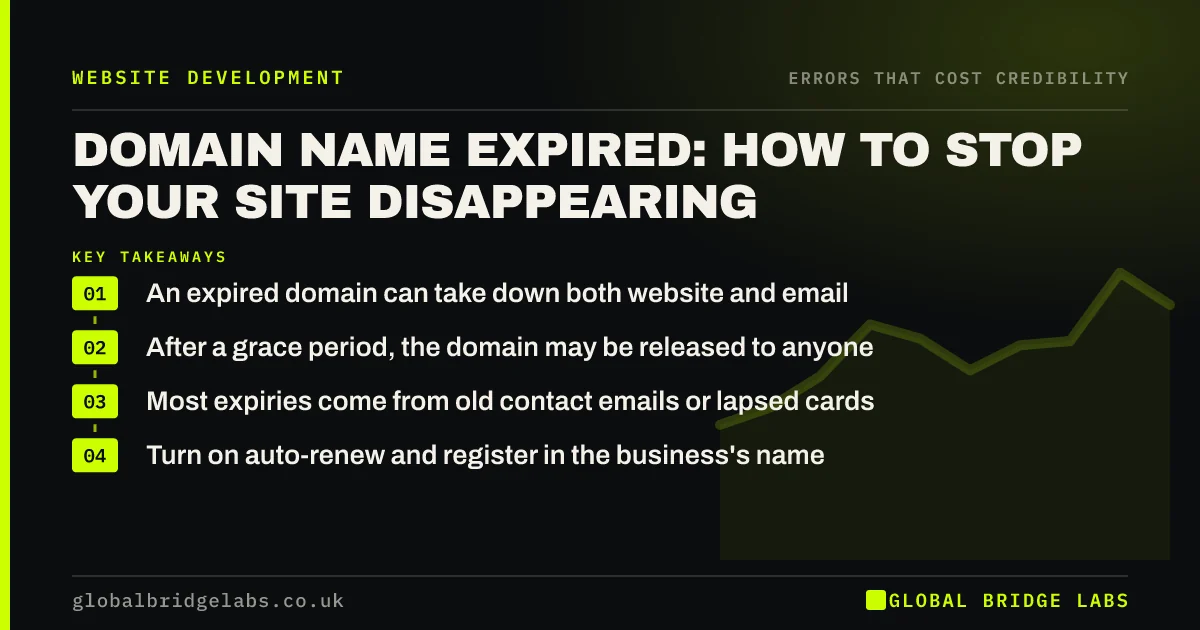
- An expired domain can take down both website and email.
- After a grace period, the domain may be released to anyone.
- Most expiries come from old contact emails or lapsed cards.
- Turn on auto-renew and register in the business's name.
Want your domains checked for ownership and renewal? Message us on WhatsApp.
Chat on WhatsApp →What happens when a domain expires?
When a domain expires, the registrar usually stops it pointing to your website and email, so visitors see an error or a parking page and emails bounce. There is normally a grace period to renew, sometimes with a fee. If it is not renewed, the domain can be released, and anyone, including a competitor or a squatter, can register it.
Why do business domains expire?
The common causes are administrative, not deliberate.
- Renewal emails go to a former employee or old agency.
- The card on the registrar account has expired.
- The domain is registered in a web designer's account.
- Nobody knows which registrar holds the domain.
- Auto-renew was never turned on.
How do you prevent it?
Register domains in the business's name, in an account the business controls. Turn on auto-renew and use a company card with a long expiry. Set renewal contacts to a shared role address, such as admin@, not a person. Renew for several years at a time and record the expiry dates in your calendar.
- Professional email address vs Gmail: what buyers think
- .co.uk vs .com: which domain do UK customers trust?
Want your domains moved into your control and set to auto-renew? Message us on WhatsApp and we will discuss your requirements.
Chat on WhatsApp →What if it has already expired?
Act immediately. Log in to the registrar and renew within the grace period; if you cannot access the account, contact the registrar with proof of ownership. If the domain has been released and bought by someone else, recovery is difficult and may need legal advice. Prevention is far cheaper.
What does this look like in practice?
A pattern we see: a firm's domain was registered by a web designer who has since moved on, and renewal emails go to their old address. The site and email go down on a Monday morning. Transferring the domain into the firm's own account with auto-renew prevents it ever happening again.
Domain protection checklist
- Find which registrar holds each domain.
- Move domains into the business's own account.
- Turn on auto-renew with a valid company card.
- Use a shared role address for renewal notices.
- Renew for several years and diary the dates.
Next step
Look up who your domain is registered to and when it expires. If you do not know, find out today.
Message us on WhatsApp for a domain and website ownership check, or book a 30-minute consultation.
Chat on WhatsApp →Sources and further reading
- Small Business Guide: cyber security · National Cyber Security Centre
- Site moves with URL changes · Google Search Central
- Uptime and availability: keeping your service online · GOV.UK Service Manual
Frequently asked questions
What happens if my domain name expires?
Your website and email usually stop working. You normally have a grace period to renew, sometimes with an extra fee. If it is not renewed in time, the domain can be released and registered by anyone else.
Can I get my expired domain back?
Usually, if you act within the grace period by renewing through your registrar. Once it has been released and registered by someone else, recovery is difficult and may require negotiation or legal action.
Who should own my business domain?
The business should, in an account it controls, with the business named as registrant. Domains held in a designer's or employee's account can be lost when relationships end. Ask for a transfer if yours is held elsewhere.
Written by

Global Bridge Labs (GBL) is a UK–Sri Lanka partner for social media, websites and BPO. Everything here comes from client delivery, not theory.