On this page
- 01Key takeaways
- 02What does more time to focus on growth actually mean?
- 03Why do internal teams run out of time for growth?
- 04How does outsourcing give your internal team more time?
- 05Which work should move out to free growth time?
- 06What should your team do with the freed time?
- 07How much time can outsourcing free, and what does it cost?
- 08Why does freed time often disappear?
- 09When will outsourcing not give your team more time for growth?
- 10What does this look like in practice?
- 11Growth time checklist
- 12Guides on growth time foundations
- 13Guides on growth work for freed hours
- 14Guides on protecting growth time
- 15Guides on people and growth roles
- 16Guides on growth time by function
- 17Guides on measuring growth time
- 18Guides on moving work while keeping focus
- 19Guides on growth moments and capacity
- 20Guides on growth time by sector
- 21Guides on growth time in practice
- 22Next step
- 23Sources and further reading
- 24Frequently asked questions
Key takeaways
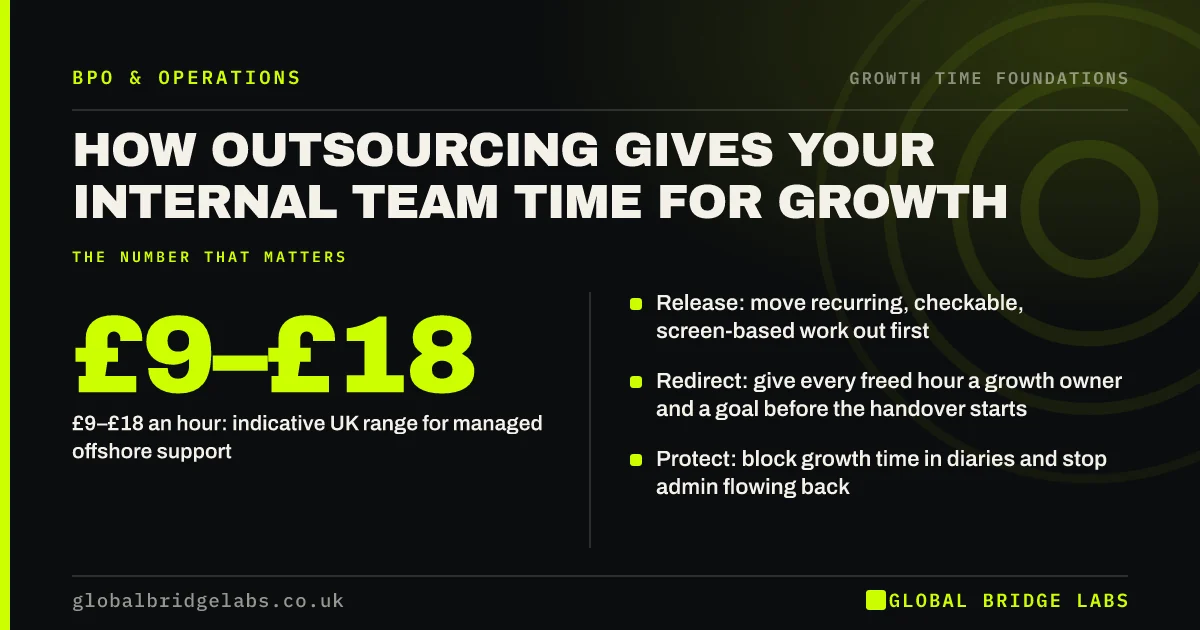
Outsourcing gives your internal team more time to focus on growth only when three things happen in order: routine work is released to a managed team, the freed hours are redirected to named growth goals, and those hours are protected from new admin. Skip the second or third step and the time quietly disappears into busier days.
- Release: move recurring, checkable, screen-based work out first.
- Redirect: give every freed hour a growth owner and a goal before the handover starts.
- Protect: block growth time in diaries and stop admin flowing back.
- £9–£18 an hour: indicative UK range for managed offshore support.
- Judge success by growth outcomes, not by how busy people look.
Want to see how many growth hours your team could get back? Message us on WhatsApp.
Chat on WhatsApp →What does more time to focus on growth actually mean?
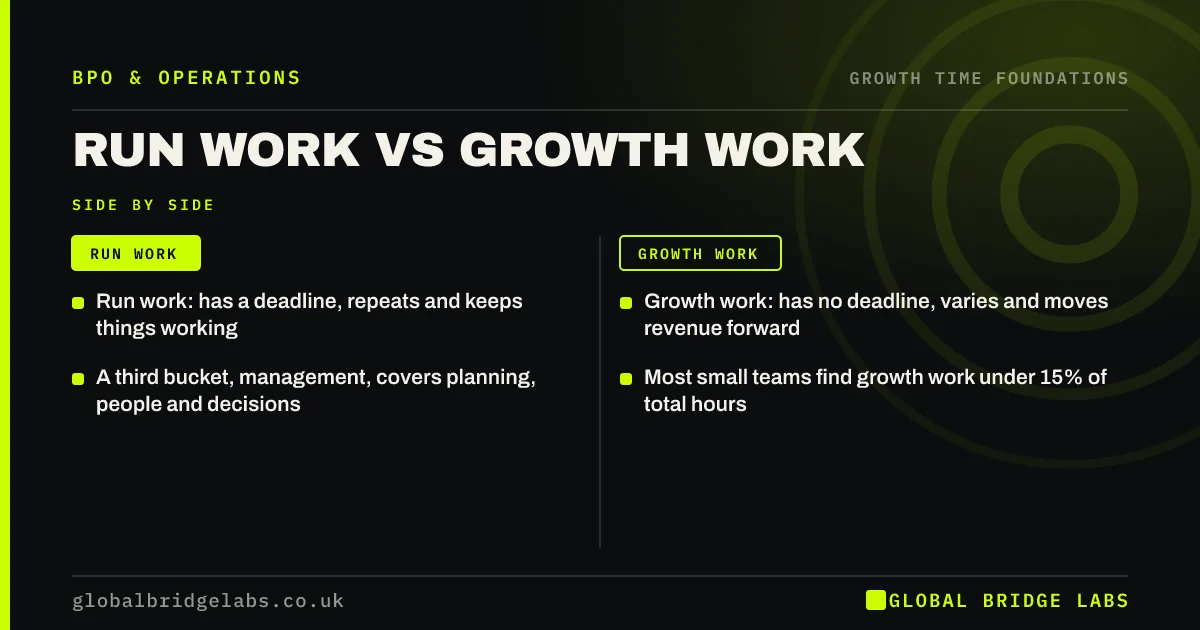
Growth time is the share of your team's paid hours spent on work that wins, keeps or expands revenue: selling, account development, new services, partnerships, pricing and customer research. Run work keeps today's business going. Outsourcing gives your internal team more time to focus on growth by moving run work out, so the same people can spend more of the week on growth work.
The distinction matters because most small teams are not short of effort. They are short of uninterrupted hours for the work that moves the business forward. A sales lead who spends Monday updating the CRM, Tuesday chasing paperwork and Wednesday building a report has done a full week, and none of it found a new customer.
This guide is about the internal team as a whole: what moves out, where the hours go and how to keep them. Deciding what is core to your business is covered in outsourcing to focus on your core business, and an owner's own freed hours are covered in how to spend time freed by outsourcing.
Why do internal teams run out of time for growth?
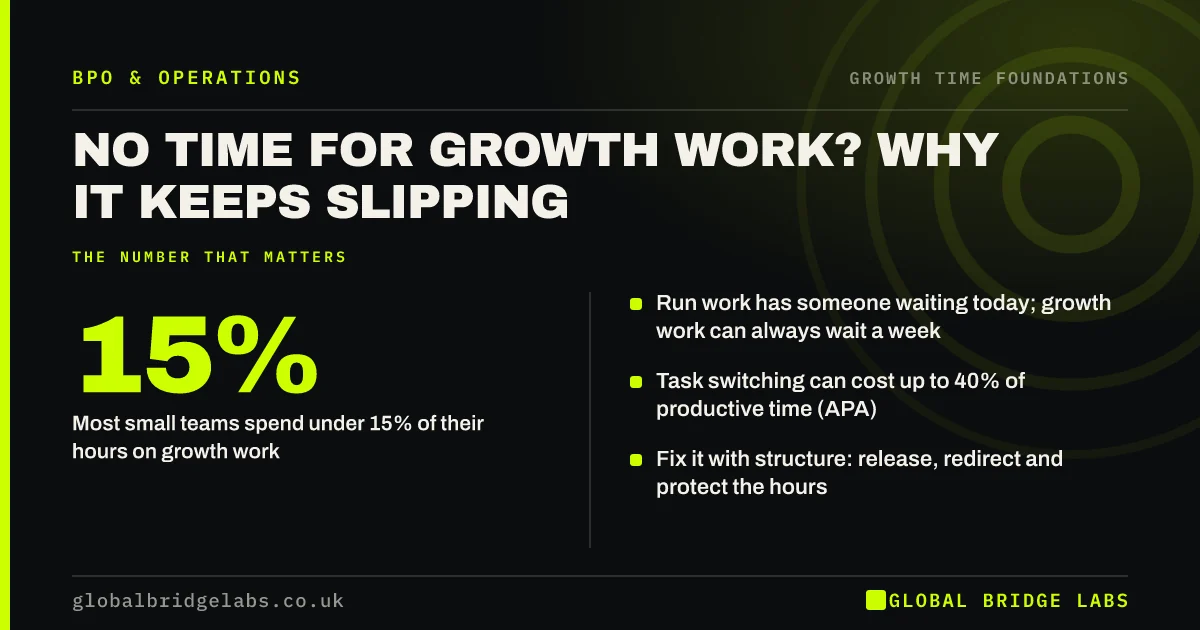
Internal teams run out of time for growth because run work always arrives with a deadline and growth work almost never does. An invoice query, a booking change or a weekly report has someone waiting for it today. A partnership conversation or a pricing review can always wait until next week, so it does, for months.
Three forces make it worse as a business grows. Volume rises faster than headcount, so routine work expands into the hours that were left. Skilled people pick up admin because it is quicker than explaining it. And constant switching between small tasks erodes focus: the American Psychological Association notes that task switching can cost as much as 40% of productive time.
The cost is real money. A UK employee on £30,000 costs about £19.81 per worked hour once employer National Insurance, pension and holiday are counted. If five people each spend a day a week on routine admin, that is roughly £40,000 a year of paid time that is not going on growth, before you count the opportunities nobody had time to chase.
How does outsourcing give your internal team more time?
Use the Global Bridge Labs (GBL) growth time model: Release, Redirect, Protect. Release moves recurring routine work to a managed outside team. Redirect assigns the freed hours to named growth goals and owners before the handover. Protect blocks those hours in diaries and stops new admin from refilling them. All three are needed; release alone just creates slack.
Most firms only do the first step. They outsource order processing or inbox management, the work moves, and six weeks later the team is just as busy as before. Nobody decided what the hours were for, so meetings, perfectionism and new small requests filled them.
- Release: hand over recurring, rule-based, screen-based work with an output you can check.
- Redirect: write down which growth goal each freed hour belongs to and who owns it.
- Protect: put growth blocks in diaries, track where hours go and push new admin to the outside team.
Which work should move out to free growth time?
Move out the work that is recurring, rule-based, done on a screen and easy to check, and that currently sits with people who could be doing growth work. Typical candidates are order and invoice processing, inbox triage, data updates, scheduling, report building, first-line customer queries and document preparation. Keep decisions, client relationships and anything that needs your judgement.
Prioritise by whose hours are released, not only by how many. Ten hours a week taken off a sales lead or an account manager is worth far more growth time than ten hours taken off someone whose role is already admin. The best first handover often comes from the most commercially valuable person's week.
If you have not yet listed the candidate tasks, start with how to identify tasks suitable for outsourcing, then come back to this guide to plan where the hours go.
What should your team do with the freed time?
Your team should spend freed time on a short list of growth work that has an owner, a goal and a deadline. The most reliable options for UK SMEs are developing existing accounts, following up leads properly, building referral and strategic partnerships, reviewing prices, developing a new service and talking to customers about what they would buy next.
Pick two or three, not ten. A team that gains 25 hours a week and spreads them across ten initiatives finishes none of them. A team that puts 15 hours into account growth and 10 into one new service usually sees results within a quarter.
- Account growth: reviews with your top 20 customers, cross-sell and renewal planning.
- New business: faster lead follow-up and better proposals rather than more of them.
- New services or products: scoping, piloting and pricing one addition.
- Partnerships: two or three referral or strategic partners worked properly.
- Customer research: ten customer conversations a quarter about what they need next.
How much time can outsourcing free, and what does it cost?
In a team of 10 to 30 people, the first well-chosen handover typically frees 20 to 40 hours a week. Indicative UK market ranges for managed offshore support are about £9 to £18 an hour, against £20 to £35 for comparable onshore support. GBL does not publish prices; these are market figures to help you size the decision.
An illustrative example: five people each spend about 6 hours a week on routine work, 30 hours in total. Moving it out at £9 to £18 an hour costs roughly £14,000 to £28,000 a year. Allow 3 hours a week of internal management, and the team gains about 27 hours a week of growth time.
The honest point is that the people stay employed, so outsourcing here is an added cost that buys growth capacity. It pays only if those 27 hours produce more than the outsourcing costs, for example a few retained accounts, one extra contract or a new service line. That is why the Redirect step is not optional.
- 20 to 40 hours a week: typical first release in a 10 to 30 person team.
- £9 to £18 an hour: indicative UK market range for managed offshore support.
- 3 to 4 hours a week: management time in month one, 1 to 2 by month three (GBL rule of thumb).
- £19.81: cost per worked hour of a UK employee on £30,000.
- BPO cost UK: what SMEs actually pay per hour
- Turning freed hours into revenue: worked examples
- Outsourcing for growth time or for cost saving?
Want your growth hours and costs sized against real market ranges? Message us on WhatsApp.
Chat on WhatsApp →Why does freed time often disappear?
Freed time disappears because work expands to fill the hours available unless something else claims them first. Without a named goal, freed hours go to longer meetings, polishing work that was already good enough, and small requests that used to be refused because everyone was busy. Within two months the team feels as stretched as before.
The fix is to claim the hours before the handover completes. Put growth blocks in diaries from week one, give each block an owner and a goal, and check every fortnight where the hours actually went. When admin starts flowing back, send it to the outside team rather than absorbing it.
When will outsourcing not give your team more time for growth?
Outsourcing will not free growth time when the work you move is not the work consuming your growth people, when the process is broken so the provider generates more questions than it saves, or when nobody owns the freed hours. It is also the wrong tool if the real constraint is skills, cash or a lack of demand rather than time.
Be realistic about the dip too. For the first four to six weeks, your team spends time briefing, answering questions and checking output, so growth time often falls before it rises. Teams that judge outsourcing in week three usually judge it too early.
If growth has stalled because of the market or the offer, more time will not fix it. Look at whether operations are the bottleneck first.
What does this look like in practice?
A pattern we see often: a 20-person professional services firm whose account managers spend about a third of their week on billing queries, document chasing and report preparation. The firm moves that work to a managed team, but also names a goal for the freed time: quarterly reviews with the top 30 clients, run by the account managers.
Across our client work, the results come from that combination: 31 hours a week returned to owners and managers and back-office cost per task down 42%. Those are results across engagements, not a promise for any one firm, and the growth gain depends on what the team does with the hours.
Growth time checklist
- Measure how many hours each person spends on run work and growth work today.
- List the routine work sitting with your most commercially valuable people.
- Choose two or three growth goals and give each an owner.
- Decide how many hours a week each goal gets before anything moves.
- Release the first block of routine work to a managed team.
- Block growth time in diaries from week one of the handover.
- Check where freed hours went every fortnight for the first quarter.
- Push new admin to the outside team instead of absorbing it.
- Review growth outcomes every quarter and adjust.
Guides on growth time foundations
- No time for growth work? Why it keeps slipping
- Run work vs growth work: sort your team's hours
- How much of your team's week goes on growth?
- Why freed-up time disappears, and how to keep it
- Is your team ready to do growth work?
- Decide where freed team hours go before handover
- Outsourcing for growth time or for cost saving?
- Release, redirect, protect: the GBL growth time model
- Mistakes that stop outsourcing freeing growth time
Guides on growth work for freed hours
- More time for business development: where to start
- Grow existing accounts with the hours admin took
- Customer retention work teams never get to
- Develop new services with the team you have
- Strategic partnerships need time: make room for them
- Entering a new market: free the team first
- The pricing review your team never has time for
- Talking to customers: the growth research teams skip
- Innovation time for small teams: is 10% realistic?
- Raise your win rate with time for better pitches
Guides on protecting growth time
- Protect your team's growth time from creeping work
- Growth time blocks: put freed hours in the diary
- Set growth goals for the hours outsourcing frees
- A growth backlog: queue what freed time will fund
- Who owns growth work once admin moves out?
- Admin creep: stop routine work flowing back
- Where did the freed hours go? A two-week check
- The manager's job when the team gets time back
- Growth sprints: spend freed capacity in focused bursts
- Judge growth work by outcomes, not busy diaries
Guides on people and growth roles
- Get your team to own the growth plan
- Upskill staff for growth work once admin moves
- Rewrite job descriptions when admin leaves a role
- Does outsourcing admin help keep good staff?
- Career paths for staff freed from routine work
- A growth skills matrix: who can take on what
- Moving an admin-heavy role into growth work
- Graduates and juniors on growth projects, not admin
- Headroom: why overloaded teams stop having ideas
- Reward growth work, not just being busy
Guides on growth time by function
- Finance team as business partner: time to support growth
- Office and admin teams: from processing to projects
- Operations teams firefighting? Free time to improve
- Marketing team stuck executing? Free time for strategy
- HR time for hiring and culture, not paperwork
- IT team stuck on tickets? Free time for projects
- Project managers stuck on admin: free them to deliver
- Developers on support duty: give them product time
- Partners in practices: from file admin to winning work
- Leadership team time for strategy, not operations
Guides on measuring growth time
- How much of your payroll pays for admin?
- What is an hour of your team's time worth?
- How much time should a team spend on growth?
- How much time do UK staff spend on admin?
- Report growth time to the board in one page
- Turning freed hours into revenue: worked examples
- KPIs that show outsourcing is funding growth
- Growth creates more admin: plan the next round
- The UK productivity gap and the admin load on small teams
- Before and after: a team's week once admin moves out
Guides on moving work while keeping focus
- A 90-day plan to turn outsourcing into growth time
- The handover dip: why growth time arrives later
- Define success: growth outcomes for an outsourcing deal
- Budget outsourcing as growth investment, not overhead
- Build growth time into next year's plan
- Brief a provider on your growth goal, not just tasks
- Service levels that protect your team's time
- Stop escalations eating the time you freed
- Quarterly check: is outsourcing still freeing time?
- When outsourcing will not free time for growth
Guides on growth moments and capacity
- Opening a second site: free the team to lead it
- Starting to export: find the team time first
- Preparing for a sale or investment: due diligence time
- Rebrand or new website: who has the time?
- Moving to a subscription model: who builds it?
- Moving to new software: free the team to adopt it
- Peak season: keep growth work alive when volumes spike
- Expanding the product range: team time to do it well
- Going for ISO or accreditation: who does the work?
- Adding a new sales channel? Find the team time first
Guides on growth time by sector
- Accountancy practices: make time for advisory work
- Law firms: give fee earners time for business development
- Recruitment consultants: more client time, less admin
- Estate agents: more time to win valuations
- Financial advisers: more client time, more referrals
- Insurance brokers: free account handlers for new business
- Manufacturers: free the sales office to win new orders
- Charities: free staff time for fundraising and impact
- Dental practices: free the team to grow private patients
- SaaS start-ups: keep the founders on product and sales
Guides on growth time in practice
- Growth time checklist: 20 checks before you outsource
- A growth time worksheet: hours freed and where they go
- Examples: how UK teams used time freed by outsourcing
- Questions to ask a provider about freeing team time
- A monthly growth meeting agenda for small teams
- A one-page team growth plan template
- Signs outsourcing is freeing time for growth
- UK hours, Sri Lanka delivery: how it frees your team
- The owner's role when the team has time to grow
- Teams of five or fewer: is there enough to free?
Next step
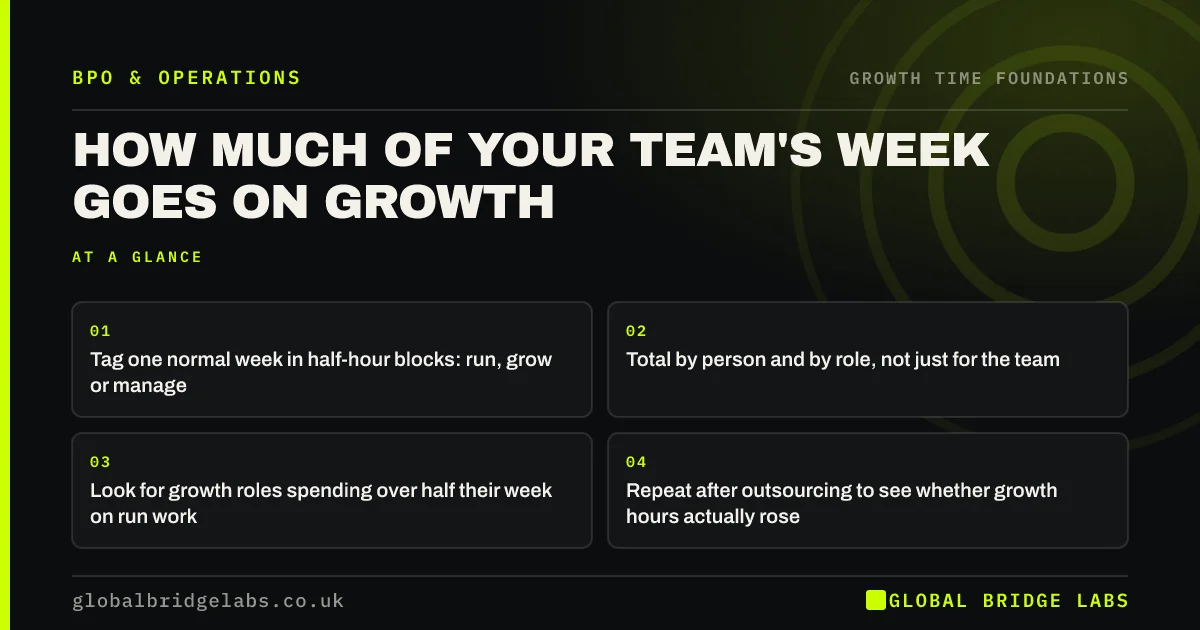
Measure one week. Ask each person on your team to mark their hours as run work or growth work, then total them. Most owners find growth work is under 15% of team time, and that number is the starting point for every decision in this guide.
Message us on WhatsApp for the GBL growth time worksheet, or book a 30-minute consultation to size your team's growth hours.
Chat on WhatsApp →Sources and further reading
- Employee earnings in the UK (Annual Survey of Hours and Earnings) · Office for National Statistics
- Multitasking: switching costs · American Psychological Association
- Work-related stress and how to manage it · Health and Safety Executive
- Business population estimates for the UK and regions 2025 · Department for Business and Trade
- Controllers and processors · Information Commissioner's Office
Frequently asked questions
How does outsourcing help a business focus on growth?
Outsourcing moves recurring routine work, such as processing, data updates and first-line queries, to an outside team. That frees your internal team's hours for growth work like selling, account development and new services. The time only turns into growth if you assign the freed hours to named goals and protect them from new admin.
How much time can outsourcing save a small team?
In a team of 10 to 30 people, a first well-chosen handover usually frees 20 to 40 hours a week. Expect a dip in the first four to six weeks while the provider learns the work, and allow 3 to 4 hours a week of management time at first, falling to 1 to 2 hours by the third month.
Will outsourcing mean job losses for my team?
Not when the goal is growth time. In this approach the people stay and their roles change: routine work moves out and growth work moves in. Tell staff early what is moving and why, and what their new focus will be. If roles are genuinely at risk, follow the consultation duties in UK employment law.
What should staff do with time freed by outsourcing?
Give them two or three growth goals with owners and deadlines: account reviews with top customers, faster lead follow-up, a new service, partnerships or customer research. Put the hours in diaries from the first week. Without a named goal, freed time fills with meetings and small requests within weeks.
How do I know if outsourcing is freeing time for growth?
Track two things. First, where team hours go: the share of time spent on growth work should rise within a quarter. Second, growth outcomes: retained and expanded accounts, proposals won, new services launched. If hours freed rise but outcomes do not, the problem is the Redirect step, not the provider.
Written by

Global Bridge Labs (GBL) is a UK–Sri Lanka partner for social media, websites and BPO. Everything here comes from client delivery, not theory.