On this page
Key takeaways
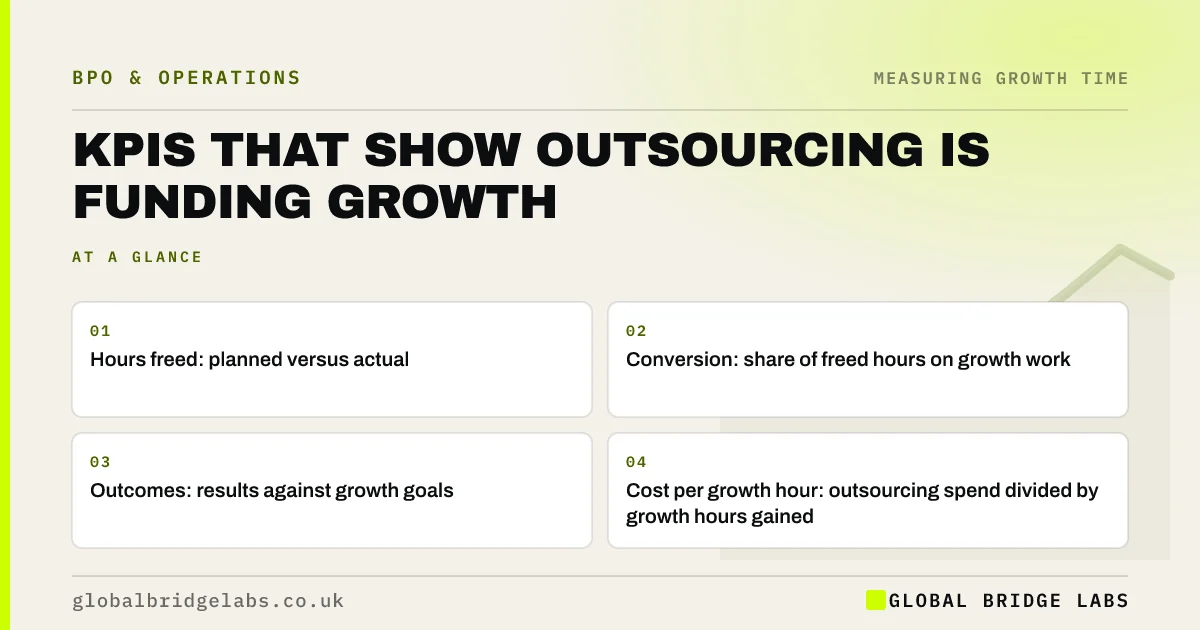
Four KPIs show whether outsourcing is funding growth: hours freed per week, the share of freed hours reaching growth work, growth outcomes against goals, and cost per growth hour gained. Together they show whether the handover worked, whether the time was used and whether it paid. Review monthly in the first quarter, then quarterly.
- Hours freed: planned versus actual.
- Conversion: share of freed hours on growth work.
- Outcomes: results against growth goals.
- Cost per growth hour: outsourcing spend divided by growth hours gained.
Want a growth capacity KPI set built for you? Message us on WhatsApp.
Chat on WhatsApp →Why do you need growth capacity KPIs?
Standard outsourcing KPIs, such as accuracy and turnaround, show whether the provider is doing the work well. They do not show whether your team is using the freed time for growth. Growth capacity KPIs fill that gap, so you can see the full return on outsourcing, not just service quality.
What are the four KPIs?
A conversion of 60% to 80% once settled is a reasonable target.
- Hours freed per week: from the handover plan, checked against actual.
- Freed-hour conversion: growth hours gained divided by hours freed.
- Growth outcomes: progress on each growth goal.
- Cost per growth hour: annual outsourcing cost divided by annual growth hours gained.
How do you collect the data?
Use the fortnightly freed hours check for the first two KPIs, your CRM or accounts for outcomes and invoices for cost. Keep it simple; a spreadsheet updated monthly is enough.
When do KPIs mislead?
When outcomes lag, as they often do in long sales cycles, or when one person's results dominate a small team. Look at trends and discuss context.
What does this look like in practice?
A pattern we see: a firm tracks only provider accuracy and declares outsourcing a success. Adding freed-hour conversion shows only 35% of freed hours reaching growth work, which leads to fixing meeting creep and lifting conversion above 70%.
Growth KPI checklist
- Record planned and actual hours freed.
- Measure growth hours gained.
- Calculate freed-hour conversion.
- Track growth outcomes against goals.
- Calculate cost per growth hour quarterly.
Next step
Add freed-hour conversion to your next monthly review. It is the KPI most firms are missing.
Message us on WhatsApp for the growth capacity KPI sheet, or book a 30-minute consultation.
Chat on WhatsApp →Sources and further reading
- Employee earnings in the UK (Annual Survey of Hours and Earnings) · Office for National Statistics
- Value Stream Mapping Overview · Lean Enterprise Institute
Frequently asked questions
How do you measure the success of outsourcing for growth?
Track hours freed, the share of those hours reaching growth work, progress on growth goals and the cost per growth hour gained. Provider quality KPIs matter too, but they only show the work moved well, not whether your team used the time for growth.
What is a good freed-hour conversion rate?
Once the handover has settled, 60% to 80% of freed hours reaching growth work is a reasonable target. Some hours go to managing the provider, some to rest and some to necessary new work. Below 50% usually means hours are leaking into meetings or admin.
How often should growth KPIs be reviewed?
Monthly for the first quarter after a handover, then quarterly. Outcomes often lag behind hours, so review trends over several quarters rather than reacting to one month. Keep the same format each time so changes are easy to spot. Keep the same format each time so changes are easy to spot.
Written by

Global Bridge Labs (GBL) is a UK–Sri Lanka partner for social media, websites and BPO. Everything here comes from client delivery, not theory.