On this page
- 01Key takeaways
- 02How do freed hours produce revenue?
- 03Example 1: account reviews
- 04Example 2: faster follow-up
- 05Example 3: a new service
- 06When do these examples not apply?
- 07What does this look like in practice?
- 08Revenue estimate checklist
- 09Next step
- 10Sources and further reading
- 11Frequently asked questions
Key takeaways
Freed hours turn into revenue only through specific growth activities with measurable results. Three illustrative examples show the logic: account reviews that retain and expand customers, faster lead follow-up that lifts conversion, and a new service sold to existing clients. Each compares the cost of outsourcing with the revenue the freed hours could produce.
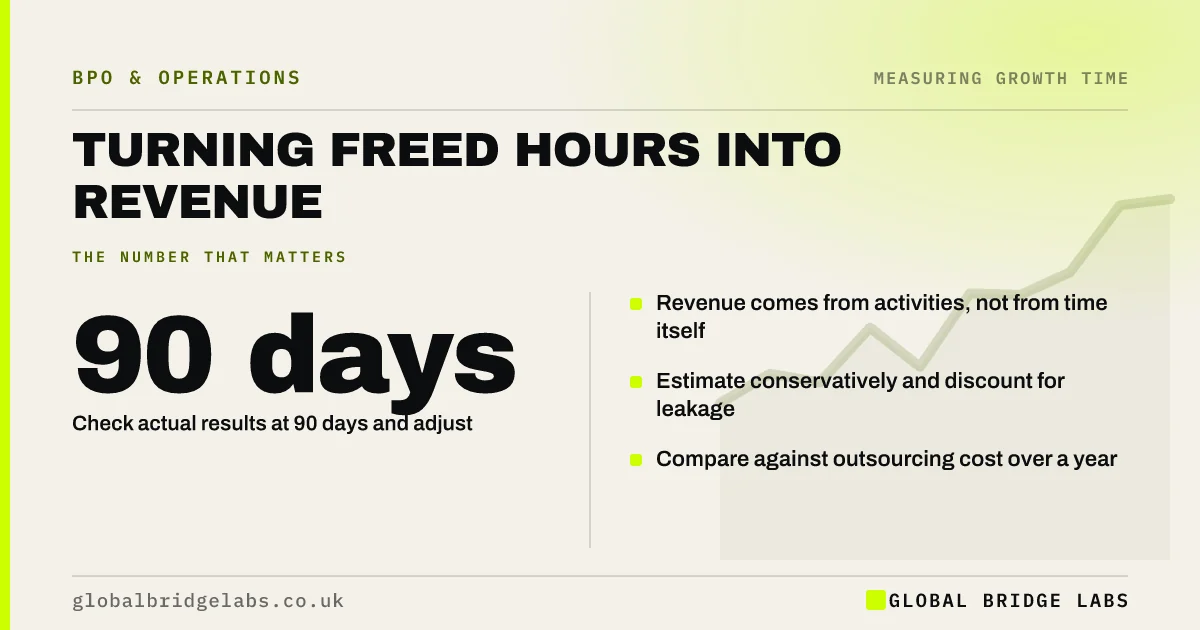
- Revenue comes from activities, not from time itself.
- Estimate conservatively and discount for leakage.
- Compare against outsourcing cost over a year.
- Check actual results at 90 days and adjust.
Want a worked example for your business? Message us on WhatsApp.
Chat on WhatsApp →How do freed hours produce revenue?
Freed hours produce revenue when they are spent on activities with a known link to sales: reviewing accounts, following up leads, launching services or developing partners. The link is rarely instant. Use conservative assumptions, test them against your own results and judge after one or two sales cycles.
Example 1: account reviews
Illustrative: an account manager gains 6 hours a week and reviews 20 top accounts each quarter. If reviews retain one account worth £15,000 a year that would otherwise have left and add £10,000 of extra orders, that is £25,000 a year. Outsourcing the 6 hours at £9 to £18 an hour costs about £2,800 to £5,600 a year.
Example 2: faster follow-up
Illustrative: a firm receives 40 enquiries a month and converts 20%. With freed time for same-day follow-up, conversion rises to 25%, two more customers a month. At an average first order of £1,500, that is about £36,000 a year from the change.
Example 3: a new service
Illustrative: a manager gains 8 hours a week and launches a new service to existing clients. Ten clients at £200 a month produce £24,000 a year from the second year.
When do these examples not apply?
When demand is weak, when the activity has no proven link to sales in your business, or when freed hours leak. Build your own estimate from your own conversion and retention data. These figures are illustrations, not forecasts.
What does this look like in practice?
A pattern we see: an owner builds a simple estimate before outsourcing, assuming half of the freed hours go to account reviews. At 90 days the reviews have produced fewer upsells than hoped but have saved two at-risk accounts, which alone covers the year's outsourcing cost.
Revenue estimate checklist
- Choose one growth activity per freed role.
- Use your own conversion and retention data.
- Estimate conservatively.
- Compare with annual outsourcing cost.
- Check actual results at 90 days.
Next step
Pick the one growth activity most likely to produce revenue in your business and build a simple estimate on one page.
Message us on WhatsApp for the revenue estimate sheet, or book a 30-minute consultation.
Chat on WhatsApp →Sources and further reading
- Employee earnings in the UK (Annual Survey of Hours and Earnings) · Office for National Statistics
- Business population estimates for the UK and regions 2025 · Department for Business and Trade
Frequently asked questions
How do I estimate revenue from freed time?
Choose the growth activity the hours will fund, use your own data on conversion, retention or average order size, apply conservative assumptions and compare the result with the annual cost of outsourcing. Check actual results after 90 days and update the estimate.
Does outsourcing increase revenue?
Not by itself. It frees hours that can be spent on activities that grow revenue, such as account reviews, faster follow-up or new services. Revenue rises when those hours are assigned to specific goals and protected from routine work coming back.
How long before freed time produces revenue?
Leading signs such as more reviews or faster follow-up appear within weeks. Revenue usually follows within one or two sales cycles, so one to two quarters for many SMEs. Judge first results at 90 days and look at trends over two or three quarters.
Written by

Global Bridge Labs (GBL) is a UK–Sri Lanka partner for social media, websites and BPO. Everything here comes from client delivery, not theory.