On this page
Key takeaways
Customer retention work is the planned effort to keep customers before they leave: checking early warning signs, planning renewals, resolving recurring issues and calling customers who have gone quiet. It slips because nothing is due today. Freed hours from outsourcing are well spent here, because keeping a customer is usually cheaper than replacing one.
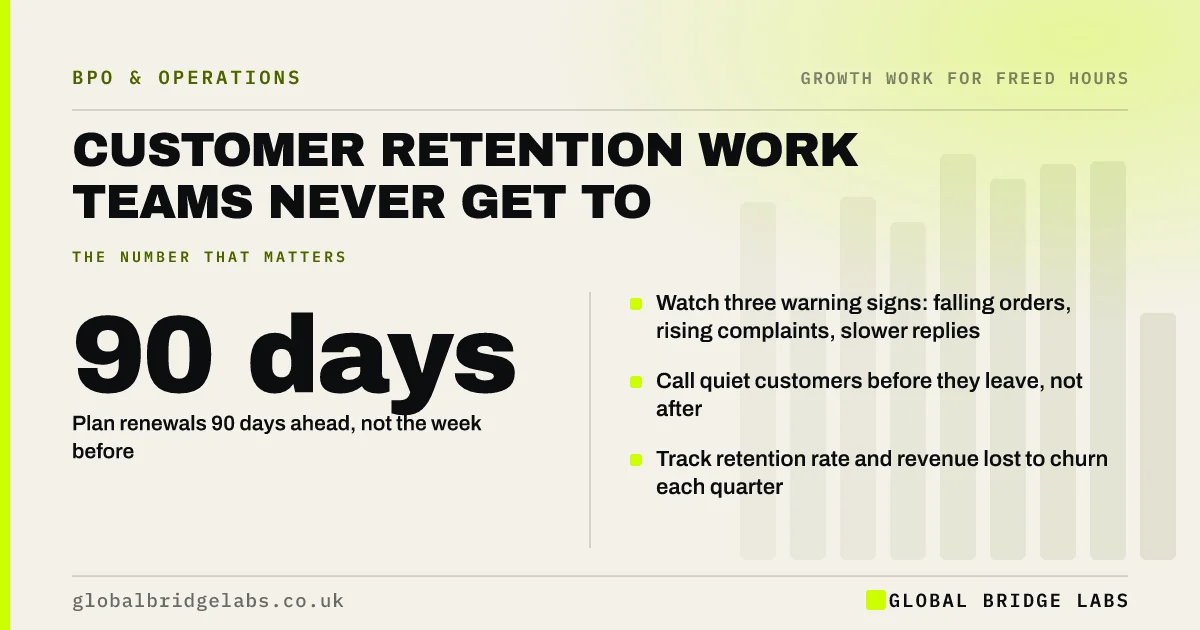
- Watch three warning signs: falling orders, rising complaints, slower replies.
- Plan renewals 90 days ahead, not the week before.
- Call quiet customers before they leave, not after.
- Track retention rate and revenue lost to churn each quarter.
Want a retention routine for your freed hours? Message us on WhatsApp.
Chat on WhatsApp →Why does retention work get dropped?
Retention work gets dropped because a customer who is drifting away rarely complains loudly. Orders fall gradually, replies slow down and then a renewal is not signed. Busy teams react to the noisy work in front of them, so the quiet signals go unnoticed until the customer has already decided.
What does retention work involve?
Some of the data work, such as building the monthly trend report, can be outsourced. The calls and decisions belong with your team.
- Monthly check of order trends for your top customers.
- Review of complaints and recurring issues by customer.
- Renewal planning 90 days before contract end.
- Calls to customers whose activity has dropped.
- Short exit conversations when customers do leave.
How do you measure retention?
Track the share of customers active a year ago who are still active, and the revenue lost from customers who left. Review both quarterly. A small improvement in retention often adds more revenue than a large marketing push.
When is retention work the wrong focus?
When the business is losing customers because of a core product or price problem, retention calls will only confirm it. Fix the underlying issue first. Retention work also matters less in one-off purchase businesses, where referral and reviews do more.
What does this look like in practice?
A pattern we see: a subscription service frees its customer team 10 hours a week by moving billing queries out. They start calling customers whose usage has dropped for two months. Several cancellations are prevented simply because someone asked what had changed.
Retention checklist
- Build a monthly order trend report for top customers.
- Flag falling orders and rising complaints.
- Plan renewals 90 days ahead.
- Call quiet customers each month.
- Track retention rate quarterly.
Next step
Pull a list of customers whose orders have fallen for three months and call five of them this week.
Message us on WhatsApp for a customer retention routine, or book a 30-minute consultation.
Chat on WhatsApp →Sources and further reading
- UK Customer Satisfaction Index · Institute of Customer Service
- Consumer Rights Act 2015 · legislation.gov.uk
Frequently asked questions
How can a small business improve customer retention?
Watch for early warning signs such as falling orders or rising complaints, plan renewals well ahead, fix recurring issues and contact customers who go quiet. Most of this needs regular, protected time. Moving routine admin out frees the hours, while the conversations stay with people who know the customer.
What is a good customer retention rate?
It varies widely by industry and business model. Subscription and contract businesses often aim above 85% to 90% annually, while one-off purchase businesses measure repeat rates instead. The most useful benchmark is your own trend: is retention rising or falling quarter by quarter?
Can customer retention be outsourced?
The supporting work can: reports on order trends, renewal reminders, survey administration and first-line queries. The relationship conversations, especially with valuable or unhappy customers, usually work best with your own team. Outsourcing the routine support is how most firms make time for them.
Written by

Global Bridge Labs (GBL) is a UK–Sri Lanka partner for social media, websites and BPO. Everything here comes from client delivery, not theory.