On this page
Key takeaways
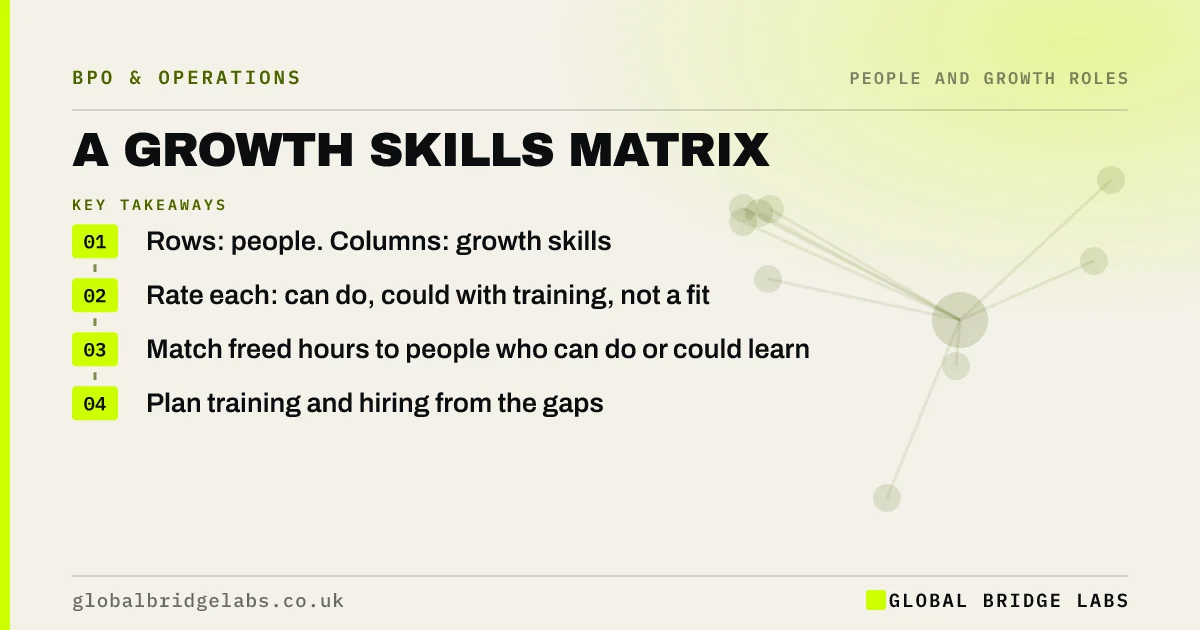
A growth skills matrix is a simple grid listing team members against the skills your growth goals need, rated as can do now, could do with training, or not a fit. It shows who should receive freed hours, what training to plan and where you need to hire or buy skills in. It takes about an hour to build for a small team.
- Rows: people. Columns: growth skills.
- Rate each: can do, could with training, not a fit.
- Match freed hours to people who can do or could learn.
- Plan training and hiring from the gaps.
Want a growth skills matrix built with you? Message us on WhatsApp.
Chat on WhatsApp →What is a growth skills matrix?
A growth skills matrix is a table that maps each team member against the skills needed for growth work, such as account reviews, proposal writing, negotiation, project management and customer research. Each cell is rated. It turns vague questions about who should do growth work into a clear picture of strengths and gaps.
How do you build one?
- List your two or three growth goals.
- Write the skills each goal needs as columns.
- List everyone who might gain freed hours as rows.
- Rate each cell: can do now, could with training, not a fit.
- Discuss ratings with each person, not just among managers.
How do you use it?
Assign growth goals to people rated can do now first. Plan training for people rated could with training. Where nobody fits, consider hiring for that skill or buying it in. The Health and Safety Executive includes role clarity and support among stress factors, so matching work to ability matters for wellbeing too.
When is a skills matrix overkill?
In a team of three or four people, a conversation is usually enough. The matrix becomes useful when several people gain freed hours and you need to decide fairly who does what.
What does this look like in practice?
A pattern we see: a 16-person firm builds a matrix for three growth goals. It shows two people ready for account reviews, three who could learn proposal writing and nobody with pricing analysis skills, which the firm buys in for one project.
Skills matrix checklist
- List growth goals and their skills.
- Rate each person honestly with them.
- Assign goals to ready people first.
- Plan training for the next tier.
- Fill remaining gaps by hiring or buying in.
Next step
Draw the matrix for your top growth goal with your managers this week, then check ratings with each person.
Message us on WhatsApp for a growth skills matrix template, or book a 30-minute consultation.
Chat on WhatsApp →Sources and further reading
- Training and study at work: your rights · GOV.UK
- What are the Management Standards for work-related stress? · Health and Safety Executive
Frequently asked questions
What is a skills matrix?
A skills matrix is a table listing people against the skills a team needs, with a rating in each cell showing current ability. A growth skills matrix focuses on the skills needed for growth work, so it shows who can take on growth goals, who needs training and where skills are missing.
How do you rate skills in a matrix?
Keep it simple: can do now, could do with training, or not a fit. Detailed scales tend to create debate without adding much. Discuss ratings with each person, because self-assessment combined with a manager's view is more accurate than either alone.
How often should a skills matrix be updated?
Review it when growth goals change, after training, and at least twice a year. A matrix that is not updated quickly becomes misleading, especially in small teams where one person's development can change who is best placed for a goal.
Written by

Global Bridge Labs (GBL) is a UK–Sri Lanka partner for social media, websites and BPO. Everything here comes from client delivery, not theory.