On this page
Key takeaways
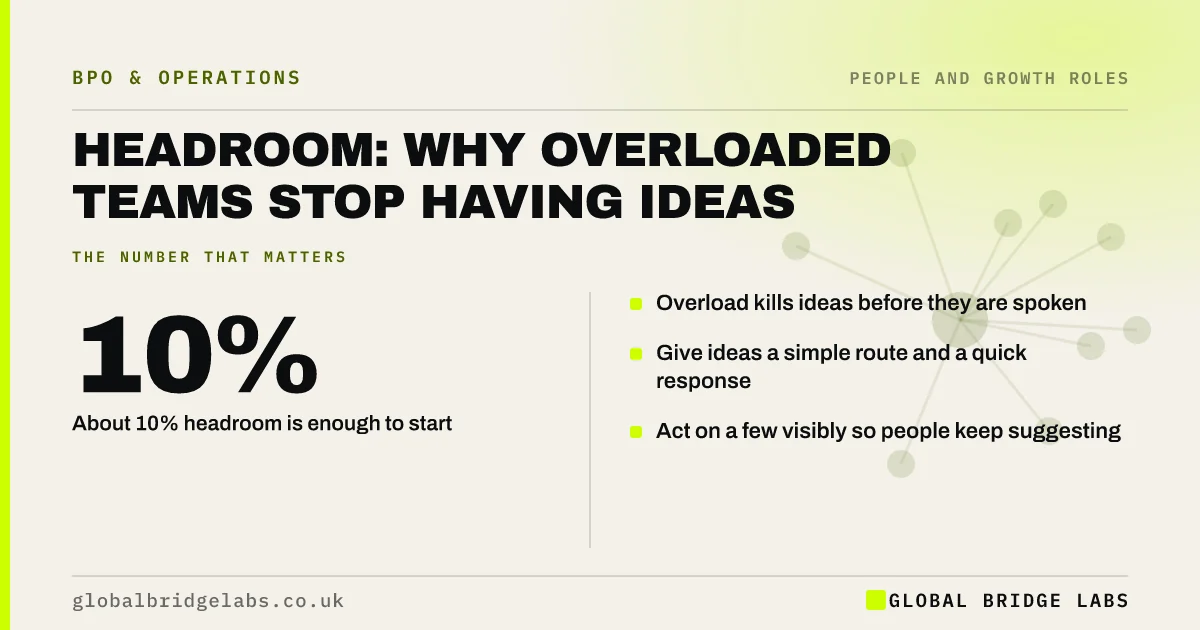
Teams that are fully booked stop suggesting improvements, not because they lack ideas but because they have no headroom to think or act on them. Freeing even 10% of the week from routine work gives people space to notice problems and propose fixes. Pair that headroom with a simple route for ideas and a visible response.
- Overload kills ideas before they are spoken.
- About 10% headroom is enough to start.
- Give ideas a simple route and a quick response.
- Act on a few visibly so people keep suggesting.
Want to create headroom in your team? Message us on WhatsApp.
Chat on WhatsApp →Why do overloaded teams stop having ideas?
Overloaded teams stop having ideas because all their attention goes to getting through the day. Noticing a better way requires a moment of slack, and acting on it requires time nobody has. People learn that raising ideas only adds to their workload, so they stop. The Health and Safety Executive treats sustained high demands as a stress risk for similar reasons.
How much headroom is enough?
About 10% of the week, half a day, is a practical start for key people. It does not need to be formal innovation time; simply being less than fully booked lets people think. Continuous switching also erodes thinking time: the American Psychological Association notes switching can cost as much as 40% of productive time.
How do you turn headroom into ideas?
- Create one route for ideas: a shared list or monthly session.
- Respond to every idea within two weeks.
- Act on a few visibly and credit the person.
- Feed the best into the growth backlog.
When is headroom wasted?
When nobody asks for ideas or acts on them. Headroom without a route becomes slack that fills with routine work again.
What does this look like in practice?
A pattern we see: after moving booking admin out, a clinic's reception team suggests a reminder change that cuts missed appointments. They had noticed the problem for a year but never had time to raise it.
Headroom checklist
- Free about 10% of key people's weeks.
- Create one route for ideas.
- Respond within two weeks.
- Act on and credit good ideas.
- Feed ideas into the growth backlog.
Next step
Ask your team one question at the next meeting: what would you fix if you had half a day a week?
Message us on WhatsApp to plan headroom for your team, or book a 30-minute consultation.
Chat on WhatsApp →Sources and further reading
- Work-related stress and how to manage it · Health and Safety Executive
- Multitasking: switching costs · American Psychological Association
Frequently asked questions
Why don't my staff suggest improvements?
Often because they have no time to think beyond the day's work, or because past suggestions added to their workload without anything changing. Freeing some routine hours, creating a simple route for ideas and responding visibly usually brings suggestions back.
How do you encourage ideas from employees?
Give people some headroom in their week, provide one simple way to raise ideas, respond quickly to every suggestion and act on a few visibly with credit to the person. Ideas increase when people see that raising them leads to change, not just more work.
How much slack should a team have?
Running every person at full capacity leaves no room for problems or improvement. Many operations aim for some buffer, and for knowledge work around 10% of the week free from routine tasks is a practical starting point for key people.
Written by

Global Bridge Labs (GBL) is a UK–Sri Lanka partner for social media, websites and BPO. Everything here comes from client delivery, not theory.