On this page
Key takeaways
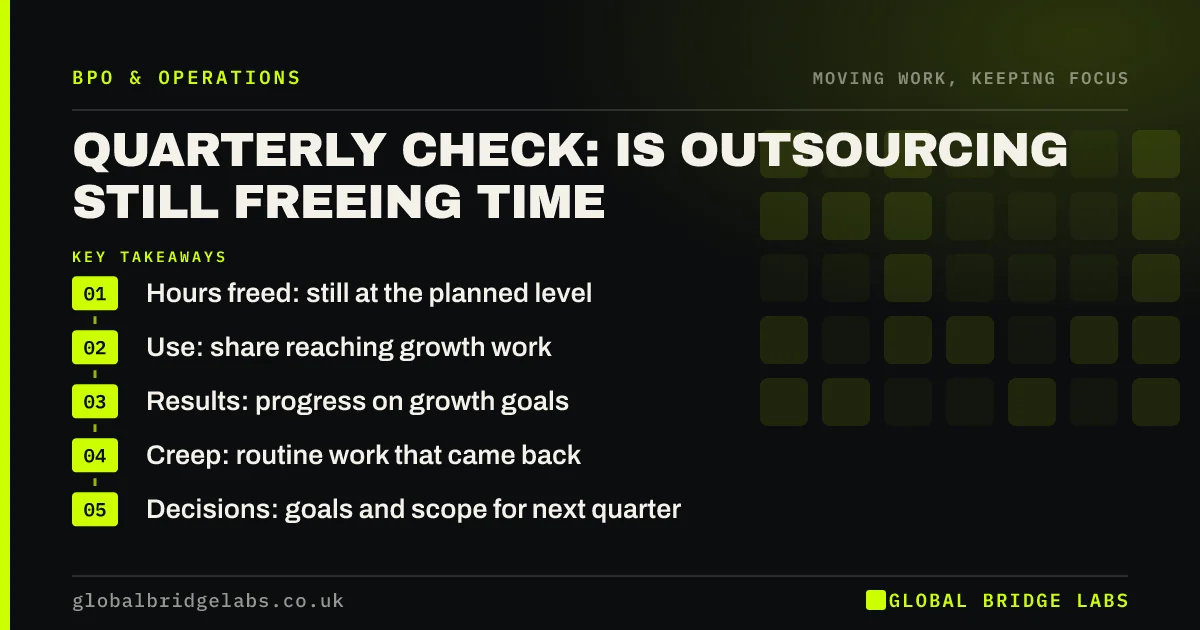
A quarterly growth time review checks whether outsourcing is still freeing time for growth: hours freed, where they went, growth results, admin creep and provider quality. It takes about an hour, involves the owner, line managers and growth owners, and ends with next quarter's growth goals and any scope changes.
- Hours freed: still at the planned level?
- Use: share reaching growth work.
- Results: progress on growth goals.
- Creep: routine work that came back.
- Decisions: goals and scope for next quarter.
Want a quarterly review agenda? Message us on WhatsApp.
Chat on WhatsApp →Why review growth time every quarter?
Because freed time erodes gradually. New admin, new meetings and new exceptions creep in, and nobody notices until the team feels stretched again. A quarterly review catches erosion early and keeps growth goals current. It also gives a regular point to decide whether to expand the outsourcing scope.
What is on the agenda?
- Hours freed this quarter versus plan.
- Share of freed hours on growth work.
- Growth goal results.
- Routine work that came back to the team.
- Provider quality and escalations.
- Next quarter's goals and scope changes.
Who should attend?
The owner or managing director, line managers of affected teams and each growth goal owner. The provider can join for the quality and scope items, but the growth discussion is internal.
When can the review be skipped?
It should not be, but it can be shortened to 20 minutes once everything is stable for two or three quarters. Keep the same headings.
What does this look like in practice?
A pattern we see: a quarterly review shows freed hours steady but growth work down from 70% to 50%. The cause is a new weekly report and a new customer portal with manual steps. Both move to the provider, and next quarter's goals are reset.
Quarterly review checklist
- Compare hours freed with plan.
- Check freed-hour conversion.
- Review growth goals.
- List routine work that returned.
- Set next quarter's goals and scope.
Next step
Book the next four quarterly reviews now, each an hour, with the same attendees.
Message us on WhatsApp for the quarterly growth time review agenda, or book a 30-minute consultation.
Chat on WhatsApp →Sources and further reading
- The Sourcing and Consultancy Playbooks · Cabinet Office
- Employee earnings in the UK (Annual Survey of Hours and Earnings) · Office for National Statistics
Frequently asked questions
How often should you review an outsourcing arrangement?
Monthly in the first quarter, then quarterly for both service quality and growth time, with an annual review of scope and terms. Quarterly reviews catch gradual erosion of freed time and keep growth goals current. Put the dates in the diary at the start so reviews actually happen.
What should a quarterly outsourcing review cover?
Provider quality, hours freed against plan, the share of those hours used for growth, growth goal results, routine work that has crept back and decisions on scope and next quarter's goals. Keep the same structure each time so trends are easy to see.
Who should run the quarterly review?
The owner or managing director usually chairs it, with line managers and growth goal owners attending. The provider joins for quality and scope items. One person should own the actions and check them at the next review. Keep actions to a short list, each with an owner and a date.
Written by

Global Bridge Labs (GBL) is a UK–Sri Lanka partner for social media, websites and BPO. Everything here comes from client delivery, not theory.