On this page
Key takeaways
Entering a new market, a new region, sector or customer type, takes sustained team time for research, testing and relationship building. Small firms usually lack the capacity, not the budget. Free 10 to 15 hours a week of routine work first, give one person ownership, and follow a staged plan: research, test, then launch.
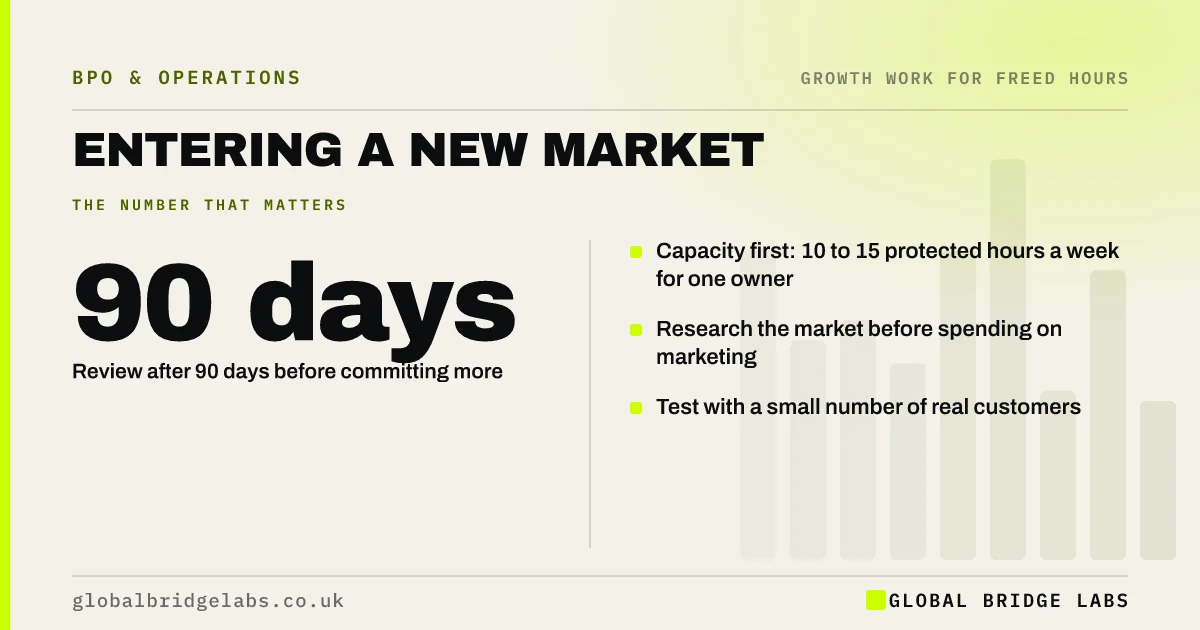
- Capacity first: 10 to 15 protected hours a week for one owner.
- Research the market before spending on marketing.
- Test with a small number of real customers.
- Review after 90 days before committing more.
Want to plan team capacity for a new market? Message us on WhatsApp.
Chat on WhatsApp →Why does market entry need team time?
Market entry needs team time because the early work cannot be bought off the shelf: understanding new customers, adapting the offer, building first relationships and learning what wins. That work needs people who know your business. If those people are fully used on today's operations, the new market stays a plan.
How do you stage a market entry?
- Research: who buys, how they buy and who you compete with.
- Adapt: what needs to change in the offer, pricing or message.
- Test: approach 10 to 20 potential customers directly.
- Launch: commit marketing and sales effort only once tests show demand.
- Review: decide at 90 days whether to scale, adjust or stop.
What should move out to make room?
Move the routine work around the person leading the market entry: their reporting, scheduling, data updates and first-line queries. Also consider outsourcing the research legwork itself, such as compiling prospect lists, while keeping conversations in-house.
When is it the wrong time?
When the core business is unstable, cash is tight or the current market is still growing fast. The Department for Business and Trade counted 5.7 million private sector businesses in the UK at the start of 2025; most grow by doing more in their current market before entering new ones.
What does this look like in practice?
A pattern we see: a commercial cleaning firm wants to move into healthcare premises. It frees its operations manager 12 hours a week by outsourcing scheduling admin. She spends three months learning the sector's standards, wins two pilot contracts and only then expands.
Market entry checklist
- Name one owner with 10 to 15 protected hours a week.
- Research customers and competitors.
- Adapt the offer and price.
- Test with 10 to 20 potential customers.
- Decide at 90 days.
Next step
Write down the market you would enter if you had the time, and who would lead it. Then list the routine work that fills that person's week.
Message us on WhatsApp to plan market entry capacity, or book a 30-minute consultation.
Chat on WhatsApp →Sources and further reading
- Export goods from the UK: step by step · HM Revenue & Customs
- Business population estimates for the UK and regions 2025 · Department for Business and Trade
Frequently asked questions
How do small businesses enter new markets?
Most do it in stages: research the new customers and competitors, adapt the offer and price, test with a small number of real prospects, and commit more only when there is evidence of demand. A single owner with protected time is usually more important than a large budget.
How much time does entering a new market take?
For a small firm, expect three to six months of sustained effort from one person with 10 to 15 hours a week before you know whether the market works. The early research and relationship-building cannot be rushed, which is why freeing that person's routine work matters.
Should I hire someone to lead a new market?
Sometimes, but hiring before you know the market works is risky. Many firms test with an existing team member who knows the business, freeing their routine hours through outsourcing. If the test succeeds, a dedicated hire is then easier to justify and brief.
Written by

Global Bridge Labs (GBL) is a UK–Sri Lanka partner for social media, websites and BPO. Everything here comes from client delivery, not theory.