On this page
Key takeaways
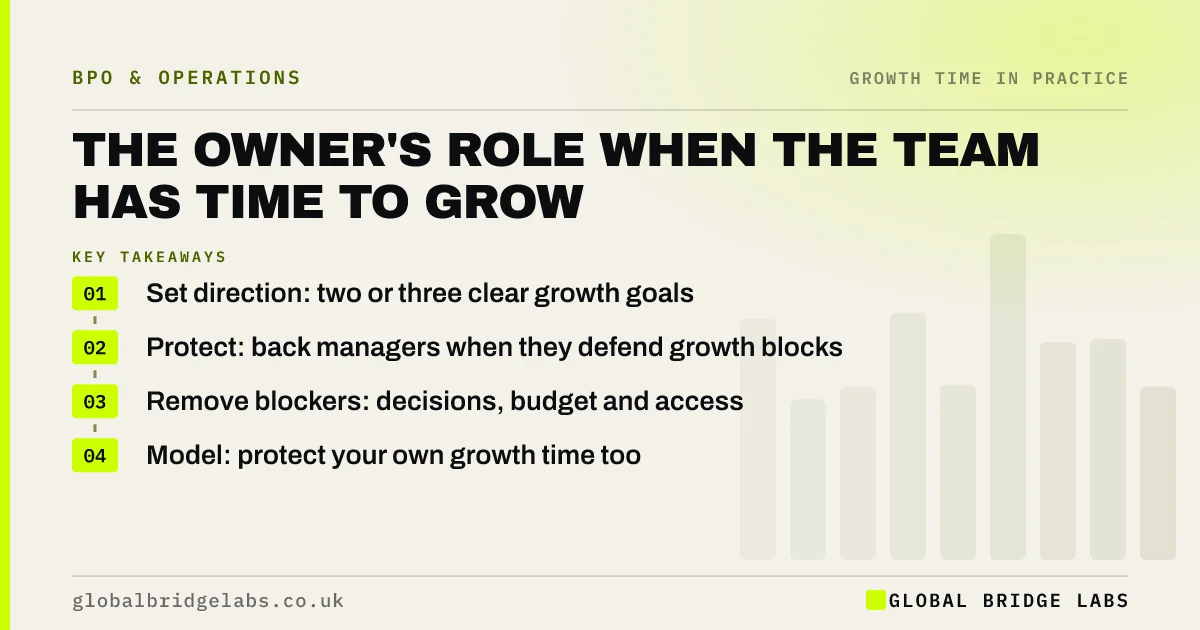
When outsourcing frees your team's time, the owner's job is to set direction, protect the hours, remove blockers and model the behaviour, not to take growth work back. Owners who step into every growth task slow the team down. Owners who set clear goals and defend growth time see the team use it well.
- Set direction: two or three clear growth goals.
- Protect: back managers when they defend growth blocks.
- Remove blockers: decisions, budget and access.
- Model: protect your own growth time too.
Want to talk through your role as owner? Message us on WhatsApp.
Chat on WhatsApp →What does the owner do differently?
The owner moves from being the person who solves every problem to the person who sets growth direction and makes sure the team has the time and support to pursue it. That means fewer operational decisions and more decisions about goals, priorities and resources.
What are the owner's four jobs?
- Direction: choose and explain the growth goals.
- Protection: back growth time when pressure rises.
- Unblocking: make decisions quickly when owners need them.
- Example: keep your own growth blocks.
What should the owner avoid?
Taking growth projects back when they move slowly, booking meetings over growth blocks and asking for routine favours that pull people back into admin. Each sends a signal that growth time is optional.
When should the owner get involved directly?
In key customer relationships, major partnerships and decisions that carry significant risk. Directors also keep their statutory duties; those cannot be delegated away.
What does this look like in practice?
A pattern we see: an owner frees his team's time but keeps asking for ad hoc reports. Once he routes those requests to the provider and protects his own Tuesday growth block, the team's growth blocks become reliable too.
Owner checklist
- Set two or three growth goals.
- Back managers who defend growth time.
- Decide quickly when asked.
- Route routine requests to the provider.
- Keep your own growth blocks.
Next step
Look at your diary for next week. If you have no growth block of your own, add one first.
Message us on WhatsApp to discuss your role, or book a 30-minute consultation.
Chat on WhatsApp →Sources and further reading
- Being a company director · GOV.UK
- What are the Management Standards for work-related stress? · Health and Safety Executive
Frequently asked questions
What should a business owner do after outsourcing?
Set clear growth goals, protect the team's growth time, remove blockers quickly, route routine requests to the provider and keep their own growth time protected. The owner's behaviour sets the tone for whether freed time is used well. Start with one well-documented bundle of work, check the first month closely and widen the scope once quality is steady.
How do owners stop taking work back?
Agree clear goals and authority with each growth owner, review progress monthly rather than daily, and resist stepping in when projects move slowly. Ask what would help instead of taking over. Revisit the answer each quarter, because team capacity and priorities change as the business grows.
Should the owner lead growth projects?
The owner should lead the most strategic ones, such as key partnerships or major customer relationships. Other projects are better owned by team members, with the owner setting direction and removing blockers. Owners who lead every project become the bottleneck, so choose a few deliberately.
Written by

Global Bridge Labs (GBL) is a UK–Sri Lanka partner for social media, websites and BPO. Everything here comes from client delivery, not theory.