On this page
Key takeaways
Allocate freed team capacity before routine work moves out. Write one line per person: hours a week freed, the growth goal those hours fund, the owner and how the result will be checked. This turns outsourcing from a cost line into a growth plan, and stops the hours disappearing into busier days.
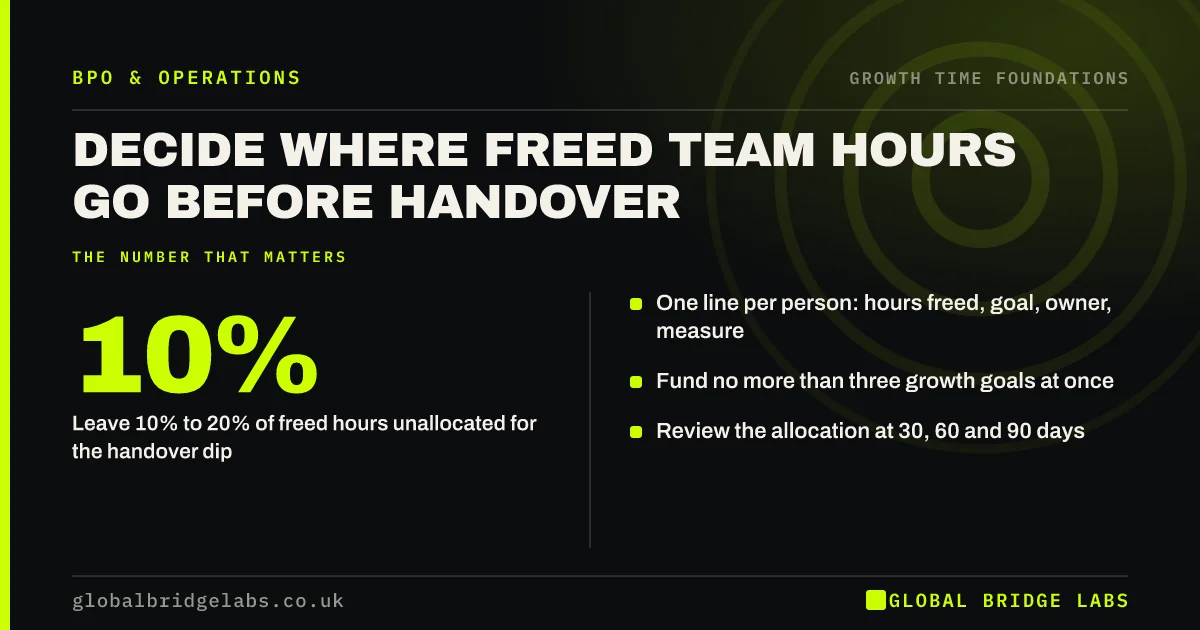
- One line per person: hours freed, goal, owner, measure.
- Leave 10% to 20% of freed hours unallocated for the handover dip.
- Fund no more than three growth goals at once.
- Review the allocation at 30, 60 and 90 days.
Want your freed capacity allocated with us? Message us on WhatsApp.
Chat on WhatsApp →What is growth capacity allocation?
Growth capacity allocation is the decision, made before outsourcing, about which growth goals the freed hours will fund and who will do the work. It is a simple table that links each person's released time to a specific outcome. Without it, outsourcing reduces workload but does not reliably increase growth.
This differs from deciding what to do with an owner's spare time. It is a team decision: several people, several hours each, pointed at a short list of goals.
How do you allocate the hours?
Build a table with five columns.
Keep 10% to 20% of the freed hours unallocated at first. The handover takes time, and an allocation that assumes every hour is free from week one will fail.
- Person and role.
- Hours a week freed, estimated from the run work moving out.
- Growth goal those hours fund.
- Owner of the goal, if different.
- Measure and review date.
How many goals should you fund?
Fund two or three. Spreading 25 freed hours across eight goals gives each about three hours a week, which is too little to finish anything. Concentrating them gives at least one goal enough weight to show a result within a quarter.
When should the allocation change?
Change it when a goal is achieved, clearly failing or overtaken by something more valuable. Review at 30, 60 and 90 days. Do not change it because someone feels busy; that usually means hours are leaking, which is a different problem.
What does this look like in practice?
A pattern we see: a 14-person firm expects to free 28 hours a week. It allocates 12 hours to account reviews, 8 to a new service pilot and leaves 8 unallocated for the first two months. By month three the unallocated hours move to the pilot, which launches on schedule.
Capacity allocation checklist
- Estimate hours freed per person.
- Choose two or three growth goals.
- Fill in one line per person.
- Keep 10% to 20% unallocated at first.
- Book reviews at 30, 60 and 90 days.
Next step
Draft the allocation table before you speak to any provider. It will sharpen what you hand over and tell you what success looks like.
Message us on WhatsApp for the capacity allocation template, or book a 30-minute consultation.
Chat on WhatsApp →Sources and further reading
- Employee earnings in the UK (Annual Survey of Hours and Earnings) · Office for National Statistics
- Write a business plan · GOV.UK
Frequently asked questions
How do you plan freed capacity after outsourcing?
Before the handover, list each person whose hours will be freed, estimate the hours a week, and assign them to one of two or three growth goals with an owner and a measure. Keep some hours unallocated for the handover period. Review the plan at 30, 60 and 90 days.
Should every freed hour go to growth work?
No. Leave some for the handover dip, some for management of the provider, and some for rest if the team was overloaded. In most firms 60% to 80% of freed hours going to named growth goals is a realistic target once the handover settles.
Who should decide where freed hours go?
The owner or managing director sets the growth goals, and line managers agree the allocation with each person. The person gaining the hours should have a say, because they know which growth work they can do well. A decision imposed without them tends to drift.
Written by

Global Bridge Labs (GBL) is a UK–Sri Lanka partner for social media, websites and BPO. Everything here comes from client delivery, not theory.