On this page
Key takeaways
Accreditations such as ISO standards, Cyber Essentials or sector schemes can open doors to bigger contracts, but they take months of team time: documenting processes, gathering evidence, training staff and preparing for audits. The lead is usually someone already stretched. Free them from routine work for the project so certification is achieved and actually used.
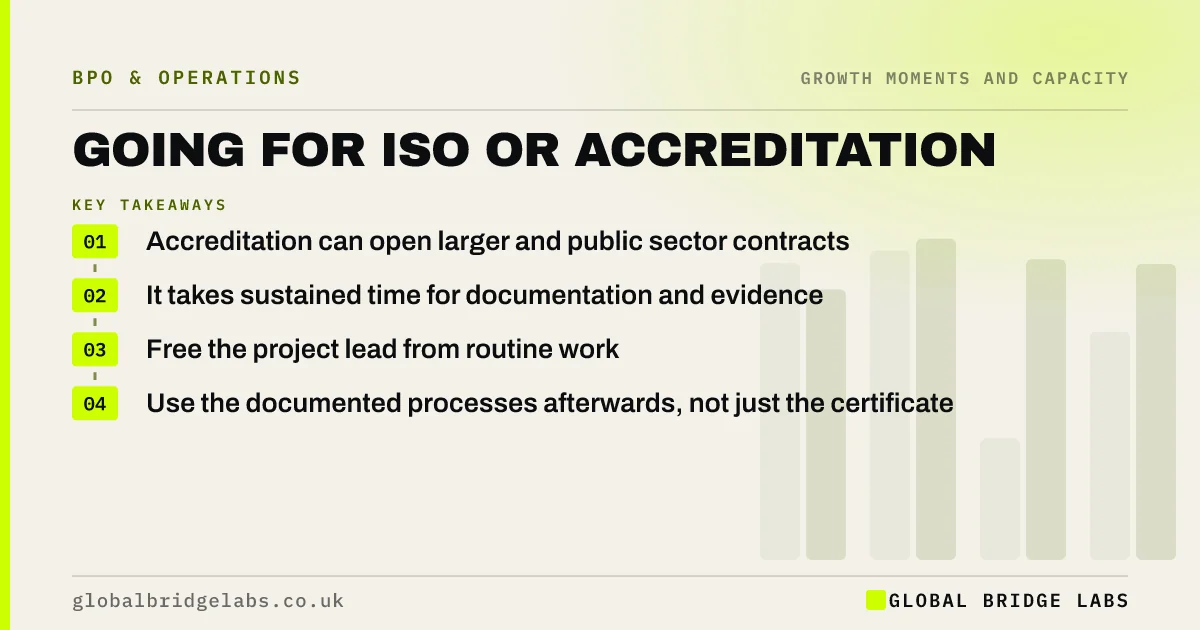
- Accreditation can open larger and public sector contracts.
- It takes sustained time for documentation and evidence.
- Free the project lead from routine work.
- Use the documented processes afterwards, not just the certificate.
Want to plan team time for accreditation? Message us on WhatsApp.
Chat on WhatsApp →Why do accreditations take so much time?
Accreditations take time because they require evidence that processes are defined, followed and reviewed. Someone has to write procedures, collect records, train staff and prepare for auditors. That work is detailed and ongoing, and it usually falls to an operations or quality lead who already has a full week.
Which accreditations help growth?
Public sector buyers following the Procurement Act 2023 guidance may set certifications as conditions, so check which ones your target customers ask for.
- Quality management standards for larger customers.
- Cyber Essentials, often required in public sector and supply chain contracts.
- Sector schemes required by trade customers or regulators.
- Environmental standards for tenders that score them.
What can move out?
The project lead's routine admin, plus support work such as formatting procedures, organising evidence and maintaining records. Your team keeps decisions on how processes should work and attends audits.
When is accreditation premature?
When no target customer asks for it, or when processes are too unstable to document. Stabilise first, then certify.
What does this look like in practice?
A pattern we see: a facilities firm needs a quality certification to bid for a council contract. Its operations manager has been trying for a year alongside routine scheduling. Moving scheduling out frees two days a week, and certification is achieved in five months.
Accreditation checklist
- Confirm which accreditation customers require.
- Name a project lead.
- Free their routine work.
- Plan documentation and evidence.
- Use the processes after certification.
Next step
Ask your three biggest prospects which accreditations they require. Then decide whether to pursue one and who leads it.
Message us on WhatsApp to plan accreditation capacity, or book a 30-minute consultation.
Chat on WhatsApp →Sources and further reading
- Cyber Essentials overview · National Cyber Security Centre
- Procurement Act 2023: guidance documents · GOV.UK
Frequently asked questions
How long does ISO certification take for a small business?
Often several months, depending on the standard, how well processes are already documented and how much time the project lead has. Firms with a dedicated lead and documented processes move much faster than those squeezing the work around routine tasks.
Is accreditation worth it for a small business?
It is when target customers require it or score it in tenders, or when the discipline of documented processes would improve the business. If no customer asks for it and processes are unstable, the time is usually better spent elsewhere first.
Can accreditation work be outsourced?
Consultants can guide the process, and support teams can format procedures and organise evidence. The business must still define and follow its processes, and staff must understand them, so the core work stays in-house. Auditors will expect staff to explain how they work in their own words.
Written by

Global Bridge Labs (GBL) is a UK–Sri Lanka partner for social media, websites and BPO. Everything here comes from client delivery, not theory.