On this page
- 01Key takeaways
- 02What should business development time be spent on first?
- 03How many hours does business development need?
- 04What rules apply to outreach?
- 05When is business development time wasted?
- 06What does this look like in practice?
- 07Business development time checklist
- 08Next step
- 09Sources and further reading
- 10Frequently asked questions
Key takeaways
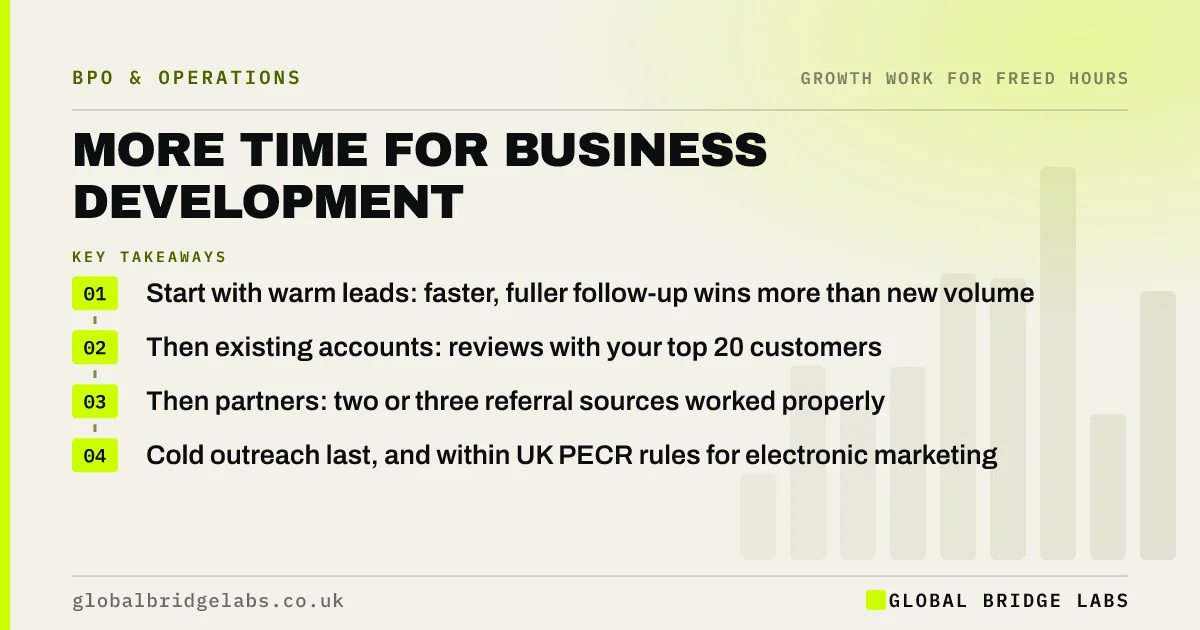
When outsourcing gives your team time for business development, start where the odds are best: follow up existing leads faster, review your top accounts and work two or three referral sources properly. Cold outreach comes later. Give each activity a weekly hour budget, an owner and a simple measure, and review it monthly.
- Start with warm leads: faster, fuller follow-up wins more than new volume.
- Then existing accounts: reviews with your top 20 customers.
- Then partners: two or three referral sources worked properly.
- Cold outreach last, and within UK PECR rules for electronic marketing.
Want a business development plan for your freed hours? Message us on WhatsApp.
Chat on WhatsApp →What should business development time be spent on first?
Business development time should go first to the opportunities closest to revenue: leads you already have, customers who already buy and contacts who already refer. These convert faster and more reliably than new outreach. A team that has been too busy usually has a backlog of half-followed leads and unreviewed accounts worth more than any new campaign.
Business development here means the planned work of finding and growing commercial relationships, as distinct from routine sales administration, which is often what outsourcing removes.
How many hours does business development need?
Set a weekly budget per person and protect it. A useful starting point for a small team is 4 to 8 hours a week for each person with a commercial role, in two or three blocks rather than scattered half-hours.
- Lead follow-up: 1 to 2 hours a week, same day where possible.
- Account reviews: 2 to 3 hours a week across the top accounts.
- Partner work: 1 to 2 hours a week on two or three partners.
- Measure: meetings held, proposals sent and revenue from each.
What rules apply to outreach?
New outreach by email or text to individuals is covered by the Privacy and Electronic Communications Regulations (PECR), and the rules differ for individual subscribers and corporate addresses. Check the ICO guidance before starting any campaign. Warm follow-up and account reviews avoid most of these questions.
When is business development time wasted?
It is wasted when it has no target list and no measure. An afternoon of networking without a follow-up plan, or a long list of cold contacts with no offer, uses the hours without moving revenue. Decide who you are trying to reach and why before the time is spent.
What does this look like in practice?
A pattern we see: a services firm moves quote preparation and CRM updates to a managed team, freeing its director 6 hours a week. Half goes to same-day lead follow-up and half to quarterly reviews with 15 key clients. Within two quarters, conversion and repeat work both rise.
Business development time checklist
- List open leads not followed up in the last month.
- List your top 20 accounts and when you last reviewed each.
- Choose two or three referral partners.
- Set a weekly hour budget per person.
- Track meetings, proposals and revenue monthly.
Next step
Spend the first freed block on your open leads: call or email every one not contacted in 30 days. It is the fastest return on business development time.
Message us on WhatsApp for a business development time plan, or book a 30-minute consultation.
Chat on WhatsApp →Sources and further reading
- Employee earnings in the UK (Annual Survey of Hours and Earnings) · Office for National Statistics
- Electronic and telephone marketing under PECR · Information Commissioner's Office
Frequently asked questions
How much time should a small business spend on business development?
Many small firms aim for 4 to 8 hours a week for each person in a commercial role, in protected blocks. Owners in early-stage businesses often need more. The right amount depends on your sales cycle, but any regular, protected time beats occasional bursts when work is quiet.
What is the difference between sales and business development?
Sales converts specific opportunities into orders. Business development creates and grows the relationships that produce those opportunities: partners, key accounts, new markets and referral sources. In small firms the same people often do both, which is why freeing them from sales admin helps both.
Can business development be outsourced?
Parts of it can: research, list building, appointment setting and CRM updates. The relationship itself, especially with key accounts and partners, usually works best with your own people. Outsourcing the routine support around business development is the common way to give your team more time for it.
Written by

Global Bridge Labs (GBL) is a UK–Sri Lanka partner for social media, websites and BPO. Everything here comes from client delivery, not theory.