On this page
Key takeaways
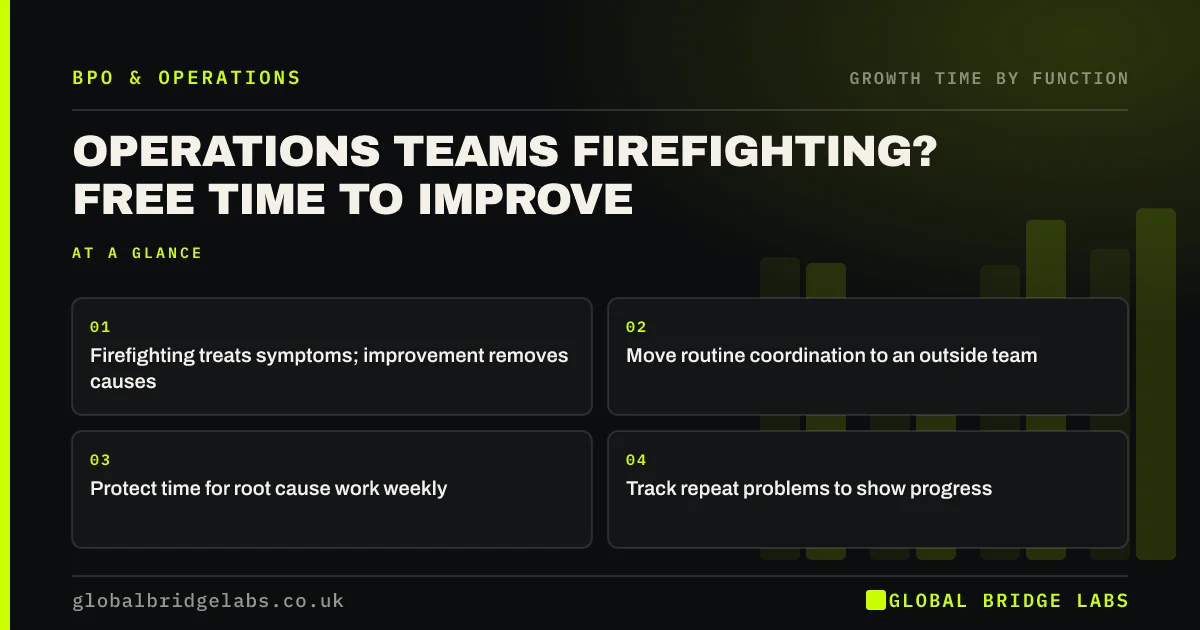
Operations teams that spend the day firefighting never fix the causes of the fires. Moving routine coordination out, such as booking updates, status chasing and data entry, gives them protected time to find and fix root causes. Each fix reduces future firefighting, so the time gained compounds.
- Firefighting treats symptoms; improvement removes causes.
- Move routine coordination to an outside team.
- Protect time for root cause work weekly.
- Track repeat problems to show progress.
Want to free your operations team for improvement? Message us on WhatsApp.
Chat on WhatsApp →Why do operations teams get stuck firefighting?
Operations teams get stuck firefighting because urgent problems always beat improvement work. Each problem is solved quickly and the team moves on, but the cause remains, so it happens again. With no spare capacity, the team never steps back, and the volume of fires grows with the business.
What should move out?
Keep decisions, exception handling and supplier relationships in-house.
- Booking and schedule updates.
- Status chasing with suppliers and customers.
- Data entry into operational systems.
- Routine reporting.
How do you use the freed time?
The Lean Enterprise Institute's value stream mapping approach and the Health and Safety Executive's guidance on human failure are both useful for finding causes rather than blaming people.
- Log every recurring problem for a month.
- Pick the most frequent or costly one.
- Find the cause, not just the fix.
- Change the process and check it worked.
- Move to the next problem.
When is improvement time wasted?
When problems are not logged, so the team improves things that are not causing the most trouble. Start with data, even a simple tally.
What does this look like in practice?
A pattern we see: a logistics firm's planners spend most of the day handling delivery exceptions. After outsourcing booking updates, they log exceptions for a month and find most come from incomplete addresses at order entry. Fixing the order form cuts exceptions sharply.
Improvement time checklist
- Move routine coordination out.
- Log recurring problems for a month.
- Protect weekly improvement time.
- Fix one root cause at a time.
- Track repeat problems.
Next step
Start a simple log of every recurring operational problem this week. In a month it will show where improvement time should go.
Message us on WhatsApp to plan operations improvement time, or book a 30-minute consultation.
Chat on WhatsApp →Sources and further reading
- Value Stream Mapping Overview · Lean Enterprise Institute
- Human factors: managing human failures · Health and Safety Executive
Frequently asked questions
How do you stop firefighting in operations?
Free some team capacity by moving routine coordination out, log recurring problems, pick the most frequent or costly, find and fix the cause, and check the fix worked. Protect time for this weekly. Each fixed cause removes future firefighting, which frees more time.
What causes constant firefighting?
Usually unresolved root causes, such as incomplete information at the start of a process, unclear handovers or unreliable suppliers, combined with no spare capacity to fix them. Growth makes it worse because the same causes create more problems as volume rises.
Can operations improvement be outsourced?
Analysis support and data gathering can be. The improvement itself usually needs people who understand the operation and can change how it works. Outsourcing routine coordination is the more common way to give your operations team time for it. Keep a named person responsible for oversight, and review samples of the work each month.
Written by

Global Bridge Labs (GBL) is a UK–Sri Lanka partner for social media, websites and BPO. Everything here comes from client delivery, not theory.