On this page
Key takeaways
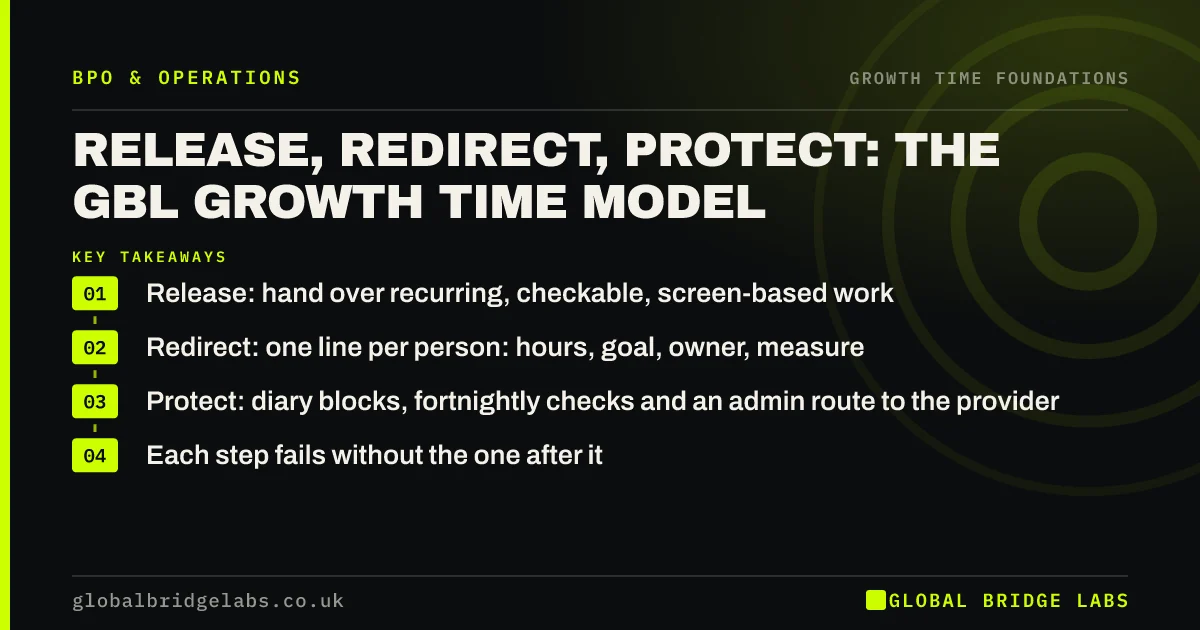
The GBL growth time model has three steps run in order. Release moves recurring routine work to a managed outside team. Redirect assigns the freed hours to named growth goals and owners before the handover. Protect keeps those hours in diaries and stops new admin refilling them. Most firms do only the first step, so the time disappears.
- Release: hand over recurring, checkable, screen-based work.
- Redirect: one line per person: hours, goal, owner, measure.
- Protect: diary blocks, fortnightly checks and an admin route to the provider.
- Each step fails without the one after it.
Want to run the three steps with us? Message us on WhatsApp.
Chat on WhatsApp →What is the release, redirect, protect model?
Release, redirect, protect is the Global Bridge Labs (GBL) model for turning outsourcing into growth time. Release is the handover of routine work. Redirect is the decision about which growth goals the freed hours fund. Protect is the set of habits that keep those hours from being reabsorbed by new admin, meetings and small requests.
How does each step work?
Release: choose recurring, rule-based, screen-based work with a checkable output, sitting with people whose hours are valuable for growth. Hand it over with clear instructions and a short pilot.
Redirect: before the handover, write the allocation: each person's freed hours, the growth goal they fund, the owner and the measure.
Protect: block growth time in diaries, check where hours went every fortnight and route new routine requests to the provider.
- Release fails if the wrong work moves.
- Redirect fails if goals are vague.
- Protect fails if nobody checks.
Why does the order matter?
Redirect must come before release finishes, because unclaimed hours fill within weeks. Protect must start in week one, because habits form quickly. Doing them in order, with redirect planned during release, is what makes the time last.
When is the model too much?
For a single task freeing two or three hours a week, the full model is overkill; a diary block and one goal are enough. Use the full model when 15 or more hours a week are moving out, or when several people are affected.
What does this look like in practice?
A pattern we see: a firm releases 30 hours a week of order and invoice admin. Because redirect was planned, two people start account reviews in week two. Because protect is in place, a fortnightly check catches a new weekly report creeping back and routes it to the provider.
Model checklist
- Release: pick the work and brief the provider.
- Redirect: write the allocation table before handover.
- Protect: book diary blocks from week one.
- Check where hours went every fortnight.
- Review outcomes at 90 days.
Next step
Take your next planned handover and write one sentence for each step. If any sentence is missing, fill it before the work moves.
Message us on WhatsApp for the release, redirect, protect worksheet, or book a 30-minute consultation.
Chat on WhatsApp →Sources and further reading
- Multitasking: switching costs · American Psychological Association
- Employee earnings in the UK (Annual Survey of Hours and Earnings) · Office for National Statistics
Frequently asked questions
What are the three steps to free team time for growth?
Release routine work to a managed outside team, redirect the freed hours to named growth goals with owners, and protect those hours with diary blocks, regular checks and a route that sends new admin to the provider. All three are needed; release alone usually leads to busier days, not more growth.
Which step do most businesses miss?
Redirect. Most firms plan the handover carefully and assume growth will follow. Without named goals and owners, freed hours fill with meetings and small requests. Writing a one-line allocation per person before the handover is the simplest fix. It takes about an hour to write and saves months of drift.
How long does the model take to show results?
Release usually settles within four to six weeks. Growth hours start rising in the second month. Growth outcomes such as expanded accounts, new services or partnerships typically show within one or two quarters, depending on the sales cycle in your industry.
Written by

Global Bridge Labs (GBL) is a UK–Sri Lanka partner for social media, websites and BPO. Everything here comes from client delivery, not theory.