On this page
Key takeaways
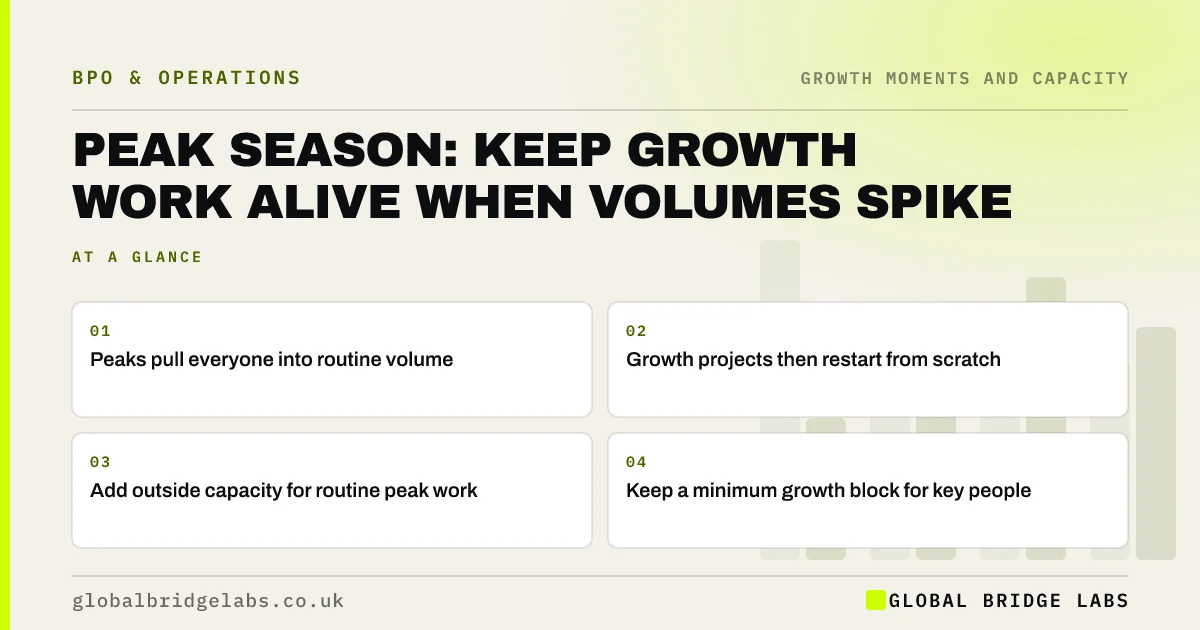
In seasonal businesses, growth work stops every peak because everyone is pulled into routine volume. That means growth projects restart from scratch each quarter. Add outside capacity for the routine peak, such as order processing, customer queries and bookings, so a few key people can keep growth projects moving through the busy period.
- Peaks pull everyone into routine volume.
- Growth projects then restart from scratch.
- Add outside capacity for routine peak work.
- Keep a minimum growth block for key people.
Want to plan peak capacity? Message us on WhatsApp.
Chat on WhatsApp →Why does growth work stop in peak season?
Growth work stops in peak season because routine volume rises sharply and every available person is pulled in to cope. That is sensible for a week or two, but in businesses with long peaks, growth projects pause for months and lose momentum. The cost shows up after the peak, when the team has to restart.
How do you keep growth work alive?
UK working time limits average 48 hours a week, so relying on overtime alone has limits.
- Forecast peak volume and the hours it needs.
- Arrange outside capacity for routine peak work in advance.
- Keep one weekly growth block for key people.
- Choose growth work that suits the peak, such as customer feedback.
- Restart full growth time straight after the peak.
What growth work suits a peak?
Peaks are a good time for customer conversations, testing offers on high traffic and capturing feedback. Heavy project work, such as launching a new service, is better scheduled outside the peak.
When should everyone help with the peak?
For short spikes of a few days, all hands is fine. The problem is long peaks of weeks or months, where growth work stopping costs more.
What does this look like in practice?
A pattern we see: an online retailer's whole team handles orders from November to January, and its wholesale project pauses every year. Outsourcing peak customer queries keeps one person on wholesale for half a day a week, and the channel launches in spring.
Peak season checklist
- Forecast peak volume and hours.
- Book outside capacity early.
- Keep one weekly growth block.
- Pick growth work that suits the peak.
- Restart full growth time after the peak.
Next step
Look at last year's peak and note which growth projects paused. Plan this year's capacity so at least one keeps going.
Message us on WhatsApp to plan peak capacity, or book a 30-minute consultation.
Chat on WhatsApp →Sources and further reading
- Maximum weekly working hours · GOV.UK
- Agency workers: your rights · GOV.UK
Frequently asked questions
How do you grow a business during busy season?
Add outside capacity for routine peak work so key people are not fully absorbed, keep at least one protected growth block a week and choose growth activities that suit the peak, such as customer feedback and offer tests. Then restart full growth work as soon as the peak ends.
How do seasonal businesses handle peak demand?
With a mix of planning, temporary staff, overtime within legal limits and outside support for routine work such as orders, queries and bookings. Forecasting volume early and booking capacity in advance makes the peak smoother and protects key people's time.
Should growth projects stop in peak season?
Short pauses for brief spikes are fine. For peaks lasting weeks or months, stopping completely means restarting from scratch afterwards. Keeping a small, protected growth block for key people maintains momentum at a modest cost. Revisit the answer each quarter, because team capacity and priorities change as the business grows.
Written by

Global Bridge Labs (GBL) is a UK–Sri Lanka partner for social media, websites and BPO. Everything here comes from client delivery, not theory.