On this page
Key takeaways
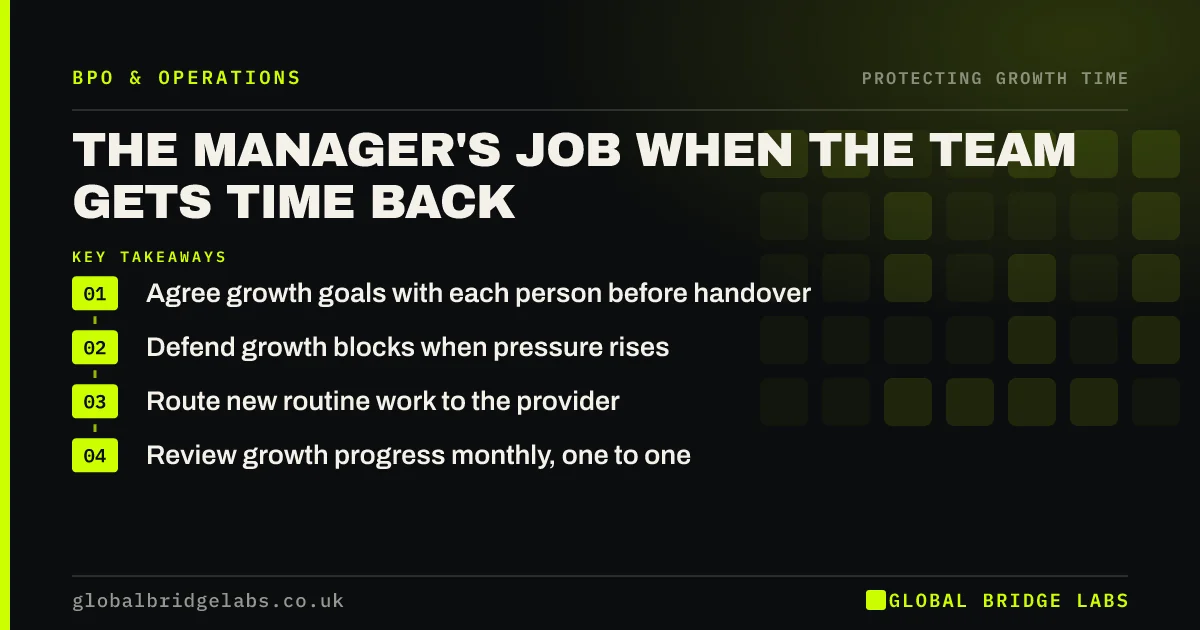
When outsourcing frees team time, the line manager's job changes. Their main task becomes turning freed capacity into growth: agreeing goals with each person, defending growth blocks, routing new admin to the provider and reviewing results monthly. Managers who only manage the provider miss half the value.
- Agree growth goals with each person before handover.
- Defend growth blocks when pressure rises.
- Route new routine work to the provider.
- Review growth progress monthly, one to one.
Want help defining the manager's role after outsourcing? Message us on WhatsApp.
Chat on WhatsApp →How does the manager's role change?
The manager's role shifts from allocating routine work to directing growth work. Before outsourcing, much of their time went on making sure routine tasks were done. Afterwards, the provider handles that, and the manager's value lies in helping each person use freed time on the right growth goals and keeping it protected.
What does the manager do each week?
- Checks growth blocks happened and helps rebook any that slipped.
- Decides where new routine requests go.
- Reviews the provider's exceptions and escalations.
- Removes blockers for growth projects.
- Holds a short monthly one-to-one on growth progress.
How much time does it take?
In the first month, expect 3 to 4 hours a week across provider management and growth support, falling to 1 to 2 hours by the third month as routines settle. Acas advises consulting employees about changes that affect them, and managers usually lead those conversations.
When does the manager become the bottleneck?
When every growth decision needs their approval, or when they check every provider task themselves. Delegate authority to growth owners and move to sample checks once quality is stable.
What does this look like in practice?
A pattern we see: an operations manager spends her first month after outsourcing checking every invoice the provider processes. Switching to a 10% sample and a monthly growth review with each team member frees her own time for a supplier savings project.
Manager checklist
- Agree growth goals one to one.
- Defend growth blocks.
- Route new admin to the provider.
- Move to sample checks once quality is stable.
- Review growth progress monthly.
Next step
Add a monthly 20-minute growth review with each team member to your diary for the next quarter.
Message us on WhatsApp for the manager's growth review guide, or book a 30-minute consultation.
Chat on WhatsApp →Sources and further reading
- What are the Management Standards for work-related stress? · Health and Safety Executive
- Consulting employees and their representatives · Acas
Frequently asked questions
What does a manager do after work is outsourced?
They manage the provider relationship, decide where new work goes and, most importantly, help their team use freed time for growth: agreeing goals, defending growth blocks and reviewing progress. The role moves from allocating routine work to directing growth work.
How much management time does outsourcing need?
As a rule of thumb, 3 to 4 hours a week in the first month, falling to 1 to 2 hours by the third month once instructions and checks settle. That includes provider management and supporting the team's growth work. It rises temporarily whenever scope changes.
How do managers keep growth time from slipping?
By defending growth blocks when pressure rises, routing new admin to the provider instead of the team, checking where hours went every fortnight in the first quarter and holding a monthly one-to-one on growth progress. Visible support from the manager is what makes the habit stick.
Written by

Global Bridge Labs (GBL) is a UK–Sri Lanka partner for social media, websites and BPO. Everything here comes from client delivery, not theory.