On this page
- 01Key takeaways
- 02Why do staff need new skills for growth work?
- 03Which skills matter most?
- 04How do you train without losing the time gained?
- 05When is training not the answer?
- 06What does this look like in practice?
- 07Upskilling checklist
- 08Next step
- 09Sources and further reading
- 10Frequently asked questions
Key takeaways
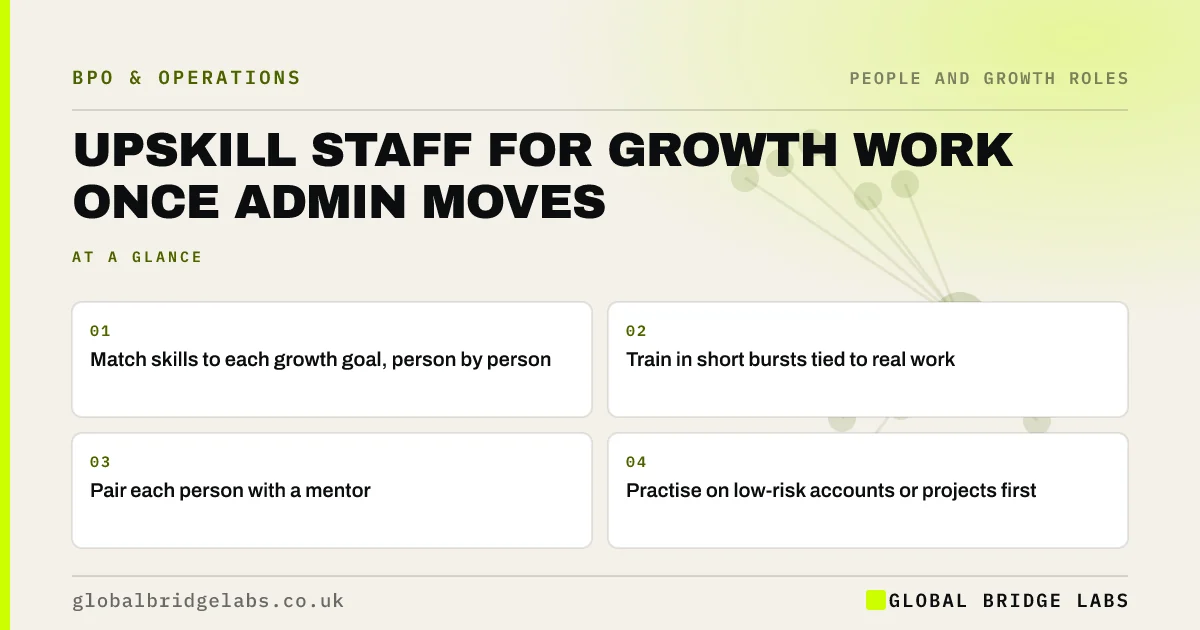
Freed hours are wasted if people lack the skills for growth work. Before or during the handover, identify the skills each growth goal needs, such as account reviews, proposal writing, negotiation or customer research, and train in short, practical bursts. Pair people with someone experienced and let them practise on low-risk work first.
- Match skills to each growth goal, person by person.
- Train in short bursts tied to real work.
- Pair each person with a mentor.
- Practise on low-risk accounts or projects first.
Want help planning skills for your team's growth work? Message us on WhatsApp.
Chat on WhatsApp →Why do staff need new skills for growth work?
Growth work uses different skills from routine work. Processing invoices rewards accuracy and speed; growing an account rewards listening, judgement and commercial thinking. People who have spent years on routine tasks may be capable of growth work but have never practised it, so they default to what they know.
Which skills matter most?
- Structured customer conversations and account reviews.
- Writing clear proposals and summaries.
- Basic negotiation and pricing conversations.
- Planning and managing a small project.
- Using data to spot opportunities and risks.
How do you train without losing the time gained?
Use short sessions linked to real work: an hour on account reviews, then a real review the same week with a mentor. Short online courses, shadowing and peer feedback cost less than long courses. In organisations with 250 or more employees, eligible staff can formally request time off for training; smaller firms can adopt the same idea informally. Apprenticeship standards also exist for many business roles.
When is training not the answer?
When the role needs specialist skills that would take years to build, or when the person does not want to move into growth work. In those cases, hire or buy the specialist skill and let the person continue in a role that suits them.
What does this look like in practice?
A pattern we see: an office administrator moves into supplier management after routine work is outsourced. Three short negotiation sessions, shadowing the finance director on two supplier reviews and a first solo review on a small supplier build her confidence within a quarter.
Upskilling checklist
- List skills each growth goal needs.
- Compare with each person's experience.
- Plan short training tied to real work.
- Assign a mentor.
- Start with low-risk practice.
Next step
For each person gaining time, write the one skill that would most help their growth goal, and book the first session this month.
Message us on WhatsApp for a skills planning sheet, or book a 30-minute consultation.
Chat on WhatsApp →Sources and further reading
- Training and study at work: your rights · GOV.UK
- Employing an apprentice · GOV.UK
Frequently asked questions
How do you retrain staff after outsourcing?
Identify the skills their new growth work needs, train in short practical sessions linked to real tasks, pair them with an experienced mentor and let them practise on low-risk work first. Review progress monthly. Most growth skills can be learnt within a quarter with this approach.
Do employees have a right to training time in the UK?
Employees in organisations with 250 or more staff who have worked there for 26 weeks can request time off for training, and the employer must consider the request seriously. Smaller firms have no such duty, but planned training is still the fastest way to make freed hours productive.
What skills do staff need for growth work?
Common ones are running structured customer conversations, writing clear proposals, basic negotiation, managing small projects and reading data to spot opportunities. The right mix depends on each person's growth goal, so plan skills person by person rather than with one course for everyone.
Written by

Global Bridge Labs (GBL) is a UK–Sri Lanka partner for social media, websites and BPO. Everything here comes from client delivery, not theory.