On this page
- 01Key takeaways
- 02Why budget outsourcing as an investment?
- 03How do you build the investment case?
- 04How does it change budgeting?
- 05When is outsourcing really an overhead?
- 06What does this look like in practice?
- 07Investment case checklist
- 08Next step
- 09Sources and further reading
- 10Frequently asked questions
Key takeaways
When outsourcing is used to free growth time, budget it as a growth investment rather than an overhead. That means stating the capacity it buys, the growth that capacity is expected to produce, the review dates and the conditions for expanding or stopping. Investments are judged on returns; overheads are judged only on cost and get cut first.
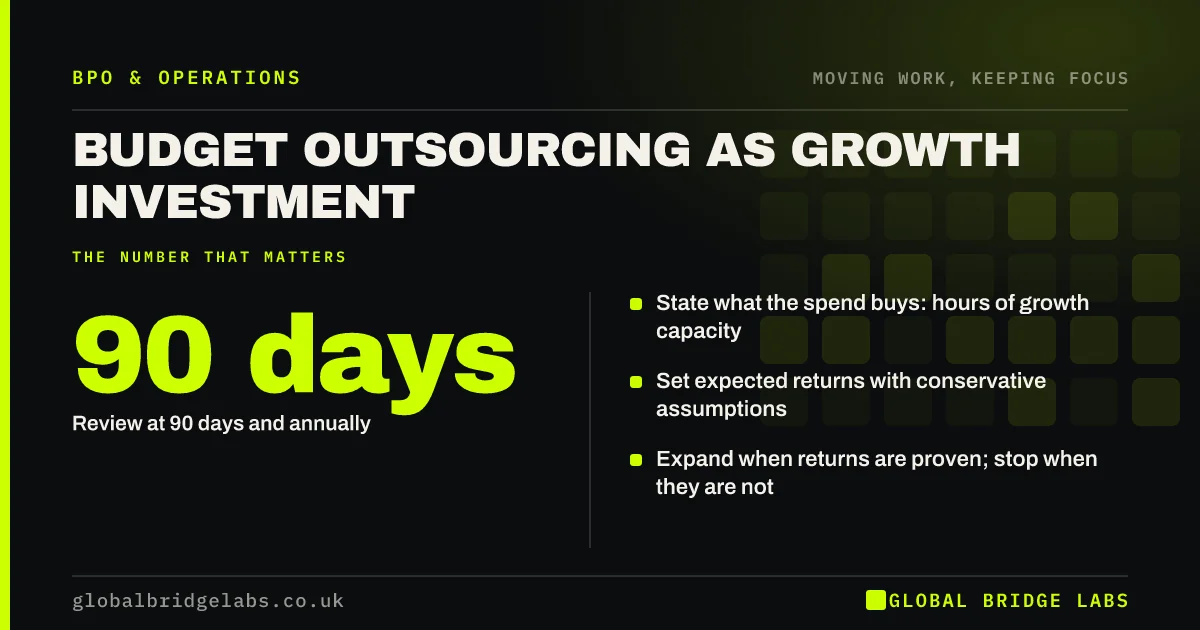
- State what the spend buys: hours of growth capacity.
- Set expected returns with conservative assumptions.
- Review at 90 days and annually.
- Expand when returns are proven; stop when they are not.
Want to frame outsourcing as a growth investment? Message us on WhatsApp.
Chat on WhatsApp →Why budget outsourcing as an investment?
Because overheads are judged only on cost, and cost always looks too high when the benefit is not shown. When outsourcing is bought to free growth time, the benefit is the growth that time produces. Framing it as an investment, with expected returns, puts both sides of the equation in front of decision-makers.
How do you build the investment case?
HM Treasury's Green Book sets out a structured way to appraise costs and benefits that small firms can simplify.
- Spend: annual outsourcing cost.
- Capacity: growth hours gained per week, net of management time.
- Return: expected revenue or margin from those hours.
- Timing: when returns are expected.
- Review: dates and conditions to expand or stop.
How does it change budgeting?
Investment budgets are linked to expected returns and reviewed against them. Overhead budgets are trimmed whenever cash is tight. Putting outsourcing in the investment column protects it while it is working and makes it easy to stop if it is not.
When is outsourcing really an overhead?
When it replaces work without changing what your team does, for example covering a vacancy you would otherwise fill. In that case judge it as a cost and compare with hiring.
What does this look like in practice?
A pattern we see: a firm's outsourcing line is cut in a cost review because nobody linked it to growth. Re-presented as an investment, showing two retained accounts and a new service line from freed hours, it is reinstated.
Investment case checklist
- State annual spend.
- State growth hours gained.
- Estimate returns conservatively.
- Set review dates and conditions.
- Report returns quarterly.
Next step
Write your outsourcing spend and the growth it should produce on one line. If you cannot fill the second half, the Redirect step is missing.
Message us on WhatsApp for the investment case template, or book a 30-minute consultation.
Chat on WhatsApp →Sources and further reading
- The Green Book: appraisal and evaluation in central government · HM Treasury
- Employee earnings in the UK (Annual Survey of Hours and Earnings) · Office for National Statistics
Frequently asked questions
Is outsourcing a cost or an investment?
It depends on the purpose. When outsourcing replaces work at lower cost, treat it as a cost. When it frees your team to do growth work, treat it as an investment and judge it by the returns that freed time produces, with clear review dates.
How do you justify outsourcing spend to a board?
Show the capacity it buys, the growth goals that capacity funds, expected returns with conservative assumptions and the review conditions for expanding or stopping. Then report actual hours, use and outcomes quarterly so the case is tested against results. Keep a named person responsible for oversight, and review samples of the work each month.
What return should outsourcing deliver?
There is no standard figure. At a minimum, the growth produced by freed hours should exceed the outsourcing cost within the period you set, often a year. Use your own conversion and retention data to estimate, and test the estimate at 90 days.
Written by

Global Bridge Labs (GBL) is a UK–Sri Lanka partner for social media, websites and BPO. Everything here comes from client delivery, not theory.