On this page
Key takeaways
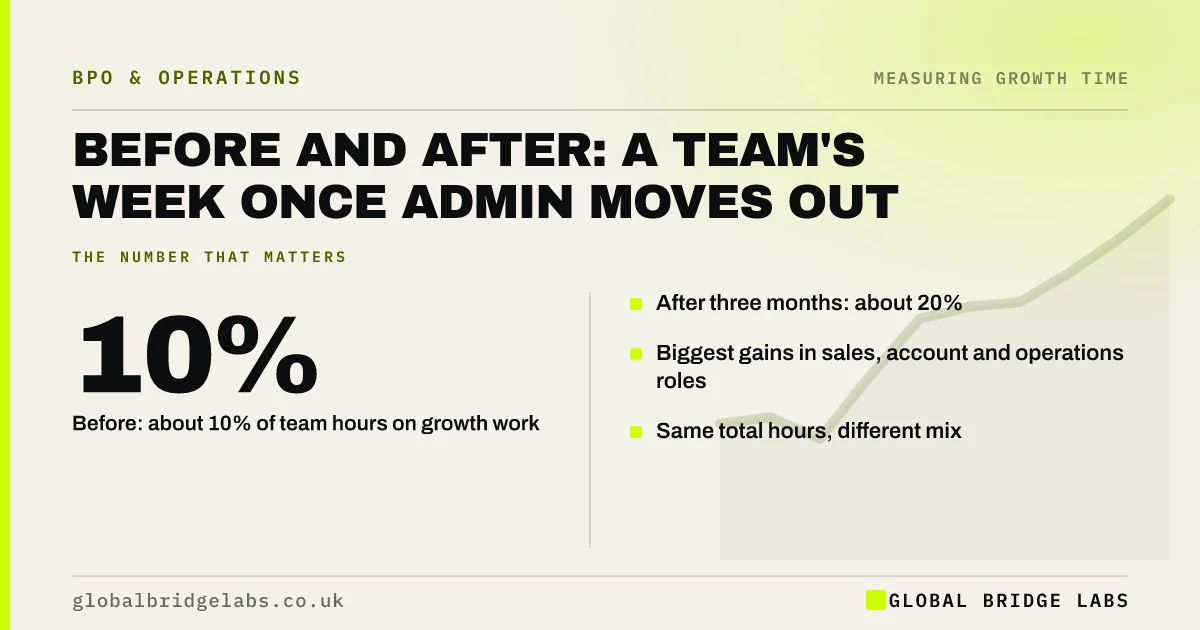
An illustrative 12-person firm shows what changes when routine work moves out. Before, growth work takes about 10% of team hours. After a well-planned handover and three months of settling, it takes about 20%. The biggest changes come in sales, account and operations roles, and the team works the same hours, not longer.
- Before: about 10% of team hours on growth work.
- After three months: about 20%.
- Biggest gains in sales, account and operations roles.
- Same total hours, different mix.
Want a before and after for your own team? Message us on WhatsApp.
Chat on WhatsApp →What does the week look like before?
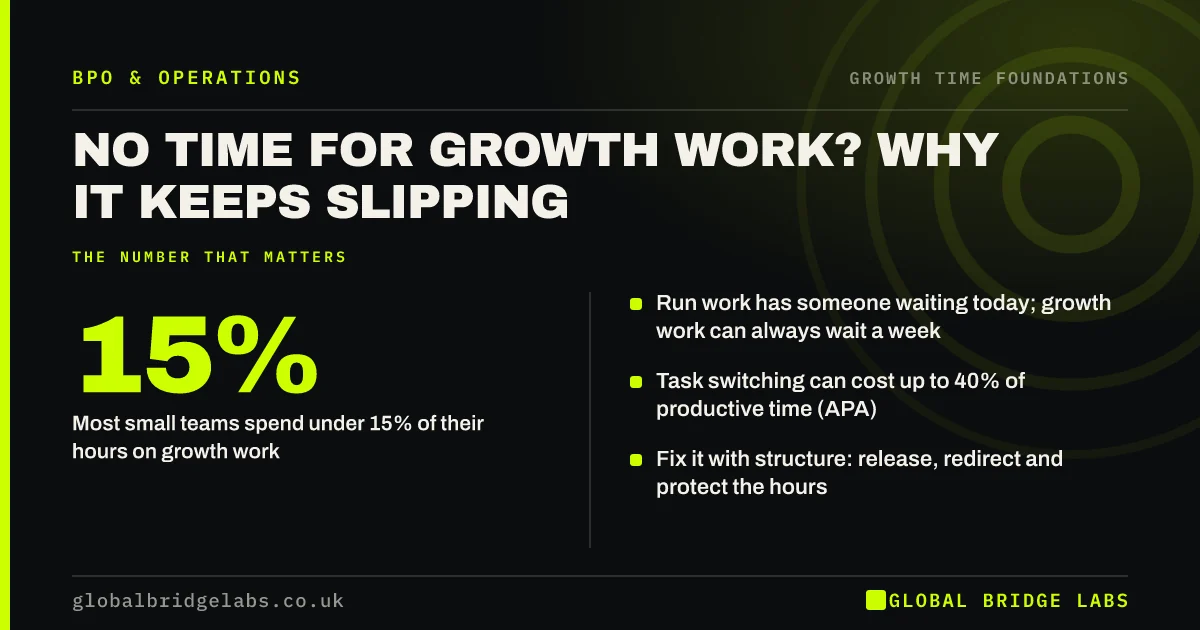
In our illustrative firm, 12 people work about 450 hours a week. Routine run work takes about 280 hours, management about 125 and growth work about 45, roughly 10%. The two account managers spend more than half their week on order updates and invoice queries. Constant switching makes it worse: the American Psychological Association notes switching can cost as much as 40% of productive time.
What moves out?
About 60 hours a week of routine work moves to a managed team: order updates, invoice queries, report building and data entry. The firm also plans where the freed hours go before the handover.
- Account managers: 12 hours each freed.
- Operations lead: 10 hours freed.
- Office team: 26 hours freed in total.
What does the week look like after?
After three months, about 45 of the 60 freed hours go to growth work, lifting it to about 90 hours a week, roughly 20% of team time. Management rises by about 5 hours for provider oversight, and the rest goes to a more normal working week for an overloaded office team.
- Account managers: half their week on account growth.
- Operations lead: a weekly improvement block.
- Office team: two supplier and onboarding projects.
When would the result be different?
If the freed hours were not planned, growth time might barely move. If the work moved from the wrong roles, total routine hours would fall but growth roles would not change. Planning matters as much as the handover.
What does this look like in practice?
This illustration mirrors patterns we see: the first month is often busier, the second shows the change and by the third the new rhythm settles. Across our client work, we have seen 31 hours a week returned to owners and managers; outcomes vary by firm.
Before and after checklist
- Measure the week before.
- Plan where freed hours go.
- Move routine work out.
- Measure again at three months.
- Compare by role, not just total.
Next step
Measure your own team's week now, so you have a real before to compare with.
Message us on WhatsApp for the before and after template, or book a 30-minute consultation.
Chat on WhatsApp →Sources and further reading
- Employee earnings in the UK (Annual Survey of Hours and Earnings) · Office for National Statistics
- Multitasking: switching costs · American Psychological Association
Frequently asked questions
What changes for a team after outsourcing?
Routine work falls, growth and improvement work rises and some time goes to managing the provider. The first month is often busier because of briefing and checking. By the third month, roles with the most routine work usually show the biggest shift towards growth work.
Do staff work fewer hours after outsourcing?
Usually the hours stay similar but the mix changes. If the team was overloaded, some freed time may go to a more normal working week. Most freed hours should go to growth and improvement work, which is why planning where they go matters.
How long does it take to see a difference in the team's week?
Expect a visible change by the second month and a settled new rhythm by the third. Measure the week before outsourcing and again at three months to compare properly, by role as well as in total. Share the before and after with the team, because seeing the change helps it stick.
Written by

Global Bridge Labs (GBL) is a UK–Sri Lanka partner for social media, websites and BPO. Everything here comes from client delivery, not theory.