On this page
- 01Key takeaways
- 02Why does growth work keep slipping?
- 03What does no time for growth cost?
- 04How do you make room for growth work?
- 05When is lack of time not the real problem?
- 06What does this look like in practice?
- 07Growth work checklist
- 08Next step
- 09Sources and further reading
- 10Frequently asked questions
Key takeaways
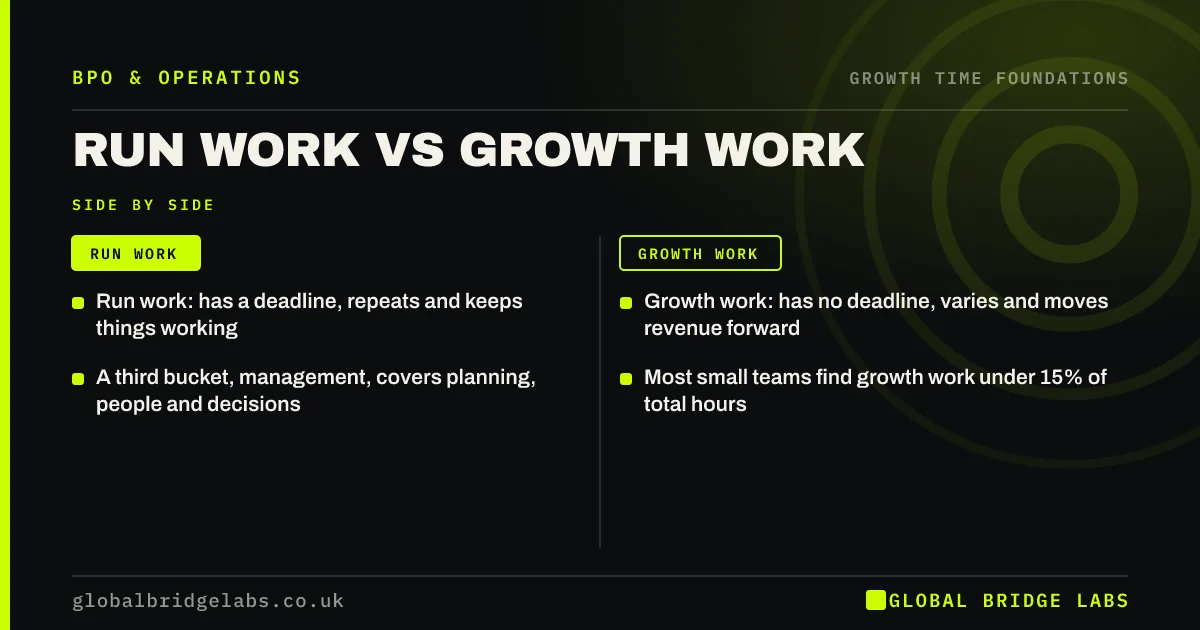
Teams have no time for growth work because run work arrives with a deadline and growth work does not. Urgent tasks win every day, so growth projects slip week after week. The fix is structural, not motivational: move routine work out, give growth work a deadline and owner, and protect the hours in the diary.
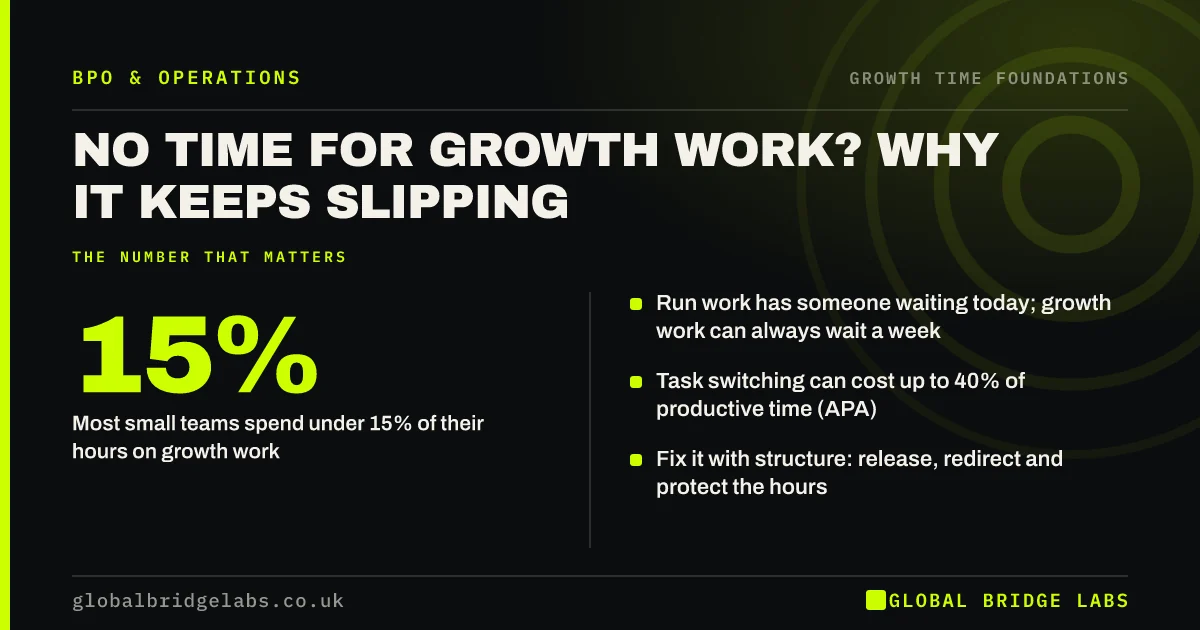
- Run work has someone waiting today; growth work can always wait a week.
- Most small teams spend under 15% of their hours on growth work.
- Task switching can cost up to 40% of productive time (APA).
- Fix it with structure: release, redirect and protect the hours.
Want to find out where your team's growth hours went? Message us on WhatsApp.
Chat on WhatsApp →Why does growth work keep slipping?
Growth work keeps slipping because nothing forces it to happen today. A customer waiting for an answer, an order to process or a report due on Friday creates pressure. A partnership idea or a pricing review creates none, so it is pushed back until the week is quieter. In a growing business, that quieter week never arrives.
The pattern is predictable. Each new customer adds a little routine work, and that work lands on the people already there. Growth work is the first thing to give way, because it is the only work with no one chasing it.
What does no time for growth cost?
It costs the growth you never pursued, which never shows up in the accounts. The visible cost is people time: a UK employee on £30,000 costs about £19.81 per worked hour once employer costs and holidays are counted. If growth work gets 4 hours of a 37.5-hour week, you are paying for roughly 33 hours of run work per person.
There is a human cost as well. The Health and Safety Executive lists unmanageable demands among the main causes of work-related stress. A team that is always busy and never moving forward tends to lose its best people first.
How do you make room for growth work?
Make room by changing the structure of the week rather than asking people to try harder. Three changes work together.
Constant switching between small tasks also eats the time that is left. The American Psychological Association notes that task switching can cost as much as 40% of productive time, so batching growth work into blocks matters as much as freeing the hours.
- Release: move recurring, rule-based routine work to an outside team.
- Redirect: give growth work a named owner, goal and deadline.
- Protect: block growth hours in diaries and defend them.
When is lack of time not the real problem?
Sometimes the team has time but no clear growth plan, or the growth idea itself is weak. If people have spare hours and still do not progress growth work, the issue is direction or skills, not capacity. Outsourcing will not fix that; a clear plan and the right skills will.
What does this look like in practice?
A pattern we see: an e-commerce business with eight staff has planned a wholesale channel for two years. Every quarter it slips because order queries and returns fill the week. Once returns admin and order updates move to a managed team, one person is given 10 hours a week and a 90-day deadline to open five wholesale accounts.
Growth work checklist
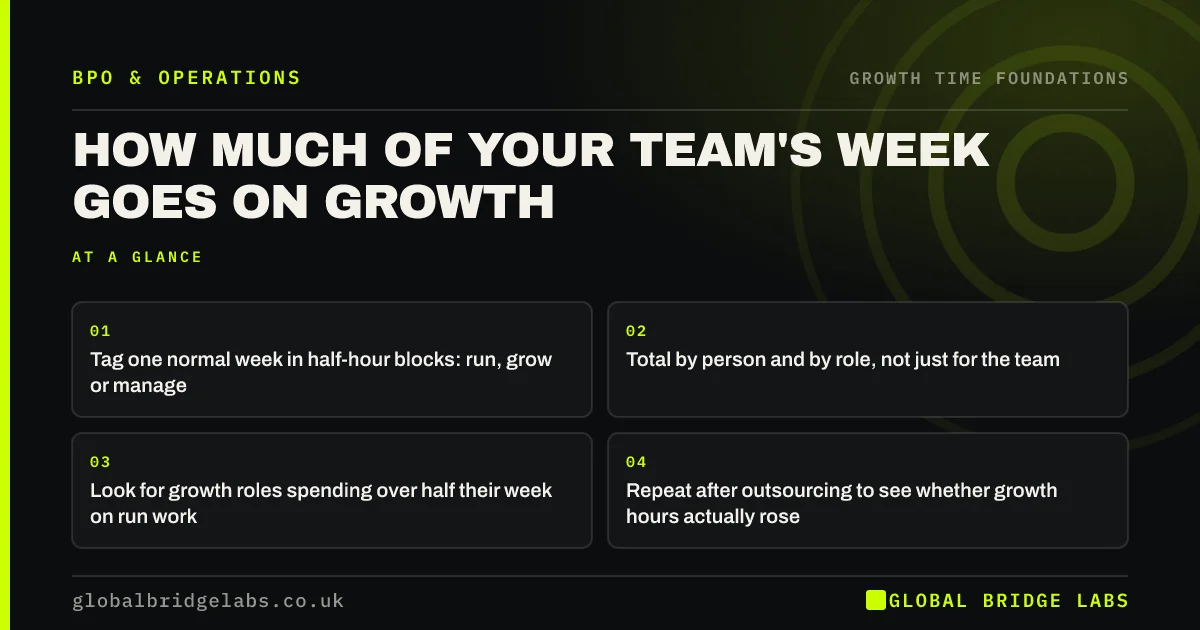
- Ask each person how many hours they spent on growth work last week.
- List the growth projects that have slipped for more than a quarter.
- Find the routine work that keeps pushing them back.
- Give each growth project one owner and a deadline.
- Block growth time in diaries before anything else is planned.
Next step
Write down the three growth projects that have slipped longest, and next to each the routine work that keeps beating it. That list is your outsourcing brief.
Message us on WhatsApp to talk through your slipped growth projects, or book a 30-minute consultation.
Chat on WhatsApp →Sources and further reading
- Multitasking: switching costs · American Psychological Association
- Employee earnings in the UK (Annual Survey of Hours and Earnings) · Office for National Statistics
- Work-related stress and how to manage it · Health and Safety Executive
Frequently asked questions
Why do I never have time to grow my business?
Because routine work always has a deadline and growth work rarely does. Customers, orders and reports demand attention today, so growth projects are pushed back week after week. Moving routine work out, giving growth projects owners and deadlines, and blocking time for them breaks the cycle.
How much time should a team spend on growth work?
There is no fixed rule, but many growth-minded SMEs aim for 20% to 30% of team hours on growth work, with sales and account roles higher. If your team is below 15%, routine work is probably crowding growth out and the first job is to measure where the hours go.
Can outsourcing really free time for growth?
Yes, if the outsourced work currently sits with people who would do growth work, and if the freed hours are given a named goal. Without a goal, freed time usually fills with meetings and small requests within weeks, so planning where the hours go is as important as the handover.
Written by

Global Bridge Labs (GBL) is a UK–Sri Lanka partner for social media, websites and BPO. Everything here comes from client delivery, not theory.