On this page
Key takeaways
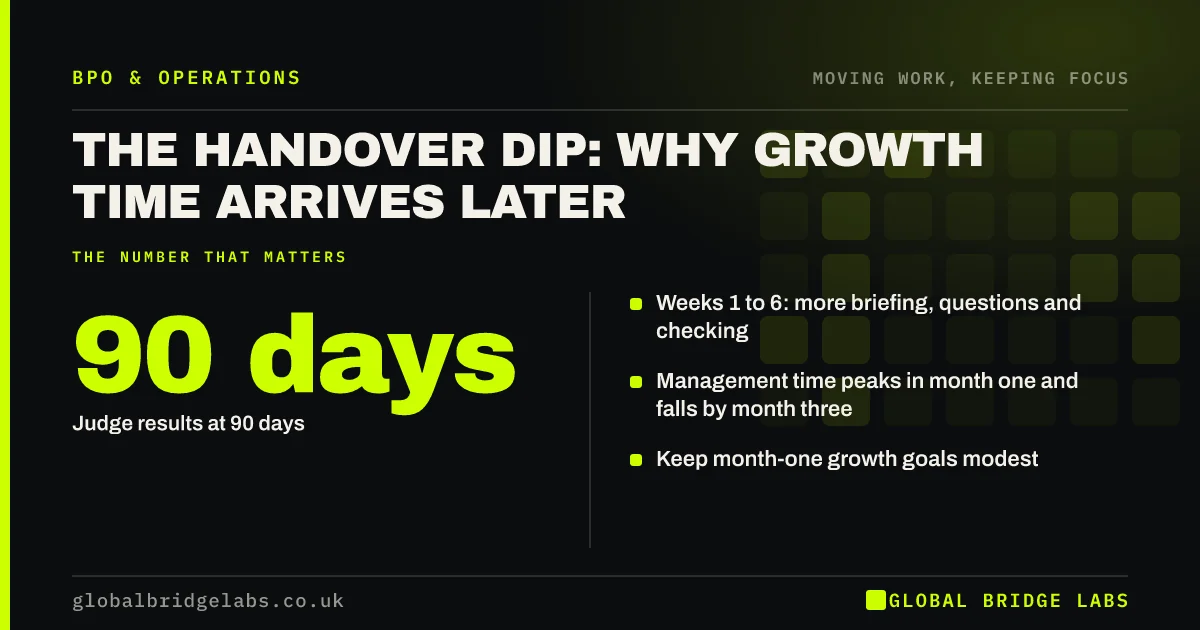
In the first four to six weeks of outsourcing, your team usually spends more time, not less, because they brief the provider, answer questions and check output. Growth time falls before it rises. Plan for the dip: keep growth goals modest in month one, budget extra management time and judge results at 90 days, not 30.
- Weeks 1 to 6: more briefing, questions and checking.
- Management time peaks in month one and falls by month three.
- Keep month-one growth goals modest.
- Judge results at 90 days.
Want help planning for the handover dip? Message us on WhatsApp.
Chat on WhatsApp →What is the handover dip?
The handover dip is the temporary fall in your team's available time at the start of outsourcing. The provider is learning your work, so questions are frequent and checks are thorough. Your team is still doing some of the work in parallel. Growth time often drops for a few weeks before it rises above where it started.
Why does it happen?
Thorough early checks are wise: the Health and Safety Executive's guidance on human failure explains why new people and unfamiliar tasks produce more errors at first.
- Instructions are incomplete until tested on real work.
- Exceptions appear that nobody wrote down.
- Your team checks every item until trust builds.
- Some work runs in parallel during the switch.
How do you shorten it?
Document the work before handover, include examples of exceptions, set clear acceptance criteria, answer questions in batches rather than one by one, and move from full to sample checks as soon as quality is stable.
When is the dip a warning sign?
When it lasts beyond eight weeks, when error rates are not falling, or when the same questions repeat. That suggests weak instructions or a poor fit with the provider, and needs a review.
What does this look like in practice?
A pattern we see: a team expects 20 hours a week back from week one. In week three they are working more hours than before and consider stopping. A plan that showed the dip, and a switch to batched questions, gets them through; by week eight they have 18 hours back.
Handover dip checklist
- Document work and exceptions before handover.
- Budget extra management time for month one.
- Batch questions and answers.
- Move to sample checks once quality is stable.
- Judge at 90 days.
Next step
Tell your team before the handover that month one will be busier. Expectations set early prevent a premature verdict.
Message us on WhatsApp to plan your handover period, or book a 30-minute consultation.
Chat on WhatsApp →Sources and further reading
- Human factors: managing human failures · Health and Safety Executive
- Controllers and processors · Information Commissioner's Office
Frequently asked questions
Why is my team busier after outsourcing?
In the first weeks your team is briefing the provider, answering questions, checking output and sometimes running work in parallel. This handover dip usually lasts four to six weeks. If it lasts longer than eight weeks, review the instructions and the fit with the provider.
How long does an outsourcing handover take?
For routine, well-documented work, four to six weeks to settle is typical. Complex or poorly documented processes take longer. Moving from full checks to sample checks once quality is stable is usually the point at which your team feels the time come back.
How can I reduce the work of an outsourcing handover?
Document the process with examples before handover, list known exceptions, set clear acceptance criteria, batch questions into one daily slot and agree a date to move to sample checks. Good preparation shortens the dip more than anything else. Start with one well-documented bundle of work, check the first month closely and widen the scope once quality is steady.
Written by

Global Bridge Labs (GBL) is a UK–Sri Lanka partner for social media, websites and BPO. Everything here comes from client delivery, not theory.