On this page
Key takeaways
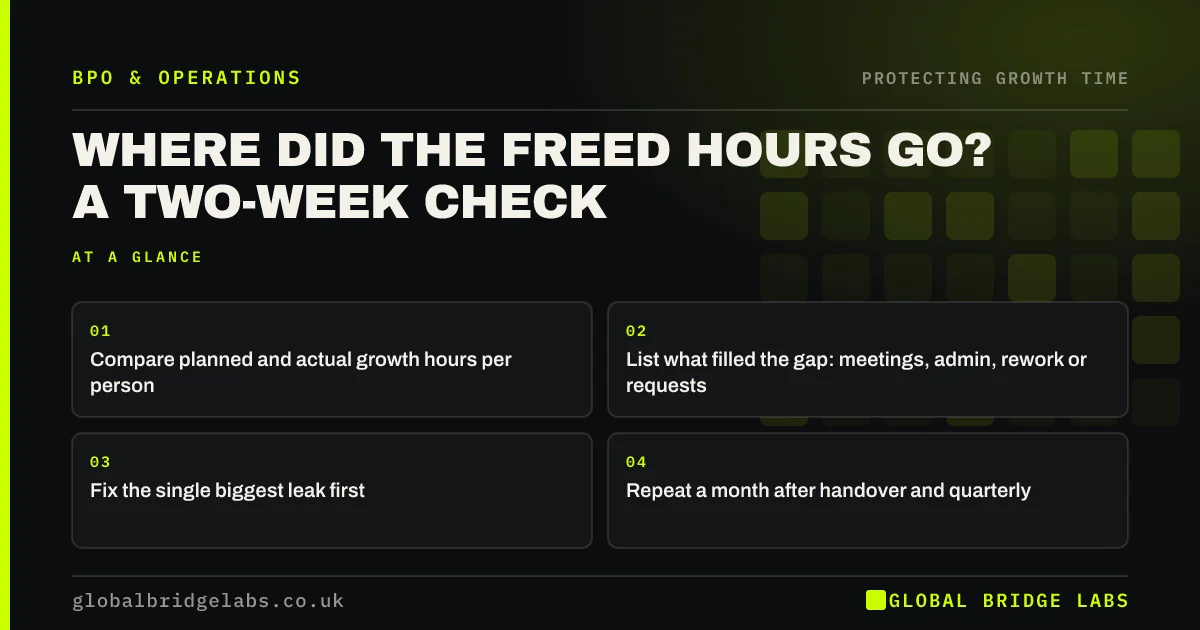
A two-week check shows where hours freed by outsourcing actually went: into growth work, or into meetings, polishing and new admin. Compare planned growth hours with actual hours for each person, list what filled the gap and fix the biggest leak. Run the check about a month after the handover and again each quarter.
- Compare planned and actual growth hours per person.
- List what filled the gap: meetings, admin, rework or requests.
- Fix the single biggest leak first.
- Repeat a month after handover and quarterly.
Want help running a freed hours check? Message us on WhatsApp.
Chat on WhatsApp →Why check where freed hours went?
Because freed hours that are not used for growth add cost without adding growth. Measuring hours saved by outsourcing tells you the work moved; it does not tell you what replaced it. This check answers the second question, which is the one that decides whether outsourcing for growth time is working.
How do you run the check?
- Take the planned allocation for each person.
- For two weeks, each person tags hours as growth, run, manage or meetings.
- Compare actual growth hours with planned hours.
- List the top three things that filled the gap.
- Agree one fix per leak.
What are the usual leaks?
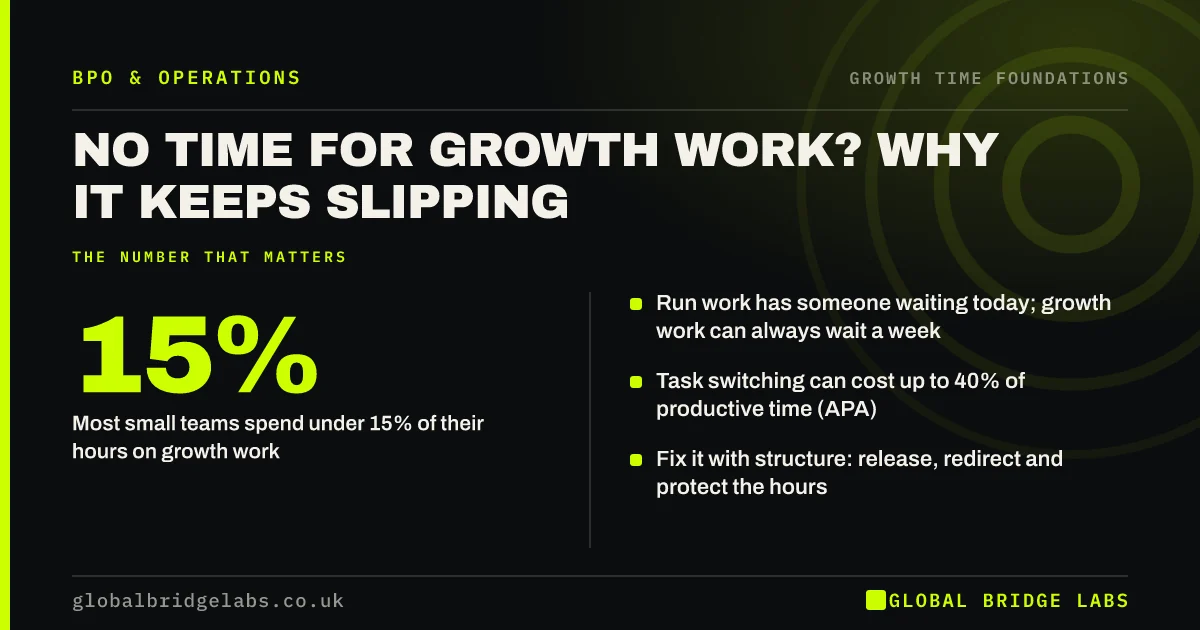
New meetings, faster replies to internal messages, rework of provider output, new admin and polishing. Fragmentation is a leak too: the American Psychological Association notes task switching can cost as much as 40% of productive time, so scattered growth minutes produce little.
When is a shortfall acceptable?
During the first four to six weeks of a handover, when briefing and checking take time. Also when some freed time was deliberately given to rest because the team was overloaded. Record those as planned, not as leaks.
What does this look like in practice?
A pattern we see: a two-week check shows a manager using only 3 of 8 planned growth hours. The gap is a new daily stand-up and checking every provider task. Cutting the stand-up to twice a week and moving to sample checks recovers most of the time.
Freed hours check
- Take each person's planned growth hours.
- Tag two weeks of actual time.
- Compare and list the gaps.
- Fix the biggest leak.
- Repeat quarterly.
Next step
Schedule the first check for four weeks after your handover starts, and tell the team why you are doing it.
Message us on WhatsApp for the freed hours check sheet, or book a 30-minute consultation.
Chat on WhatsApp →Sources and further reading
- Multitasking: switching costs · American Psychological Association
- Employee earnings in the UK (Annual Survey of Hours and Earnings) · Office for National Statistics
Frequently asked questions
How do I know if freed time is being used well?
Compare the growth hours you planned for each person with the hours they actually spent on growth work over two weeks. Then look at growth outcomes such as account reviews completed or proposals won. If both are on track, the time is being used well.
When should I check how freed time is used?
About four weeks after the handover begins, once the provider is past the earliest learning stage, and then quarterly. Check sooner if the team still feels as busy as before, because that usually means hours are leaking into meetings or new admin.
Is this the same as measuring time saved?
No. Measuring time saved shows how many hours of work moved out. This check shows what those hours were used for afterwards. You need both: the first proves the handover worked, the second shows whether it produced growth. Revisit the answer each quarter, because team capacity and priorities change as the business grows.
Written by

Global Bridge Labs (GBL) is a UK–Sri Lanka partner for social media, websites and BPO. Everything here comes from client delivery, not theory.